Image credit: Reference only
---
Meta
---
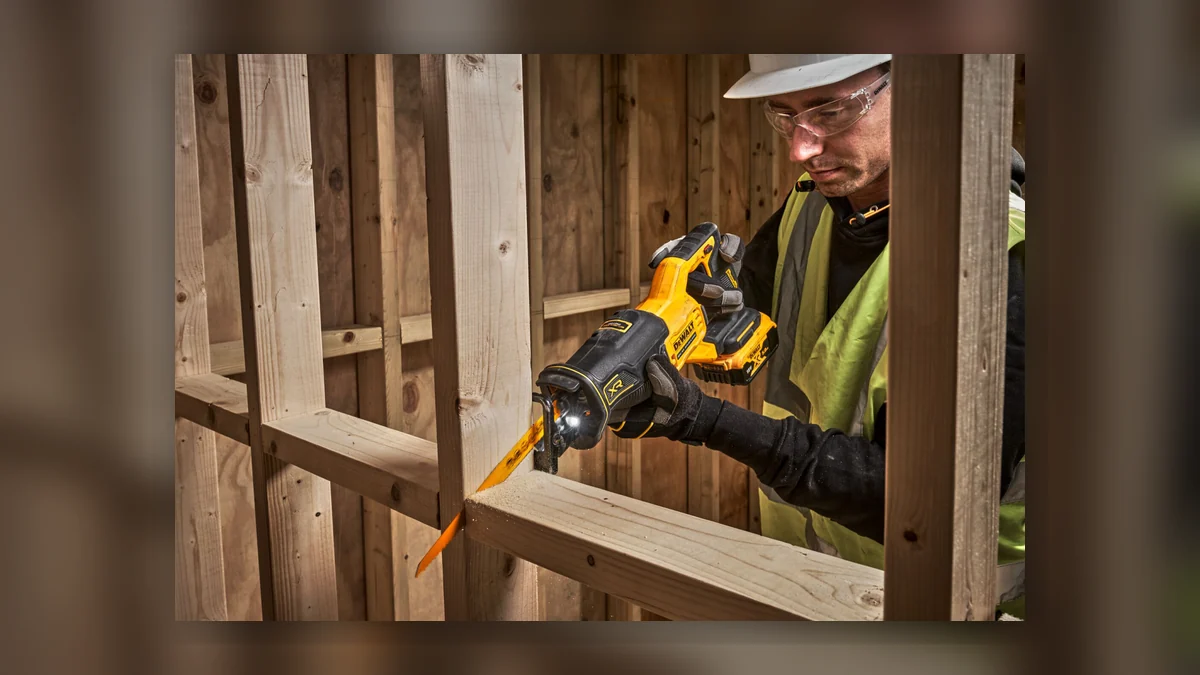
The reciprocating saw is the demolition specialist. It cuts through timber, metal, plasterboard, plywood, and old pipework that a circular saw or jigsaw would balk at. It fits in wall cavities. It reaches angles where no other saw can go. And for roofing trades, groundworkers, plumbers cutting out old cast-iron soil pipes, or anyone stripping out a building, it is essential.
DeWalt makes two cordless reciprocating saws in the UK: an 18V XR and a 54V XR FlexVolt. Understanding which is the right tool is not just about power, it is about what work you do, how often you do it, and what batteries you already own.
---
What is a reciprocating saw and why does voltage matter?
A recip saw drives a blade back and forth in a straight line, like an aggressive mechanical jigsaw. The blade protrudes from the front and the tool can be used at any angle, including upside down. Unlike a circular saw, there is no spinning blade guard to deal with, and the tool can cut in locations where a circular saw cannot physically fit.
Voltage in a cordless tool directly affects how hard the motor can push. Higher voltage means more sustained cutting power under load, particularly relevant when the saw is working through thick green timber, old oak beams, or corroded steel pipe where resistance is high and inconsistent.
The practical difference between 18V and 54V in a recip saw is most apparent when cutting material that genuinely resists the blade: dense hardwood, thick steel, layered build-up, and material that is wet or irregular.
---
DeWalt 18V XR reciprocating saw
The DeWalt 18V XR recip saw is a fully capable tool for the majority of demolition and rough cutting tasks that trades encounter. XR is DeWalt's designation for tools using brushless motors, which operate more efficiently and with less heat generation than brushed equivalents.
In brushless terms: a brushed motor has carbon contacts (brushes) that press against a rotating commutator to transfer electricity. Over time they wear down and produce heat through friction. A brushless motor uses electronics to switch the magnetic field, with no physical contact. The result is more power reaching the work, less energy lost as heat, and a motor that lasts longer.
The 18V XR runs on standard DeWalt 18V XR batteries. If you are already using DeWalt on site with drills, drivers, or circular saws, the batteries you already own power this saw. That compatibility is a significant practical and economic advantage.
For cutting 2x4 framing timber, standard roof battens, old copper pipe, conduit, plasterboard, and typical demolition materials, the 18V XR is more than sufficient. SPM (strokes per minute) on the 18V models typically runs up to around 3,000 in top gear, with adjustable speed for more controlled cuts when needed.
---
DeWalt 54V XR FlexVolt reciprocating saw
The 54V FlexVolt model is in a different category in terms of raw cutting ability. FlexVolt is DeWalt's multi-voltage battery system: the same battery operates at 54V in FlexVolt-designated tools and drops down to 18V when inserted into a standard DeWalt 18V tool.
This dual-voltage capability is significant. It means a FlexVolt battery is not a stranded investment. The batteries work across DeWalt's entire 18V XR platform, so you are not committed to a separate, incompatible battery family.
The 54V output in the recip saw produces cutting performance that is noticeably more sustained under difficult load. Where an 18V tool might slow or stall working through a 200mm oak beam or a thick section of cast-iron pipe, the FlexVolt maintains consistent blade speed. The motor simply has more headroom to work with.
The blade stroke rate on 54V models typically reaches 3,000 SPM or higher with more consistent speed under load, rather than the drop-off that occurs when an 18V motor is working at its limit.
---
Which saw is right for which work?
18V XR suits you if:
- Most of your demolition and rough cutting involves standard timber, copper pipe, plasterboard, and typical construction materials
- You are already running DeWalt 18V batteries and want to add a recip saw to the platform without investing in new batteries
- You use the recip saw regularly but not as a primary all-day tool
- Weight is a factor: the 18V model is lighter
54V FlexVolt suits you if:
- You regularly cut through dense, thick, or heavily resistant materials: large section hardwood, cast-iron, steel angle sections, layered composite materials
- You use the recip saw as a primary tool for extended demolition stints where power consistency under load matters
- You are stripping out houses, cutting through structural elements, or working in environments where the material being cut is unpredictable
- You want the top end of what cordless cutting technology currently offers
---
Battery compatibility and the FlexVolt advantage
This is the detail that often determines the decision. FlexVolt batteries are physically the same size as a large DeWalt 18V pack, and they work in every 18V XR tool DeWalt makes. If you have a FlexVolt saw, you can use the same batteries in your combi drill, circular saw, and impact driver.
The 54V output is only active when the battery is in a FlexVolt-designated 54V tool. In an 18V tool, the same battery behaves as a high-capacity 18V pack. So buying FlexVolt batteries for the saw gives you high-capacity 18V batteries for everything else as well.
---
Blade choice matters as much as the tool
A recip saw is only as good as its blade. The right blade for the material makes a significant difference to both cut speed and blade life.
Wood blades have widely spaced teeth designed to clear chips quickly. Metal cutting blades have finer teeth and are typically shorter, reducing flex in the cut. Specialist blades exist for cutting through nail-embedded timber, for flush cuts close to a surface, and for pruning and outdoor work.
Running a metal-cutting blade on timber is slower than necessary. Running a wood blade on steel will ruin it in seconds. Matching the blade to the material is basic but often overlooked when trades grab the nearest blade from the bag.
---