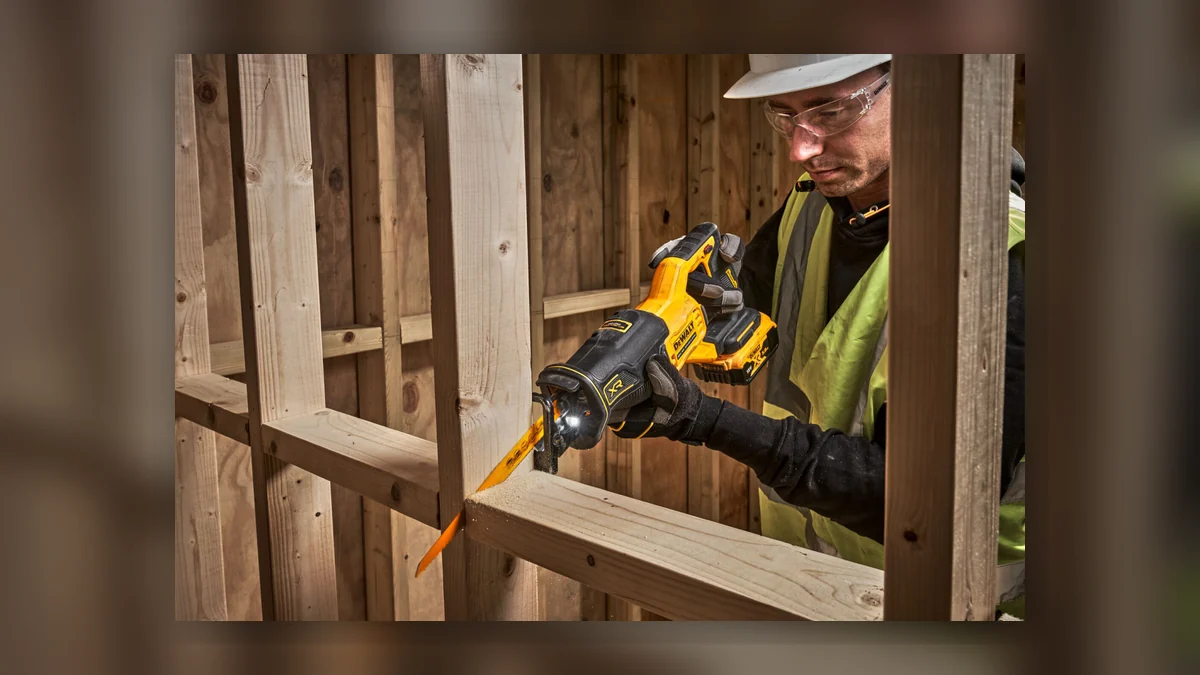
The reciprocating saw -- the recip, the sabre saw, the demo saw, call it what you will -- is one of those tools that earns its place on site fast. It cuts through timber, plasterboard, old pipe work, nails in walls, and roof battens with a minimum of fuss. Set it up with the right blade and it handles cuts that a circular saw cannot access and a jigsaw would struggle with.
Cordless recip saws have made the tool more practical than ever. No cable to manage in a demolished room, no extension lead out to the van, no transformer on older 110V site setups. DeWalt makes cordless reciprocating saws across two platforms: the established 18V XR and the higher-output 54V FLEXVOLT. Both are genuine site tools. The question is which platform you actually need for the work you do.
---
Understanding the Two Platforms
DeWalt 18V XR
The 18V XR platform is DeWalt's core professional cordless system. XR (Extreme Runtime) tools use brushless motors and high-capacity batteries to extract maximum efficiency from 18 volts. The platform has been the backbone of DeWalt's trade range for years, with hundreds of tools sharing the same battery.
An 18V XR reciprocating saw is a capable, proven site tool. The brushless motor delivers efficient power use, and a 5.0Ah or 6.0Ah battery provides serious run time. For the majority of site cutting tasks -- timber framing, plasterboard removal, pipe cutting, roof work -- the 18V XR is more than adequate.
The key practical advantages: the batteries are shared across your entire XR tool kit. If you already run DeWalt 18V XR drills, circular saws, or impact drivers, you have batteries that go straight into an 18V recip saw. No new battery investment required.
DeWalt 54V FLEXVOLT
FLEXVOLT is DeWalt's step-up platform, delivering 54V when used in FLEXVOLT tools and stepping down to 18V for backward compatibility with XR tools. That dual-voltage trick means a FLEXVOLT battery works in your existing 18V XR tools -- useful if you are building a mixed kit.
In a FLEXVOLT reciprocating saw, those 54 volts deliver noticeably more cutting power and speed than the 18V equivalent. Think of it in terms of what that extra power actually does: on heavy demolition -- cutting through engineered timber, old cast iron pipe work, or dense hardwood -- the FLEXVOLT saw keeps cutting at pace where an 18V may slow down or require more passes. It also runs through blade life more comfortably on demanding materials.
The trade-offs: FLEXVOLT tools are heavier. A 54V recip saw with a large FLEXVOLT battery in the tail is a bigger, heavier tool than the 18V equivalent, which matters when you are cutting overhead or in a confined space. FLEXVOLT batteries also cost more, and the run time advantage only shows up if you are regularly drawing that extra power.
---
What the Numbers Actually Mean on Site
Voltage on its own does not tell the whole story, but here is a practical way to think about the difference.
Imagine cutting through a 200mm x 50mm timber joist embedded in a wall during a demolition job. The 18V XR will cut through that joist. It may work the motor a little harder on a long run and you may feel the tool slow slightly in the cut. The FLEXVOLT will cut through the same joist with more headroom -- less loading on the motor, smoother cut, more consistent blade speed through the material.
The difference becomes more pronounced on prolonged heavy use. If you are cutting one or two things a day, the 18V XR does the job cleanly. If you are running a recip saw for most of a working day on demolition work, the FLEXVOLT's power reserve and thermal performance start to matter.
---
Who Should Choose the 18V XR Recip Saw?
The 18V XR reciprocating saw is the right choice for most tradespeople who use a recip saw as one tool among many -- reaching for it when a circular saw cannot access a cut, or when removing old pipe work and cabling during a first fix.
If you already run the DeWalt 18V XR platform, adding an 18V recip saw means zero additional battery investment. That is a real cost advantage.
It is also the lighter option, which matters for overhead cutting or working in tight ceiling voids where a heavier saw becomes tiring quickly.
Best for: Plumbers, electricians, joiners, general builders who use a recip saw regularly but not as a primary daily tool.
---
Who Should Choose the 54V FLEXVOLT Recip Saw?
The FLEXVOLT reciprocating saw makes most sense for trades where the recip saw is a primary tool, particularly on demolition work, roofing, or structural alteration jobs.
If you regularly cut through dense or hard materials -- structural timber, roof rafters, old cast iron soil pipes, or mixed waste materials during strip-out -- the extra power reserve of the FLEXVOLT delivers real productivity. Faster cuts, less motor strain, better blade life on hard materials.
The heavier battery and tool body is a minor inconvenience on demolition work where the tool is doing serious cutting. On a strip-out job, weight matters less than getting through the material cleanly.
Best for: Demolition trades, roofers, structural alteration work, and any tradesperson who uses a recip saw as a primary cutting tool through the working day.
---
Battery Compatibility: The Practical Consideration
If you are starting from scratch with no existing DeWalt batteries, the battery investment for each platform is comparable -- both need a battery and charger to start, and both have FLEXVOLT compatibility in common (FLEXVOLT batteries run 18V XR tools at 18V).
If you already have an 18V XR battery collection, the 18V recip saw drops straight in. If you are planning to grow a FLEXVOLT collection over time, a FLEXVOLT recip saw makes sense as part of that build.
The worst outcome is buying expensive FLEXVOLT batteries for a recip saw when 18V XR would have done the job, then having those batteries sit in a single tool rather than serving a wider platform.
---
Blade Choice Matters More Than You Think
Whichever platform you choose, the blade is what actually cuts the material. Both the 18V XR and FLEXVOLT use standard universal shank blades, so the same blade range fits either tool.
Match the blade to the material: wood-cutting blades for timber, bi-metal blades for mixed materials and nail-embedded wood, dedicated metal-cutting blades for pipe work. An aggressive demolition blade will cut faster but leave a rougher edge; a finer-tooth blade cuts slower but cleaner.
Blade length matters for depth of cut. Longer blades flex more at speed -- account for this in confined spaces.
---