
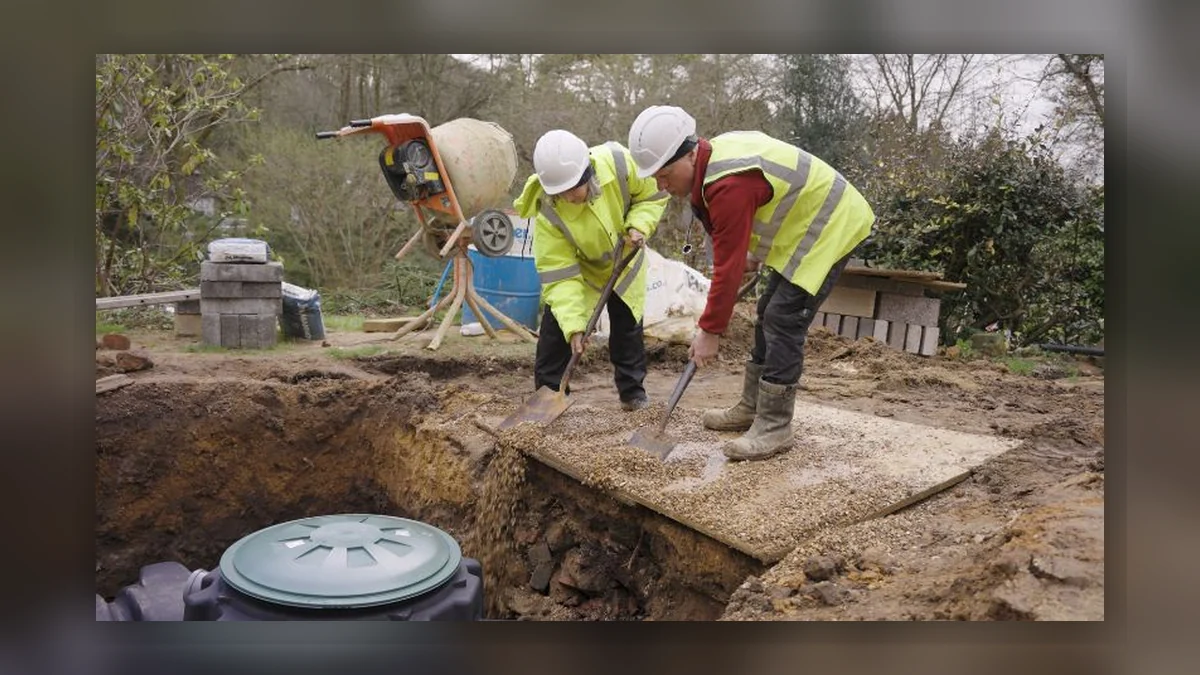
GRAF UK has released its AA Eco-Plus rainwater harvesting range in the UK market. The system has picked up awards in Europe and is designed around a principle that more builders are being asked to accommodate: use captured rainwater for as many purposes as possible before drawing on the mains supply. Here is what the range involves, where it fits on UK projects, and what groundworkers and drainage contractors need to understand about installing these systems.
---
What is the GRAF AA Eco-Plus system?
The AA Eco-Plus is a below-ground rainwater harvesting system. Rainwater collected from roof surfaces is fed into a buried tank, filtered, and distributed to points in the building where drinking-quality water is not required. That typically means toilets, outdoor taps, washing machines, and garden irrigation.
The "AA" designation in the name refers to the system's configuration: it has an automatic top-up from the mains supply when the tank level drops below a set point, but the design philosophy is to minimise how often that top-up is needed. The Eco-Plus variant is specifically engineered to maximise rainwater utilisation by combining large storage capacity with efficient filtration and a calmed inlet that does not disturb settled sediment.
GRAF is a German company with a strong European track record in water management products. The UK market launch puts the AA Eco-Plus in direct competition with established UK suppliers in the harvesting sector.
---
Why is rainwater harvesting becoming relevant on UK projects?
Rainwater harvesting has existed as a concept for decades, but the regulatory and commercial push behind it has intensified in the past two years. Several factors are driving this on UK sites:
Part G water efficiency targets. Part G of the Building Regulations (England and Wales) sets a maximum water consumption target of 125 litres per person per day for new dwellings, with an optional higher-performance target of 110 litres. Rainwater harvesting for toilet flushing — typically accounting for around 30 percent of domestic water use — is one of the more effective ways to get under that threshold on developments where water efficiency is tight.
Planning conditions on new developments. An increasing number of local planning authorities in water-stressed areas (much of South East England is classified as such) are attaching water efficiency conditions to planning consents. Rainwater harvesting is increasingly cited as an acceptable compliance route.
BREEAM and HQM credits. Commercial buildings chasing BREEAM credits and new homes targeting the Home Quality Mark both award credits for water recycling measures. A properly designed harvesting system with clear documentation is a straightforward way to pick up those points.
Sustainability commitments from housebuilders. Large-volume housebuilders with net-zero commitments in their supply chains are specifying water efficiency measures on estate developments more routinely than they were five years ago.
---
How does installation work?
Rainwater harvesting systems at this level are groundworks jobs. The AA Eco-Plus tank is buried, so the installation sequence sits within the drainage and groundworks phase of a new build project:
1. Excavation. The tank requires a level bed, typically bedded on compacted pea gravel or lean-mix concrete depending on ground conditions and the tank size. 2. Tank installation. GRAF's systems use polyethylene tanks that are lightweight to handle but require careful backfilling to avoid deformation under load. 3. Inlet filtration. Downpipes from the roof connect via a self-cleaning filter before water enters the tank. Correct filter selection depends on roof surface area and the local rainfall intensity. 4. Distribution pump. A submersible pump in the tank distributes filtered rainwater to the building. The pump is controlled by the AA Eco-Plus control unit, which also manages the mains top-up valve. 5. Calmed inlet. The AA Eco-Plus uses a floating inlet that draws from the clearest water in the tank rather than disturbing the bottom sediment. This is the design feature that distinguishes it from simpler collection systems. 6. Overflow. An overflow connection runs to the storm drainage system.
All potable water connections must comply with Water Regulations Advisory Scheme (WRAS) requirements, and the mains top-up backflow prevention arrangement must be correctly installed to avoid contamination of the mains supply. This part of the installation is not negotiable and must be done in accordance with Water Regulations.
---
What trades are involved?
Rainwater harvesting installation crosses several trades. On a new build, the scope typically divides as follows:
- Groundworker / drainage contractor: tank excavation, bedding, installation, inlet and overflow connections.
- Plumber: distribution pipework inside the building, connection to toilet cisterns and other non-potable points, mains top-up and backflow prevention.
- Electrician: power supply to the pump and control unit.
On smaller domestic projects these trades often overlap, but the regulatory compliance responsibilities — particularly around WRAS and backflow prevention — sit with the plumber.
---
Is rainwater safe to use in the home?
Does a rainwater harvesting system need planning permission?
How much rainwater can a typical UK house collect?
What maintenance does a rainwater harvesting system require?
Is the GRAF AA Eco-Plus WRAS-approved?
What tank sizes are available?
The bottom line
The GRAF UK AA Eco-Plus launch adds a well-regarded European system to the UK market at a time when water efficiency requirements on new builds are only going one direction. If you are a groundworker or drainage contractor on new build schemes, understanding how these systems install is commercially useful. If you are a plumber, the non-potable distribution and mains connection requirements are the parts that carry regulatory weight.
---
- Professional Builder
- graf-water.com/uk
- *Tags: GRAF UK, AA Eco-Plus, rainwater harvesting, groundworks, drainage, Part G, water efficiency, new build UK, WRAS, sustainable drainage*