
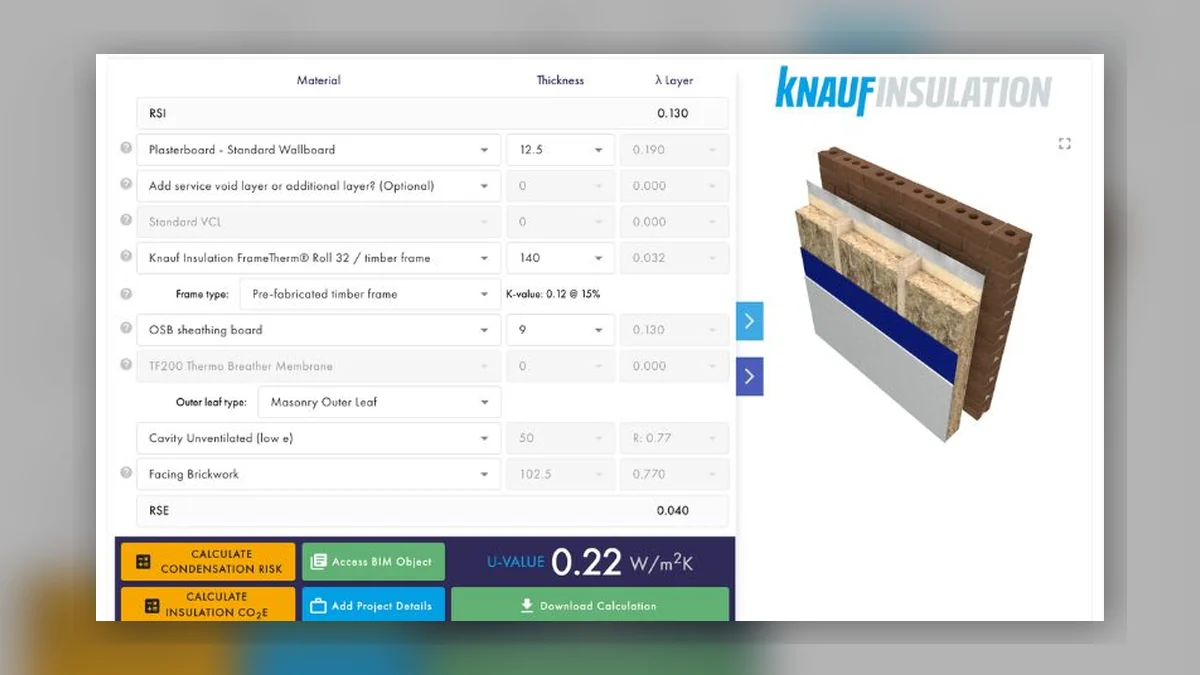
Knauf Insulation has launched a free online embodied carbon calculator, and if you are specifying insulation on new build or retrofit projects in the UK, this tool is worth understanding. Not because carbon accounting has suddenly become your job, but because more and more clients and main contractors are asking for it, and the numbers you choose now affect what ends up on a building's carbon report.
Here is what embodied carbon actually means, how the Knauf calculator works in practice, and why it has become a real consideration for UK building trades in 2026.
---
What is embodied carbon?
When most people in construction talk about a building's carbon footprint, they mean the energy it uses for heating, lighting, and hot water over its lifetime. That is called operational carbon, and it has been the main focus of Part L building regulations upgrades for years.
Embodied carbon is different. It is the carbon released during the manufacture, transport, installation, maintenance, and eventual disposal of the building materials themselves. In other words, the carbon cost of getting the materials to site and putting them in place, before the building even switches on.
A practical example: producing a tonne of mineral wool insulation consumes energy and releases carbon dioxide. Rigid polyisocyanurate (PIR) foam board has a different embodied carbon profile. So does cellulose, hemp, or recycled glass fibre. Two products might perform equally well for thermal resistance (measured in U-values), but have very different environmental footprints before the building is occupied.
As UK buildings have become significantly more energy-efficient under Part L, the balance is shifting. Operational carbon is falling. Embodied carbon now makes up a larger proportion of a building's total lifetime carbon impact, sometimes the majority of it on highly insulated new builds. That is why specifiers and sustainability consultants are starting to measure it.
---
What does the Knauf calculator do?
Knauf Insulation's new tool is free to access online and allows specifiers to calculate the embodied carbon associated with specific insulation products and thicknesses for a given application. Instead of relying solely on a product's thermal performance value, you can now compare the full carbon picture across different Knauf product options.
This matters in a few practical situations:
Planning applications with sustainability statements. An increasing number of local planning authorities in England, Wales, and Scotland ask for sustainability statements with planning applications on new homes or larger extensions. Embodied carbon figures, while not yet universally required, are appearing in these documents as evidence of responsible specification.
Passivhaus and low-energy build standards. Passivhaus certification in the UK now includes lifecycle carbon assessment. Projects chasing that certification need product-level data that the Knauf calculator can provide.
Main contractor requirements. On commercial projects and housing schemes delivered for registered social landlords or public bodies, supply chain carbon reporting is moving from optional to standard. If your trade work is being specified by a main contractor under a net-zero commitment, they may ask for this data from subcontractors and their material suppliers.
Retrofit schemes. Government-backed retrofit grants increasingly come with sustainability criteria. Being able to demonstrate that specified insulation has a low embodied carbon profile strengthens applications.
---
Does this affect day-to-day trade work?
For self-employed builders working on domestic extensions, loft conversions, or refurbishments for private clients, the Knauf calculator is unlikely to change how you specify next week. The immediate practical impact is greater for those working on:
- New build housing schemes with main contractor oversight
- Social housing retrofit programmes
- Projects pursuing Passivhaus, BREEAM, or HQM certification
- Commercial fit-outs where tenant sustainability requirements flow down the supply chain
If you are in any of those categories, understanding embodied carbon now means you will not be caught out by a client or main contractor asking for it later.
---
How to use it
The Knauf calculator is available through the Knauf Insulation UK website. You select a product category, input the area and thickness, and the tool returns an embodied carbon figure in kilograms of carbon dioxide equivalent (kgCO2e). You can compare that figure between different product specifications to find the lower-carbon option when thermal performance is otherwise equal.
Knauf has published Environmental Product Declarations (EPDs) for its products. An EPD is a third-party verified document that sets out the environmental impact of a product across its lifecycle. The calculator draws on this data, so the figures are verifiable, not estimates.
---
Do I legally have to calculate embodied carbon on UK projects?
Is embodied carbon the same as a product's carbon footprint?
What is kgCO2e?
Does the choice of insulation thickness change the embodied carbon figure significantly?
Can I use the calculator for products from other manufacturers?
The bottom line
Embodied carbon is no longer a niche sustainability topic. It is moving into mainstream specification on UK construction projects, and Knauf Insulation's free calculator makes it significantly easier to run the numbers on insulation choices without a specialist consultant. If you are specifying insulation on anything beyond a straightforward domestic job, it is worth spending ten minutes understanding the tool.
---
- Professional Builder
- knaufinsulation.co.uk
- *Tags: Knauf Insulation, embodied carbon, carbon calculator, insulation UK, EPD, sustainable construction, Part L, building regulations, mineral wool, UK builders*