
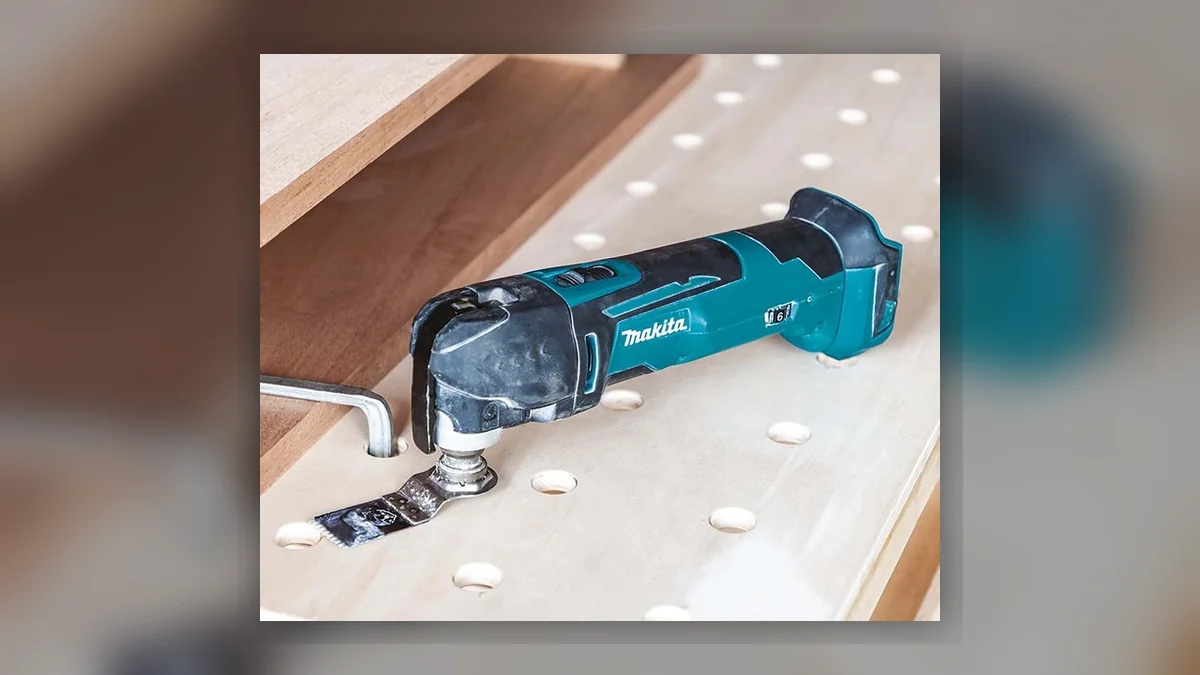
The oscillating multi-tool is one of those tools that earns its place in a van once you understand what it actually does. It does not replace a jigsaw or a circular saw. What it does is get into corners, doorways, flush against walls, and under window sills where nothing else fits. The blade choice is the whole game.
Use the right blade and the cut is fast and clean. Use the wrong one and you will overheat it, snap the teeth, or leave a ragged edge that takes ten minutes to tidy up. Makita makes a wide range of multi-tool accessories, and here is how to match them to the job.
---
The Basics: How Multi-Tool Blades Work
An oscillating multi-tool moves its blade side to side through a very tight arc, typically 1 to 3 degrees. That tiny movement is what makes it controllable in tight spaces, and it is also why the blade takes more punishment than a saw blade that spins away from the cut. Heat and vibration build up in the blade rather than dispersing.
The practical result is that blade choice matters more on a multi-tool than on almost any other power tool. A cheap general-purpose blade on hard material will cost you more in blade replacements than buying the right specific blade in the first place.
All Makita multi-tool accessories use the Makita Star Lock or OIS (Oscillating Interface System) fitting, which connects without a wrench on compatible models.
---
Blade Types by Material and Task
Cutting Wood
Bi-metal wood blades are the standard choice for most timber work including floorboards, skirting boards, door casings, and framing timber. The bi-metal construction means the body of the blade flexes without snapping while the teeth stay hard enough to cut.
For flush cutting, such as trimming door jambs level with a new floor, use a flush-cut blade which positions the cutting edge at the tip of the blade rather than along the side. This is one of the most common multi-tool applications on first-fix joinery.
If the timber is likely to contain nails or screws (which is extremely common in renovation work), choose a bi-metal blade specifically rated for wood with nails rather than a clean-wood blade. The cobalt content in bi-metal handles intermittent contact with metal without shattering, unlike standard HSS blades.
Cutting Metal
For cutting through metal pipe, conduit, sheet metal, or metal fixings, use a high-speed steel (HSS) or bi-metal blade designed specifically for metal. These have finer teeth than wood blades and are made to handle the heat generated by cutting ferrous and non-ferrous metals.
The slower you cut, the longer the blade lasts. Letting the tool do the work at moderate pressure will always outlast forcing it.
For the common scenario of cutting a bolt or a seized screw flush with a surface, a short segment blade gives better control and puts less leverage on the tool spindle.
Cutting Grout and Tile
Grout blades are carbide-grit or diamond-edged rather than toothed. They abrade the grout away rather than cutting it, which is why they work on materials that would snap a toothed blade instantly.
For grout removal between floor or wall tiles, a carbide-grit blade suited to the joint width is the correct tool. Take the depth slow: cutting too aggressively into a grout line on a tiled floor can nick the tile edge and turn a grout job into a regrout-and-replace job.
For cutting through hard tile or cementboard, a diamond-edge segment blade gives a cleaner result with less edge chipping.
Sanding
Makita multi-tool sanding pads attach to a triangular base and take hook-and-loop sanding sheets. The triangular shape is specifically designed to get into corners that a random-orbit sander cannot reach, and into window rebates, door corners, and cabinet interiors.
Sanding pads are available in both standard and detail (smaller) sizes. For tight corners on joinery work, the smaller detail pad gives better access.
Sanding sheets for multi-tools come in the same grit range as conventional sandpaper. Start with 60 or 80 grit for paint removal or rough shaping, move to 120 for smoothing, and finish with 180 or 240 for a fine surface before painting or varnishing.
Plunge Cutting and Scraping
Plunge-cut blades have a pointed tip designed to pierce directly into a surface without a starter hole. These are used for cutting access holes in plasterboard, making service openings in timber, and cutting around outlets.
Rigid scraper blades are flat, wide blades used for removing old sealant, adhesive residue, vinyl tiles, and other bonded materials from floors and surfaces. The oscillating action lifts material without the risk of gouging the substrate that a manual scraper carries.
---
Blade Compatibility: Makita Star Lock
Most current Makita multi-tools use the Star Lock fitting, which is a six-point star-shaped interface that clamps the blade without a tool. It is faster to change than older systems and provides a more rigid connection, which reduces vibration and prolongs blade life.
Makita also produces accessories in the OIS format for older models. Check which fitting your specific multi-tool takes before buying accessories.
---
When to Replace a Blade
Blades are consumables. The signs that a blade needs replacing are the same across types: the tool is taking noticeably longer to cut, the blade runs hot faster than before, the cut line is wandering, or you can see the teeth are worn down or the grit is polished flat.
Working a worn blade harder to compensate shortens the life of the spindle and the tool itself. Blade replacement is one of the cheapest parts of the job.
---