
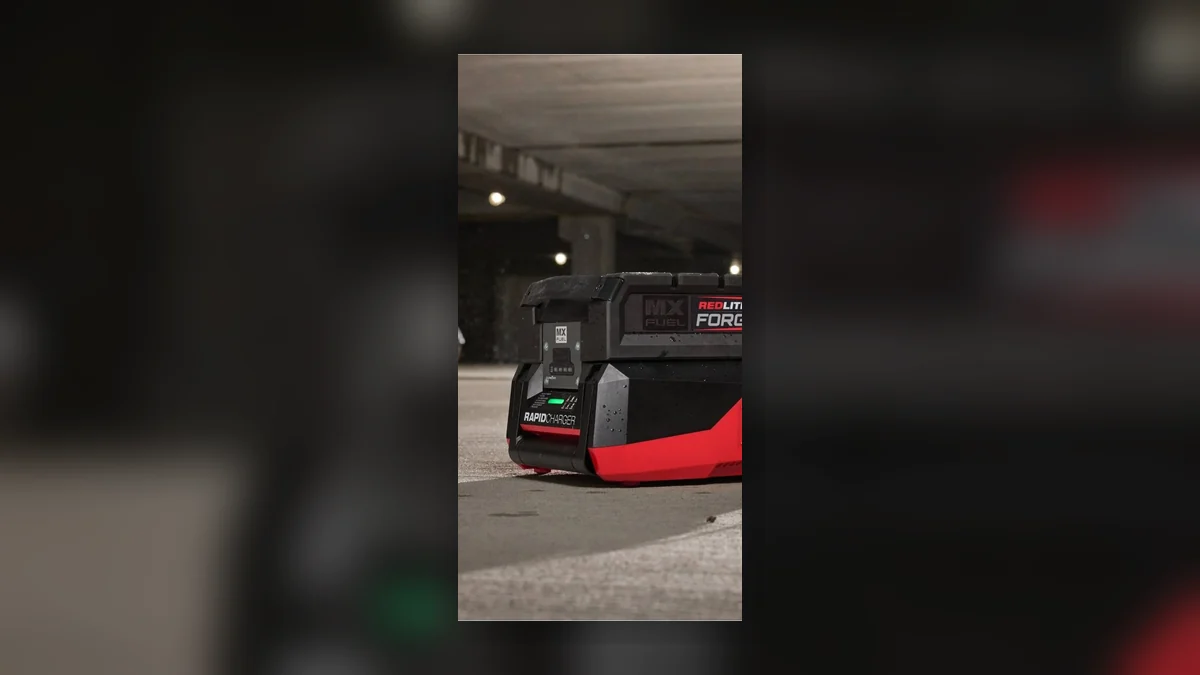
Image credit: Milwaukee Tool UK (reference only -- use Milwaukee press imagery for publication)
---
If you are running Milwaukee M18 cordless tools, you already know that the batteries are a significant investment. What is less obvious, until you are standing on a job wondering why your battery is not ready, is that the charger you use makes a genuine difference to how long you wait and how well the packs perform over time.
Milwaukee makes several M18 chargers, each suited to different use patterns. This guide explains what each one does, how fast it charges, and which one is likely to be the right choice depending on how you use your tools.
---
Why the charger matters more than most trades realise
A cordless tool's battery pack is a collection of lithium-ion cells managed by an electronic circuit board. The charger does not just push electricity into the pack -- it communicates with that circuit board to monitor cell temperature, voltage, and state of charge, and adjusts the charging rate accordingly.
A charger that pushes too much current too fast generates heat. Heat is the thing that shortens lithium-ion cell life more than almost anything else, including heavy discharge during use. Milwaukee's REDLITHIUM battery management system monitors this, but the charger still needs to be matched to the job.
If you are someone who charges a couple of batteries overnight and goes to work, the basic charger is probably all you need. If you are someone who runs four or five batteries through a full day and needs a depleted pack back in use within an hour, the charger choice becomes important to your workflow.
---
The Milwaukee M18 charger range explained
M18 AC -- the standard charger
The M18 AC is Milwaukee's entry-level M18 charger. It charges M18 battery packs at a standard rate: roughly 60 minutes for a 5.0Ah HD pack, around 30 minutes for a 2.0Ah compact pack.
It does the job reliably. For trades who charge batteries at the end of the working day and start the morning with full packs, the M18 AC is a perfectly adequate charger. The limitation is that it only handles one battery at a time and does not charge as quickly as the rapid or fast charger options.
It also only handles M18 packs. If you are running a mixed M12 and M18 setup, this charger will not help with the M12 side.
M18 and M12 Simultaneous Multi-Voltage Charger
Milwaukee makes a multi-voltage charger that can charge both M18 and M12 batteries simultaneously, using two separate charging ports that operate independently. This is the charger that makes sense if you run both platforms -- for example, an electrician who uses M18 tools for heavy work and M12 tools for light fastening and inspection cameras.
The M18 port on the multi-voltage charger operates at a similar rate to the standard M18 AC. The M12 port charges M12 packs in around 40 to 60 minutes depending on capacity. The value is the simultaneous capability: you can put an M18 battery in one slot and an M12 battery in the other and charge both at the same time with a single unit.
For van storage and job site setups where charger count matters, having one unit handling both platforms simplifies things.
M18 Rapid Charger (RC)
The Rapid Charger is Milwaukee's mid-tier charging option. It charges faster than the standard M18 AC -- a 5.0Ah HD pack comes back in around 45 minutes -- while still communicating with the battery's management system to avoid overheating.
The Rapid Charger is a sensible upgrade from the standard charger if you find yourself waiting for batteries during the day. For a one or two-person trade setup where a quick turnaround between packs matters, the step up in charge speed is often worth it.
M18 Fast Charger
The M18 Fast Charger is Milwaukee's fastest M18 charging option in the current range. A 5.0Ah HD pack charges in around 30 minutes. A 12.0Ah high-capacity pack takes around 75 minutes.
To understand what 30 minutes means practically: if you start charging a 5.0Ah pack at the beginning of your lunch break, it is ready before you go back to work. For a busy trade with multiple batteries in rotation, the Fast Charger compresses the dead time between charges enough to meaningfully affect site productivity.
The Fast Charger uses REDLINK PLUS intelligence to monitor the pack temperature and adjust the rate during charging. If a pack comes off a tool still warm from heavy use, the charger will hold back slightly until the temperature drops to a safe level before pushing the higher current. This is automatic and does not require the operator to do anything -- the pack just charges at the rate the system judges to be correct.
---
How many chargers do you actually need?
The short answer is: more than one, if you are doing full days of heavy cordless tool use.
A standard workflow for many trades is two batteries per tool, alternating between them during the day. If you are running the standard M18 AC charger, you need to manage those rotations carefully to avoid a situation where both batteries are depleted and neither is ready.
With a fast charger, you have more margin. A depleted 5.0Ah pack can be back in service in 30 minutes, which means you only need to manage a relatively short gap rather than planning around a 60-minute charge cycle.
For larger gangs or trades running multiple M18 tools simultaneously, a combination of one fast charger and one or two standard chargers gives a sensible balance between fast-turnaround capability and cost.
---
Battery kit purchases: what comes in the box
Milwaukee sells M18 battery and charger kits that pair one or two battery packs with a charger at a lower combined cost than buying the components separately. These kits typically include a 5.0Ah or 8.0Ah HD battery with either the standard M18 AC charger or the Rapid Charger, depending on the kit.
For trades entering the M18 platform for the first time, a kit purchase is the most straightforward way to start: you get a compatible charger and battery together, without having to verify compatibility or check which charger handles which pack. All M18 chargers work with all M18 batteries -- there is no subset of packs that only works with certain chargers -- but the kit takes the research step out of the equation.
Milwaukee's battery kit range is at uk.milwaukeetool.eu.
---
Taking care of your Milwaukee batteries to protect the investment
Charger choice affects battery life, but so does how you handle the packs day to day.
Lithium-ion cells degrade faster when stored at very high or very low temperatures. Leaving batteries in the back of a van parked in direct sun during a June heatwave puts unnecessary heat stress on the cells. When not in use, store packs somewhere that stays reasonably cool -- a charged pack sitting at around 20 degrees holds its capacity far longer than one that routinely sees 40-plus degrees on a baking van floor.
Avoid running packs completely flat before charging. Milwaukee's REDLITHIUM system has cell-level protection that prevents hard over-discharge, but regularly draining to the cut-off point puts more cycles on the cells than partial-discharge charging does. Putting a battery on charge when it hits around 20% remaining is a better habit than running to flat every time.
The charger's diagnostic capability is worth using. Milwaukee M18 chargers display a fault indicator if a pack has a problem. If a battery shows a fault on the charger, it is worth noting which pack it is and monitoring whether the fault clears on the next charge or recurs. Persistent faults typically mean a cell within the pack has degraded and the pack needs replacing.
---