
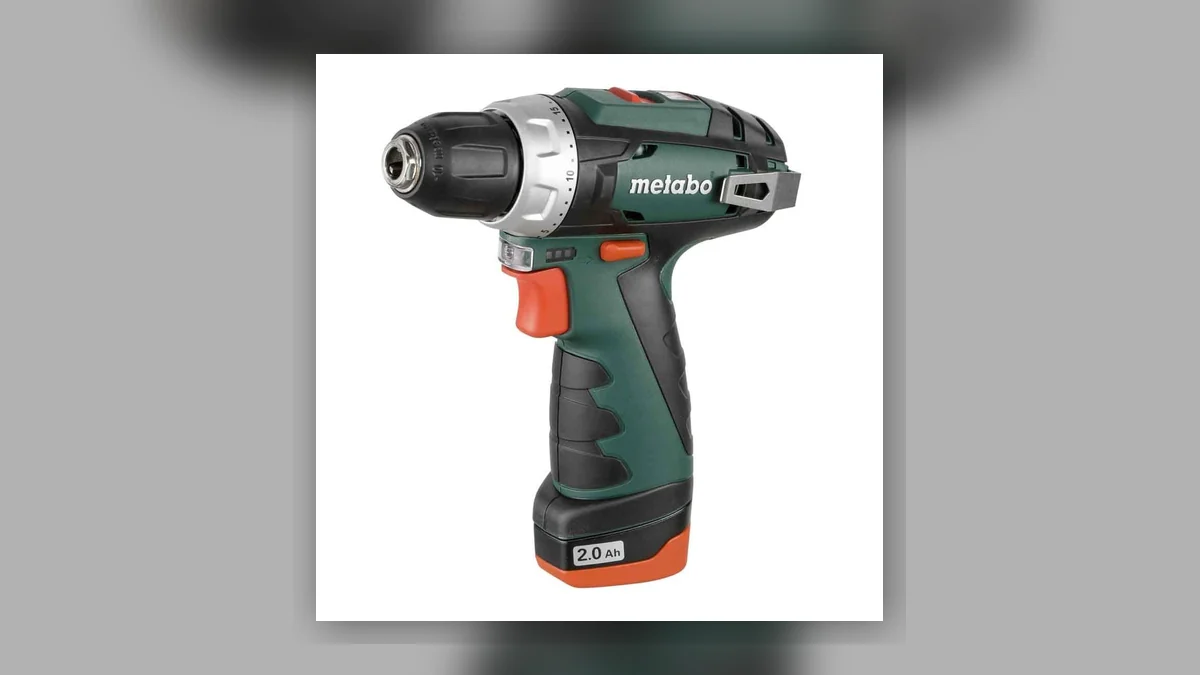
Image credit: Power Tool World (reference only - use Milwaukee press imagery for publication)
---
If you drive a lot of screws, fix a lot of bolts, or spend any meaningful time on fastening as part of your trade, the impact driver you choose will make a genuine difference to the pace and quality of your work. Milwaukee Tool's M18 FUEL impact driver range has become one of the most specified cordless fastening lines in the UK trade market. This guide breaks down what is in the range, what the numbers actually mean in real-world terms, and which variant is most likely to suit your work.
---
What makes an impact driver different from a drill driver?
A standard drill driver applies continuous rotational force to a screw or fastener. An impact driver adds rapid, concussive hits in the rotational direction, several thousand times per minute, which allows it to keep driving when a drill driver would stall or strip the screw head. The practical result is that an impact driver can drive longer, heavier fasteners with far less effort from the operator and far less risk of the bit camming out of the screw head.
The trade-off is noise and vibration. Impact drivers are louder and produce more vibration than drill drivers. They are not the right choice for every fastening task, but for high-volume or high-resistance fastening work, nothing else comes close for speed.
---
The Milwaukee M18 FUEL platform: why it matters for your battery investment
All Milwaukee M18 FUEL impact drivers run on the M18 battery platform, the same batteries used across the entire Milwaukee M18 cordless range. This is commercially significant for trades who are already using M18 tools. An M18 battery pack you already own for your drill, circular saw, or angle grinder will power any M18 impact driver without any adaptation. The batteries are not locked to specific tools within the M18 family.
Milwaukee's REDLITHIUM battery technology manages cell performance and temperature to maintain consistent output as the battery drains. In practical terms, the driver should feel roughly the same at 80% battery charge as it does at 100%, rather than noticeably slowing down as the pack depletes.
---
Milwaukee M18 FUEL Impact Driver: what the specs mean
The flagship M18 FUEL impact driver in Milwaukee's current UK range delivers up to 305 Newton metres (Nm) of torque. To put that in terms that mean something: 305 Nm is roughly equivalent to the rotational force you would need to apply with a 30cm wrench while pushing with the full weight of a 100kg person. That is a substantial amount of driving force, well beyond what any cordless drill driver can produce, and more than enough for the demanding fastening tasks most UK trades will encounter.
The tool reaches up to 3,600 impacts per minute at full speed. These rapid concussive hits are what allow it to keep driving through resistance that would stop a drill driver in its tracks.
DRIVE CONTROL mode selection on the Milwaukee M18 FUEL allows the operator to dial the impact rate up or down across four settings. On the lowest setting, the tool runs as a controlled, lower-speed fastener for precision work. At the top, it delivers maximum fastening performance for structural timber, decking, or steel fixings. This prevents overdriving screws in softwood when the operator needs fine control, while still having the full performance available when the job demands it.
The tool also features REDLINK PLUS intelligence, which is Milwaukee's over-load protection system. If the tool detects conditions that could damage the motor, battery, or electronics, it reduces output to protect the components rather than burning through them.
---
The Right Angle variant: for when space is the problem
Milwaukee makes an M18 FUEL Right Angle Impact Driver for work in confined spaces where a standard impact driver cannot fit. Electrical first-fix work in stud walls, plumbing in tight service voids, or any application where the driver head needs to go where the body of a standard tool cannot follow.
The right-angle head means the drive axis runs perpendicular to the body of the tool. It takes some adjustment to how you hold and position the tool, but for the applications it is designed for, it is substantially faster and less awkward than trying to work around obstacles with a straight-body driver.
---
The Sub Compact variant: when weight and bulk are the constraint
The M18 FUEL Sub Compact Impact Driver runs on the same M18 batteries but in a smaller, lighter body. The power output is reduced compared to the full-size model, but for trades doing prolonged overhead work, working in tight areas, or undertaking work where a lighter tool reduces fatigue across the day, the Sub Compact makes a strong case.
Electricians and plumbers in particular tend to favour compact impact drivers for the majority of their daily work, reserving larger, higher-torque models for the heavier fastening tasks.
---
Which Milwaukee M18 FUEL Impact Driver should you choose?
For most trades doing general fastening work, the standard M18 FUEL Impact Driver is the reference choice. It has the power to handle the vast majority of tasks UK trades encounter, the mode control to manage precision situations, and the platform compatibility to slot into an existing M18 battery setup.
If your work regularly puts you into cramped service areas or stud walls, the Right Angle variant is worth assessing as a second driver alongside the standard model rather than as a replacement for it.
If you are on your feet all day doing high-volume light fastening work, particularly in multi-storey domestic or commercial applications where weight adds up over hours, the Sub Compact is a serious option.
---
Caring for your Milwaukee impact driver on site
Impact drivers are robust tools, but sustained exposure to fine dust, water ingress, and drops onto hard surfaces will shorten their service life. Milwaukee M18 FUEL tools are IP-rated for some degree of water and dust resistance, but they are not submersible and should not be left exposed to driving rain.
Battery care makes a significant difference to long-term performance. REDLITHIUM packs perform best when they are not regularly drained to completely flat. Charging before the battery is exhausted, and storing at moderate temperatures rather than in the back of a van on a hot day, extends cell life meaningfully.
---