
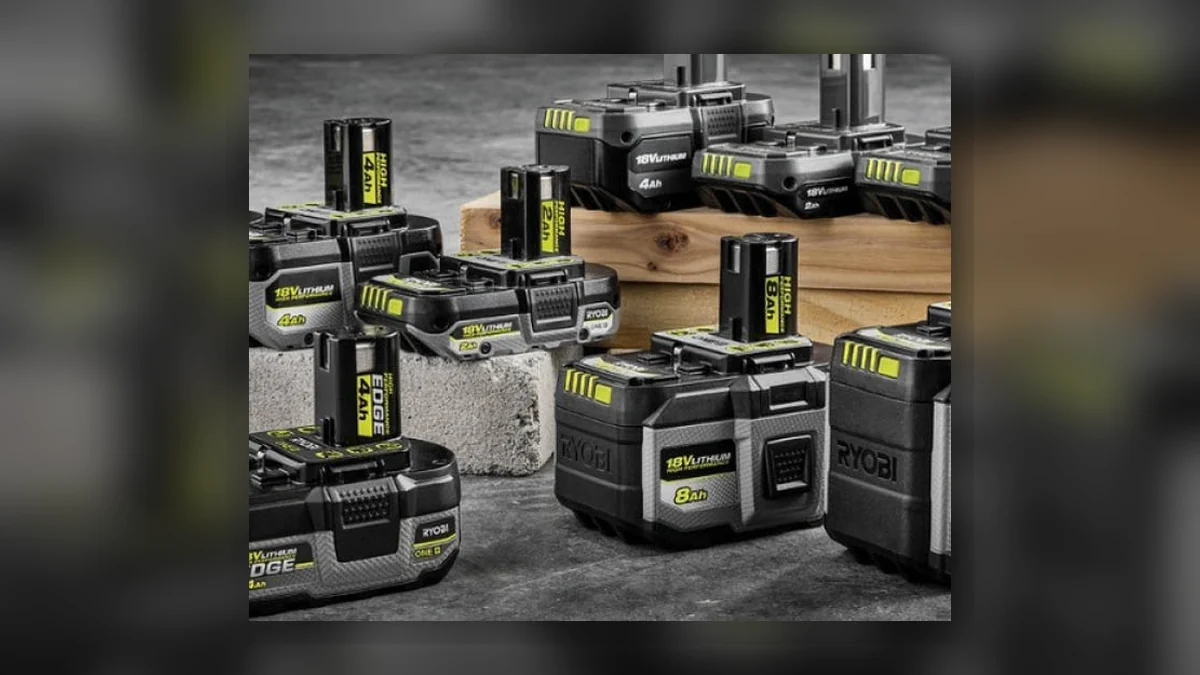
The premise behind Ryobi ONE+ is straightforward: one battery, any tool. It is one of the most compelling things about the platform for tradespeople who want flexibility without investing heavily in multiple separate systems. But "one battery, any tool" comes with a specific boundary that catches out a lot of buyers, especially when Ryobi's 36V MAX POWER range sits on the same shelves as the 18V tools.
This guide covers exactly what works with what, how to spot the difference, and why getting it right before buying saves you a return trip to the merchant.
---
How the Ryobi ONE+ platform works
Ryobi ONE+ is an 18V cordless platform. Every tool in the ONE+ range — drills, drivers, saws, lights, fans, radios, and more — runs on the same 18V battery. The battery connection is standardised across the whole range, which means a battery bought in 2015 fits a tool bought in 2025, and a new high-capacity battery bought today runs fine in an older ONE+ tool from years earlier.
That backwards and forwards compatibility is deliberate and it is the main reason the ONE+ platform has built such a large following among both professional tradespeople and homeowners. You are not starting from scratch when you buy a new tool. Your battery collection grows in value as the tool range expands.
The ONE+ battery range currently spans from 1.5Ah up to 9.0Ah. A higher Ah number means the battery holds more charge and runs longer — it does not change how powerful the tool is. A 9.0Ah battery and a 2.0Ah battery deliver the same voltage and the same motor speed to any ONE+ tool; the difference is how long you get before you need to recharge.
---
The 36V MAX POWER system: a completely separate platform
Here is the boundary that matters. Ryobi also makes a 36V MAX POWER range of tools. These are higher-power tools — larger lawnmowers, heavy-duty circular saws, brushless angle grinders — designed for tasks that benefit from higher voltage. Specifically: 36V delivers more sustained power for cutting through dense materials or sustained heavy use, which is why the heavier garden and outdoor power tools typically run 36V.
The 36V MAX POWER battery does not fit 18V ONE+ tools. The 18V ONE+ battery does not fit 36V MAX POWER tools. The connector is physically different, so there is no risk of accidentally fitting the wrong battery — it simply will not go in. But the problem is not physical fitting; it is buying the wrong battery before you discover that.
If you pick up a Ryobi 36V circular saw and then reach for an 18V ONE+ battery to power it, the battery will not connect. And if you go to buy a battery without checking the voltage first, you can easily pick up an 18V pack for a 36V tool.
---
How to tell which platform a Ryobi tool is
The voltage is printed on the tool, on the battery compartment, and on the packaging. Look for:
- "ONE+" or "18V" — this is the 18V platform. Any ONE+ battery works.
- "36V MAX POWER" or just "36V" — this is the separate platform. Requires a 36V battery.
Some Ryobi tools are also available in a 12V format (the RY12V or One+ HP 12V range), which is a third, separate battery size designed for compact, lighter tools. Again, the batteries are not cross-compatible with 18V or 36V.
If you are equipping a crew and need to standardise, the simplest approach is to decide which platform your primary tools use and buy everything within that ecosystem. For most trade use, 18V ONE+ covers the full range of everyday power tools and the battery bank is transferable across the widest selection of tools in the Ryobi catalogue.
---
Old ONE+ batteries and new ONE+ tools: do they still work?
Yes. Ryobi has maintained backwards compatibility across the ONE+ range for over two decades. A battery from an older ONE+ kit will run a new ONE+ tool, and a new high-capacity ONE+ battery will run an old ONE+ tool.
The one practical consideration is that older batteries have lower maximum capacity. A 2.0Ah battery from an early ONE+ kit will still physically fit and electrically connect to any current ONE+ tool, but it will run down faster than a modern 5.0Ah or 9.0Ah pack. The tool will perform identically — it is only the runtime that changes.
If you have a battery that is several years old and starting to run down quickly between charges, it is reaching the end of its service life. Lithium-ion cells degrade over charge cycles; this is normal. A new higher-capacity ONE+ battery improves runtime significantly and is backwards compatible with your existing tools.
---
Choosing the right ONE+ battery capacity for the job
1.5Ah and 2.0Ah: Light tools with occasional use. A torch, a small screwdriver, or a staple gun where the tool is not running continuously. Also the lightest option for overhead work where total tool weight matters.
4.0Ah: A mid-range battery that suits most everyday tool use — drills, drivers, jigsaws — where the job runs for less than a full day or where you are swapping to a second battery before a long task completes.
5.0Ah: The practical all-day choice for most professional use. A 5.0Ah battery in a ONE+ combi drill covers a typical site day of drilling and driving without a mid-afternoon flat. Running two 5.0Ah batteries in rotation is the standard setup for full-day site use.
9.0Ah: The high-capacity pack for power-hungry tools or sustained use. An angle grinder cutting steel for an afternoon, or a reciprocating saw going through a demolition job, both benefit from the extra runtime. Heavier than a 5.0Ah by a noticeable margin, which matters if the tool is being held for long periods.
---
Charging ONE+ batteries: which charger for which battery?
Any Ryobi 18V ONE+ charger charges any 18V ONE+ battery. Capacity does not change charger compatibility. The difference between chargers is speed: a standard charger charges more slowly than a rapid charger. Ryobi's 18V rapid charger can bring a 4.0Ah battery to full charge in around 40 minutes; the standard charger takes longer.
For the 36V MAX POWER range, a 36V-specific charger is required. A 18V ONE+ charger will not charge a 36V battery.
---
What happens if you try to use the wrong battery?
If the voltages mismatch, the connector will not physically fit. There is no way to force a 36V battery into an 18V tool or vice versa. Within the 18V ONE+ range, all batteries and all tools connect, so there is no compatibility risk inside the platform.
The risk is only at the boundary between platforms — specifically, buying a 36V battery thinking it is an 18V ONE+, or vice versa.
---