
Image credit: ITS Hub (reference only - verify reuse rights before publication)
---
The Ryobi ONE+ system is built around a single core promise: one battery, many tools. But as the range has grown to include standard, high-performance, and higher-voltage variants, the compatibility picture has become more nuanced than the original pitch suggests. This guide cuts through the confusion and answers the questions UK buyers ask most often before committing to the platform.
---
What is the Ryobi ONE+ system?
Ryobi ONE+ is an 18V cordless tool platform that shares a single battery design across the entire range of ONE+ compatible tools. The system was introduced to give DIYers and light trade users a single battery investment that works across a growing library of tools, from drills and circular saws to garden equipment and hobby tools.
The key number is 18V. All Ryobi ONE+ batteries are nominally 18V. All ONE+ tools are designed to run on any 18V battery in the range. This is the compatibility promise at the heart of the system.
---
Are all Ryobi ONE+ batteries interchangeable?
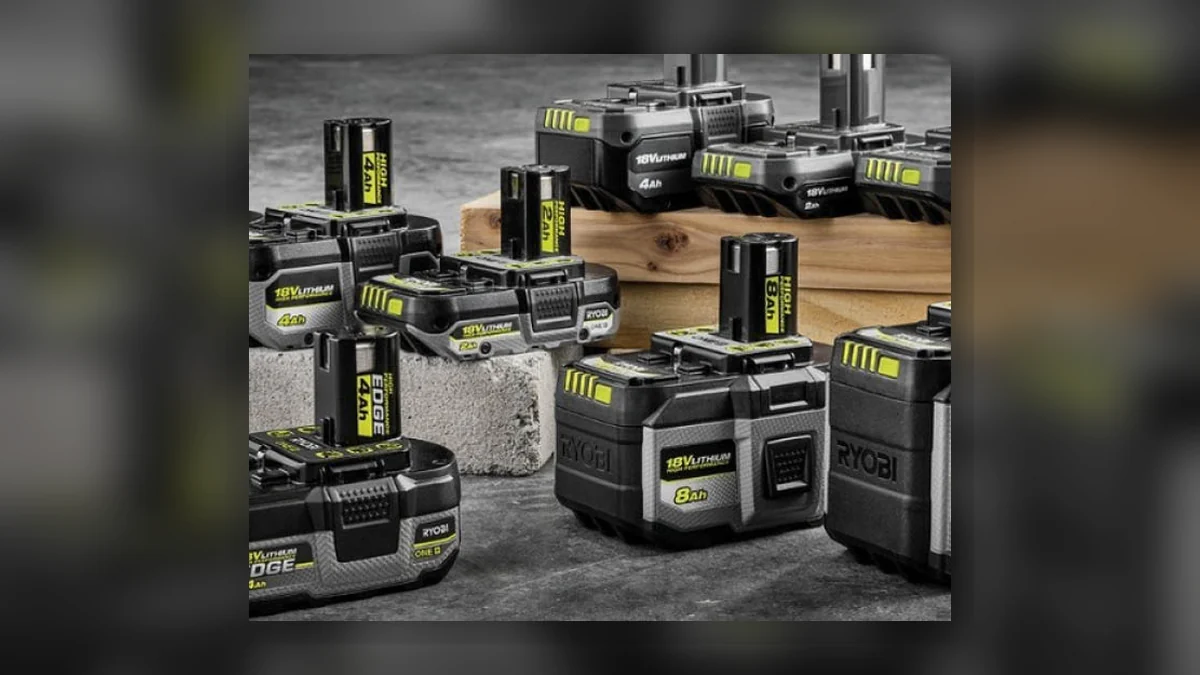
The straightforward answer for the vast majority of users and tools is yes. Any Ryobi ONE+ 18V battery, whether it is a compact 1.5Ah pack or a larger 5Ah or 9Ah high-capacity unit, will physically fit and function in any Ryobi ONE+ 18V tool.
The more nuanced answer involves the difference between standard ONE+ batteries and the newer ONE+ HP (High Performance) batteries. HP batteries contain higher-output cells that allow them to deliver more power continuously, which is beneficial in power-hungry tools like circular saws, reciprocating saws, and brushless angle grinders. The HP cells are more capable, but the batteries themselves are still 18V and still physically compatible with all ONE+ tools.
Ryobi's own guidance confirms that both standard and HP batteries are forward and backward compatible across the ONE+ 18V range. An older tool bought several years ago will work with a current HP battery pack. A current HP tool will work with an older standard battery, though it will not deliver peak HP performance from the standard pack.
---
What is the Ryobi 36V MAX POWER range, and how is it different?
This is where the most significant compatibility boundary sits, and it is the source of most confusion for buyers new to the Ryobi ecosystem.
Ryobi 36V MAX POWER tools are a separate product family from the ONE+ 18V range. They run at 36V, and they achieve this by connecting two 18V ONE+ batteries together in series within the tool. The batteries themselves are standard ONE+ 18V packs, and they fit in the tool, but the tool requires two batteries and operates them as a 36V system.
This means: a 36V MAX POWER tool is not a ONE+ 18V tool and cannot run on a single 18V battery. It needs two. And a ONE+ 18V tool cannot accept the 36V operating voltage that some standalone 36V battery products provide. The 36V designation on the tool is the voltage, not a compatible platform label.
For practical buying decisions: if you own ONE+ 18V batteries and are looking at a Ryobi product labelled 36V MAX POWER, check whether the tool runs on two ONE+ batteries (compatible, but requires two packs) or on a dedicated 36V battery (a separate purchase). The product description will specify this.
---
ONE+ HP batteries: what they are and when they matter
Ryobi's ONE+ HP battery range uses higher-performance cells compared to the original ONE+ standard battery range. The cells deliver more current per charge cycle, which translates to more power under heavy load and better sustained performance when a tool is working hard.
In practical terms: if you are running a standard ONE+ circular saw or a brushless angle grinder on a standard ONE+ battery, the tool will function correctly but may feel underpowered in demanding cuts or extended heavy use. Fitting an HP battery to the same tool typically produces noticeably more responsive performance in those high-demand situations.
For lighter-duty ONE+ tools, sealers, detail sanders, inflators, garden lighting, and similar low-draw applications, the difference between a standard and an HP battery is negligible. The tool will not draw more current than it needs, so the improved cell capability of the HP pack provides no practical advantage in that context.
The capacity of the battery (measured in ampere-hours, Ah) determines how long it runs before recharging, not how powerful the tool is during use. A 2Ah HP battery will run a circular saw for a shorter time than a 5Ah HP battery, but the power delivery when running will be similar. Capacity is about runtime; HP cell rating is about sustained output.
---
Which Ryobi ONE+ battery should you buy?
The answer depends on what tools you plan to use and how you plan to use them.
For a mixed kit that includes both power tools and lighter cordless tools, a combination of HP batteries in higher capacities for the power tools, plus a couple of standard compact packs for the lighter tools and as spares, is a sensible approach.
For a setup that is primarily light tools such as a drill, a detail sander, and garden tools, standard ONE+ batteries in a mid-range capacity are a reasonable starting point. The HP premium is not worth paying for applications that will not benefit from the improved cell output.
For a setup centred on power-hungry tools such as a circular saw, angle grinder, or reciprocating saw, HP batteries in 4Ah or 5Ah capacity are worth the additional cost for the performance and runtime they provide.
---
How many tools can I run from one set of Ryobi ONE+ batteries?
There is no technical limit to how many tools can share a set of batteries, subject only to how many tools you need to run simultaneously (which requires a battery in each) and how many charge cycles you complete in a working day. For domestic DIY use where only one tool is typically in use at a time, two batteries is a practical minimum: one in use, one on charge.
For more intensive use, or for tradespeople using Ryobi tools as secondary or supplementary tools alongside a primary trade platform, three to four batteries in rotation is a more comfortable number for sustained use across a day.
---
Ryobi ONE+ battery care: making them last
Lithium-ion batteries, including Ryobi ONE+ packs, are affected by temperature, depth of discharge, and charge habits over their service life.
Running a battery to completely flat regularly accelerates cell degradation. The ONE+ chargers will recharge from flat, but lithium cells maintain better long-term capacity if recharged before they are fully exhausted. For tools used in short bursts, it is worth keeping partially discharged batteries on charge rather than waiting for them to run out entirely.
Temperature matters at both extremes. Storing batteries in a van or shed during UK winters where temperatures drop below 0 degrees Celsius will reduce short-term capacity and accelerate long-term degradation. Storing in a dry, moderate indoor environment is better. Equally, leaving batteries in a hot vehicle in summer, or leaving them out in direct sun on a warm site, generates heat that shortens cell life.
Ryobi's chargers include overcharge protection, so leaving a battery on the charger after it reaches full charge is not harmful, unlike older battery technologies.
---