
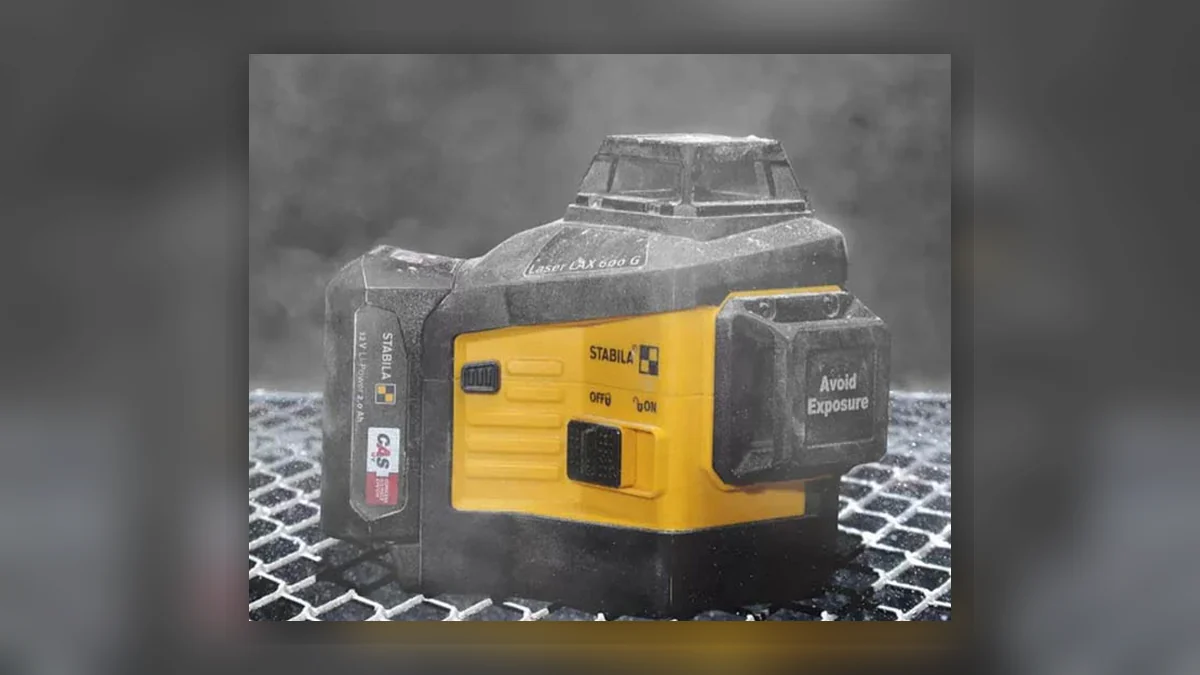
Laser levels have become a site staple across trades. Electricians use them for consistent socket heights across a run of rooms. Tilers rely on them to keep grout lines straight on large floor areas. Joiners use them for door and skirting alignment. Plasterers use them to set datum lines before screeding. If you are working to any kind of level, plumb, or horizontal reference on site, a laser level removes the margin for error that comes from chalk lines and spirit levels alone.
Stabila is one of the most trusted names in precision measurement tools in the UK trade market. Their LAX series covers green laser levels across a range of capabilities, from a compact entry model up to a full 360-degree layout tool. The range uses a number system that broadly tracks up in capability: the higher the number, the more lines and coverage you get.
Here is what separates each model in the LAX series and who each one suits.
---
Why Green Laser?
Before the models: green laser versus red laser matters more than most people expect.
The human eye is most sensitive to green light -- it is why traffic lights and emergency exits use it. A green laser beam is typically four times more visible than a red beam of equivalent power, particularly in bright conditions or across longer distances. On a sunny British summer site, a red laser can become difficult to read at 5 metres. A green laser stays readable considerably further, and in more challenging light.
Green laser modules also draw more power, so battery life is often shorter than equivalent red laser tools. That is the trade-off, and it is worth knowing before you buy.
---
The Stabila LAX Range: Model by Model
LAX 60 G
The entry point to the range. The LAX 60 G projects two green laser lines -- a horizontal and a vertical -- and is designed for fast, single-position room layout.
Think of it this way: if you need a perfectly level reference line for fitting a kitchen run, tiling a bathroom wall, or setting skirting heights across one room, the LAX 60 G does that job efficiently and without unnecessary complication.
The working range is shorter than the upper models in the range, which makes it better suited to interior work in typical room sizes rather than open-plan spaces or large commercial jobs.
Best for: Interior trades working room to room. Electricians, tilers, joiners, and decorators who need a reliable horizontal or vertical reference without a large working range.
---
LAX 300 G
The LAX 300 G steps up with a three-line projection -- adding a second vertical line or a cross-hair pattern, depending on model configuration. This extends the range of layout tasks the tool can handle from a single position.
With three lines available, you can set a horizontal datum and both plumb lines simultaneously. That speeds up tasks like squaring a room for floor tiling, setting out a stud wall layout, or aligning features across opposite walls from one central position without moving the tool.
Working range increases at this level, making it a better fit for larger rooms or commercial spaces.
Best for: Tilers laying large floor areas, stud wall and partition trades, anyone who needs both horizontal and vertical reference from one position.
---
LAX 600 G
The LAX 600 G is the flagship of the range and the professional choice for complex layout work. It projects a full 360-degree horizontal line around the room, covering every wall from a single central position. Combined with vertical lines, this turns the tool into a complete room layout device in one setup.
The working range at this level extends significantly. On a large floor screed, a 360-degree horizontal beam means you can set level datum at every wall simultaneously, which dramatically speeds up prep work. Fitters installing suspended ceilings, full-floor tiling, or underfloor heating layouts benefit most from this capability.
The LAX 600 G is the tool for anyone who regularly works across large areas or full-room installs where moving the laser repeatedly is a genuine time cost.
Best for: Screeding and flooring trades, ceiling fitters, shopfitters and commercial interior trades working in large open-plan spaces.
---
Key Things to Look For Across the Range
Self-levelling range: All LAX models self-level within a certain angle tolerance -- typically plus or minus 4 degrees. Place the tool outside that range and it will alert you rather than project an inaccurate line. This is useful protection on uneven surfaces.
Out-of-level warning: All Stabila LAX models cut the beam or flash when the tool cannot self-level, rather than projecting a false line. That matters on site where someone might accidentally knock the tripod.
IP rating: Laser levels on site face dust, moisture, and the occasional knock. Check the IP rating for the specific model against the conditions you work in.
Tripod compatibility: A laser level is only as good as its mount. All LAX models use a standard 1/4-inch tripod thread, so existing tripods and adjustable mounts will work. An adjustable wall mount is essential for many trades.
---
Which Stabila LAX Model Should You Buy?
The honest answer is: buy the model that matches the largest job you regularly do, not the smallest.
If your work is mostly domestic room-by-room jobs -- kitchens, bathrooms, single rooms at a time -- the LAX 60 G will handle the majority of your layout needs at the lowest cost and in the smallest, lightest package.
If you regularly set out floor tiling, full stud wall runs, or work across open-plan domestic extensions, the LAX 300 G adds meaningful capability without moving into the top tier.
If you work in commercial spaces, large floor areas, or regularly run full-room level references, the LAX 600 G pays for itself in time saved. Setting level datum at every wall simultaneously from one position is a material difference on a large floor screed.
---