
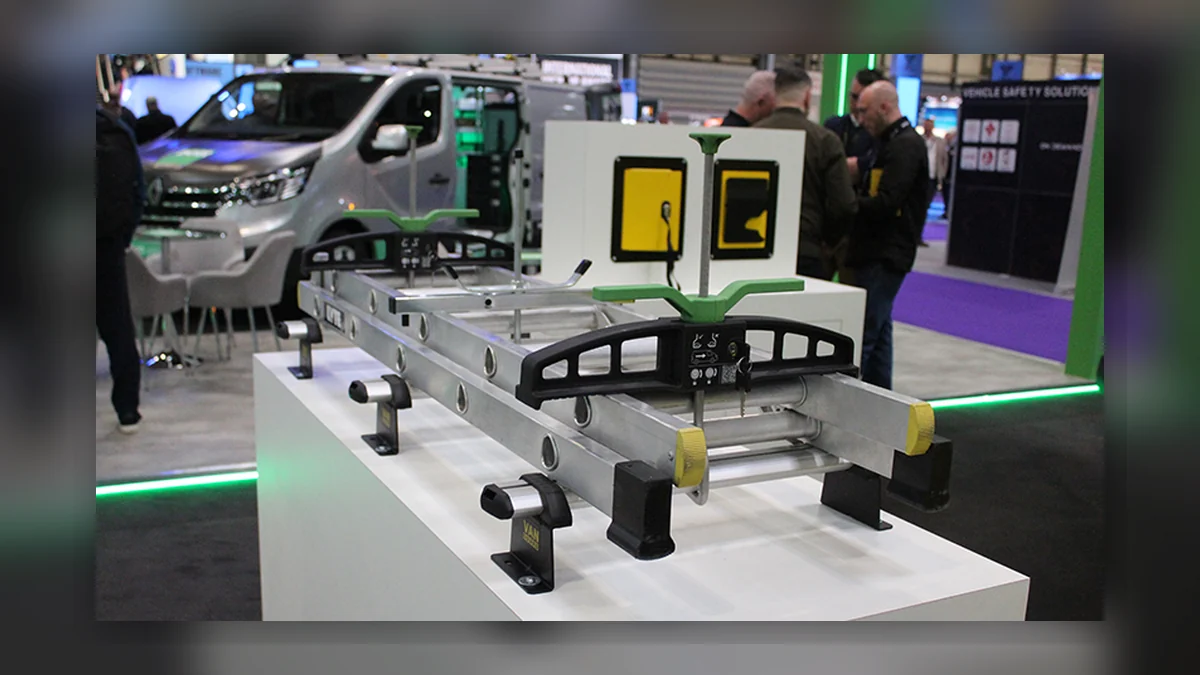
Image credit: Professional Builder / Van Guard (reference only)
Sources
- Any tradesperson who carries ladders on a van roof knows the drill. Bungee cords that stretch and lose tension over a working week. Ratchet straps that catch and fray. And the nagging awareness, especially on a motorway run, that the load security depends on whatever five minutes of effort you managed at the start of a busy morning.
- Van Guard and Bott have now jointly developed a ladder clamp that aims to solve this with a piece of genuine mechanical engineering rather than a workaround. The result is a patented system built around a triple-start thread, and it is worth understanding what that actually means before dismissing it as marketing language.
- ## What Is a Triple-Start Thread?
- A standard bolt or clamp uses a single-start thread: one continuous groove that winds around the shaft. To tighten the clamp, you rotate it through multiple full turns, each turn advancing the thread by a small amount.
- A triple-start thread has three grooves starting at different points around the shaft, equally spaced. Each full rotation of the clamp therefore advances the thread three times as far as a single-start design. In practical terms, a clamp that previously needed six turns to reach full clamping pressure now needs just two.
- For a tradesperson loading and unloading ladders four or six times a day, across a five-day week, that adds up to a significant reduction in wasted effort and time spent at the van before and after every job.
- ## The Spring-Loaded Lock
- The second key feature is a set of spring-loaded secure locks. These hold the clamp body closed independently of the thread, meaning the clamp cannot accidentally spring open while you are positioning a ladder or during transit if the thread has not yet been fully engaged.
- On a standard clamp, there is a transition point when the thread begins to engage where the clamp is neither securely open nor securely closed. That is the moment where ladder loads can shift during loading. The spring-loaded lock eliminates this gap by holding the clamp body in a closed position until the thread takes over.
- ## Van Guard and Bott: The Partnership Behind It
- Van Guard has built a strong reputation in the UK van equipment market for roof racks, ladder loaders, and transit accessories designed for working vans rather than general vehicles. Bott is a long-established manufacturer of van racking and vehicle storage systems, with a focus on workshop-quality durability applied to mobile workspace applications.
- The collaboration brings Van Guard's roof system expertise together with Bott's mechanical engineering capability. The clamp is described as designed for use with Van Guard roof bar systems, though compatibility details across specific van roof bar configurations should be confirmed directly with Van Guard before ordering.
- ## Who This Is For
- The Van Guard and Bott ladder clamp is most relevant to tradespeople who:
- Carry long ladders on a van roof daily, loading and unloading multiple times per shift
- Work across multiple sites where ladder removal and replacement is part of the normal workflow
- Have found bungee cords, ratchet straps, or basic cam-buckle clamps unsatisfactory for consistent load security
- Want a solution that holds the ladder securely in an intermediate position while they adjust positioning, before final tightening
- Electricians, plumbers, carpenters, painters and decorators, and general builders who access roof work regularly are the primary audience. HVAC engineers carrying long copper lengths and guttering contractors are also a strong fit.
- ## Why Ladder Security Matters Beyond Convenience
- Load security on van roof equipment is not just a time and frustration issue. UK law requires that any load carried on a vehicle is secured so that it cannot become a danger to other road users. A ladder that shifts during transit and makes contact with another vehicle can carry serious consequences: a fixed penalty notice at minimum, and potential liability in the event of an accident.
- The Highway Code and the Road Vehicles (Construction and Use) Regulations 1986 both address load security. While bungee cords and ratchet straps are not prohibited, a purpose-designed mechanical clamp with a positive locking mechanism provides a more auditable and reliable standard of restraint.
- ## Frequently Asked Questions
- **How does a triple-start thread ladder clamp work?**
- A triple-start thread has three separate grooves starting at equally spaced points around the clamp shaft. Each full rotation advances the clamp three times further than a single-start thread, so you reach full clamping pressure with far fewer turns. The Van Guard/Bott clamp uses this system to reduce tightening time significantly compared to conventional ladder clamps.
- **Is the Van Guard Bott ladder clamp compatible with all van roof bars?**
- The clamp is designed for use with Van Guard roof bar systems. Compatibility with third-party roof bars should be confirmed with Van Guard before purchase. Van bar spacing and rail profile dimensions are the key variables to check.
- **What are the legal requirements for securing ladders on a van roof in the UK?**
- Under the Road Vehicles (Construction and Use) Regulations 1986, any load must be secured so that it cannot cause danger to other road users. There is no specific regulation that mandates a particular clamp type, but a purpose-designed mechanical clamp with a locking mechanism provides a more reliable and demonstrable standard of compliance than bungee cords or straps alone.
- **What is the difference between Van Guard and Bott?**
- Van Guard specialises in van roof systems, roof racks, and ladder loaders for working vans. Bott manufactures van racking, vehicle storage solutions, and workshop equipment. The two companies have collaborated on this ladder clamp, combining Van Guard's roof system expertise with Bott's mechanical engineering capability.
- **How many times a day do most tradespeople load and unload ladders?**
- This varies considerably by trade and job type. Electricians and plumbers visiting multiple domestic properties in a day may load and unload three to six times. Builders working on a single large site may only do it once. The triple-start thread benefit is most noticeable for the higher-frequency users.
- Professional Builder
- Van Guard UK
- Bott UK