
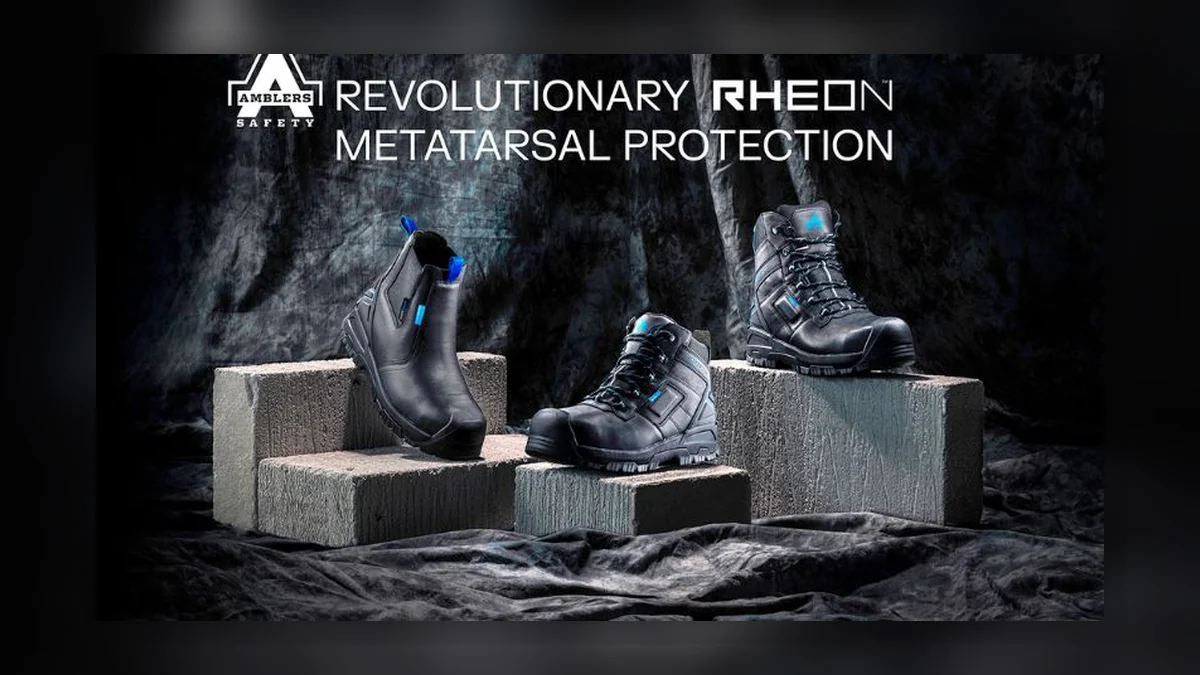
Amblers Safety has launched what it says is the first metatarsal protection safety boot range in its category to use RHEON technology. The brand, which is part of the Footsure group, has built a strong position in the UK safety footwear market. This launch is a step into more technically specified territory.
What is metatarsal protection, and why does it matter?
The metatarsal bones are the five long bones that run across the top of your foot, between your ankle and your toes. They are exposed on most standard safety boots, which protect the toes but leave the upper foot vulnerable to heavy falling objects such as steel plate, kerb stones, concrete blocks, or power tool heads.
Metatarsal protection adds a guard or absorption layer over that area. In certain occupations it is not optional. The Health and Safety Executive guidance on foot protection identifies metatarsal guards as a requirement where there is a foreseeable risk from heavy falling or rolling objects. Structural steelwork, groundworks, quarrying, heavy fabrication, and precast concrete installation are typical environments where this risk exists.
Despite this, metatarsal-protected boots have historically been a niche, uncomfortable category. Earlier designs often featured rigid external overlays that were effective but bulky and inflexible. The market has been slow to change.
What RHEON technology brings to a safety boot
RHEON is a viscoelastic lattice material developed by a UK-based material science company. Rather than being a rigid plate or a simple foam cushion, it is a three-dimensional structure that stiffens on impact. The harder and faster an object hits it, the more the material resists. At lower forces it remains flexible and allows natural foot movement.
Think of it this way: standard foam squashes under any force, including the normal flex of your foot as you walk. A rigid steel plate never moves at all, which makes a boot feel heavy and awkward. RHEON sits between those two states. Under the slow, constant force of your foot flexing as you walk, it stays soft. Under the sharp, sudden force of something heavy dropping onto your foot, it locks up and spreads the load across a wider area.
The practical result, in a metatarsal boot context, is a guard that does not feel like wearing a foot brace all day but still meets the protection requirement when something goes wrong.
The Amblers Safety range
Amblers Safety is describing this as a range rather than a single model, which suggests different build specifications and likely different safety ratings for different industry applications. The range sits under the Footsure group, which distributes to a broad network of safety footwear stockists across the UK.
Specific model names, EN ISO 20345 safety ratings, and price points had not been published in trade press at the time of writing. The Professional Builder piece announcing the launch was dated 6 July 2026, so full trade distribution details are expected to follow shortly.
For site safety managers, procurement leads, or foremen specifying PPE on groundworks, steelwork, or heavy-industry contracts, this range is worth requesting samples from your Footsure or Amblers Safety distributor.
Is metatarsal protection mandatory on your site?
Not universally, but the correct answer depends on a site-specific risk assessment rather than a general rule. Under the Personal Protective Equipment at Work Regulations 1992, employers are required to provide PPE where a risk assessment identifies a hazard that cannot be fully controlled by other means. Where heavy falling objects are a foreseeable risk, foot protection should include metatarsal coverage.
If your current PPE specification for groundworks or structural erection does not include metatarsal protection, and the risk assessment has not explicitly addressed it, this is worth reviewing. HSE inspectors do look at PPE specification relative to identified site risks.
What this launch signals for the category
RHEON has already been used in products from specialist tactical footwear and sports performance brands. Its appearance in a mainstream UK safety boot range from a volume distributor like Footsure suggests the material has reached a price point that works at scale in the safety footwear market.
That matters for the UK trades sector because it expands the realistic options for sites that need metatarsal protection but have struggled to find boots that workers will actually wear all day. The historical objection to metatarsal boots is comfort and weight. If RHEON technology genuinely addresses that, adoption could improve in sectors where it has been historically low despite being a compliance requirement.
What is a metatarsal guard on a safety boot?
A metatarsal guard is a protection layer built into or attached to the upper part of a safety boot, covering the top of the foot. It is designed to absorb or deflect the energy from a heavy object falling onto the foot. Standard safety boots with steel or composite toe caps protect the toes but not the metatarsal bones above.
Do I need metatarsal protection on a UK construction site?
It depends on your risk assessment. If your work involves the risk of heavy or sharp objects falling onto the top of your foot, such as in steel erection, groundworks, quarrying, or heavy fabrication, then metatarsal protection is likely required under the Personal Protective Equipment at Work Regulations 1992. Your site safety manager or H&S advisor should confirm based on a specific assessment.
What is RHEON technology in a safety boot?
RHEON is a viscoelastic lattice material that behaves differently under slow and sudden forces. During normal walking, it stays soft and flexible. Under sudden impact from a falling object, it stiffens and spreads the load. This means it can provide meaningful impact protection without the rigid, uncomfortable feel of a traditional external metatarsal guard.
Who is Amblers Safety?
Amblers Safety is a UK safety footwear brand within the Footsure group. The brand produces a broad range of safety boots and shoes across multiple safety ratings and sector applications, and is widely available through UK safety footwear distributors and workwear suppliers.
What EN standard applies to metatarsal safety boots?
Metatarsal protection is covered under EN ISO 20345 for general safety footwear. The metatarsal protection designation appears as M within the product code. A boot rated M1 provides metatarsal protection at a lower energy test level; M2 is a higher energy rating. Check the specific rating against your site requirements. ---
- Professional Builder
- Reference image: Amblers Safety new metatarsal boot range