
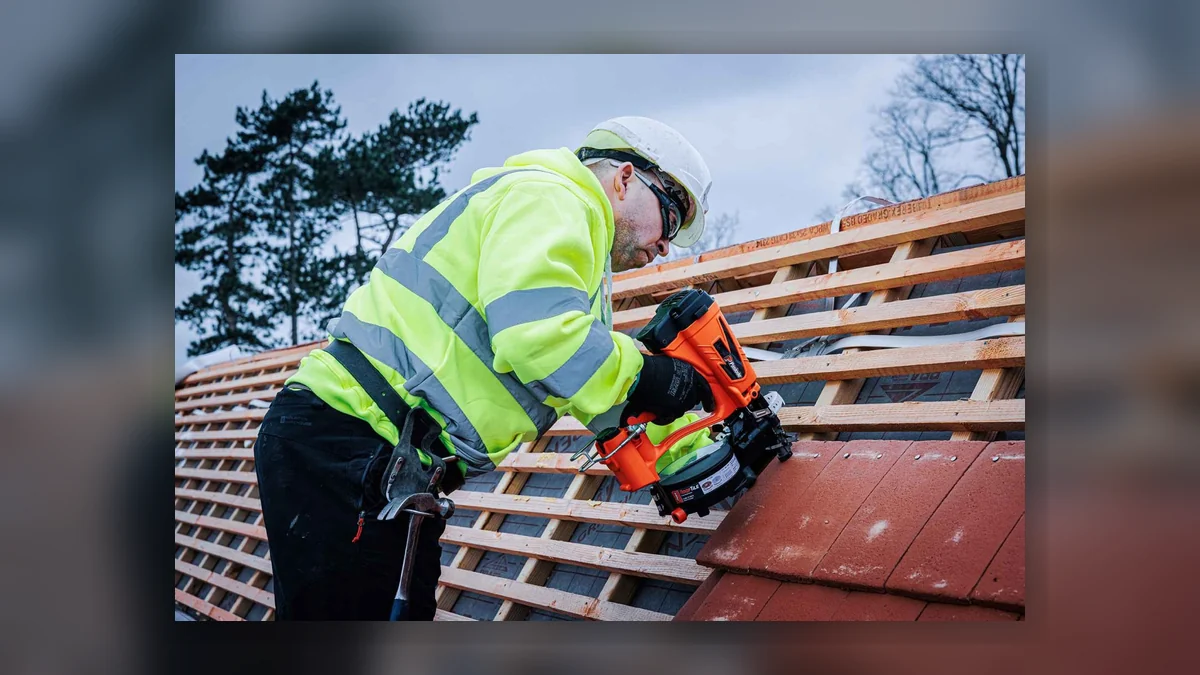
Paslode has announced the world's first dedicated RoofTile Nailer, and the roofing trade will want to pay attention. No manufacturer has previously produced a nailer purpose-built for fixing roof tiles, which makes this a category launch rather than a product update.
Why there has never been a dedicated rooftile nailer before
The roof tile fixing process is one of the last significant fastening tasks on a UK building site that has remained stubbornly manual. Framing carpenters have had pneumatic and gas nailers for decades. Floor layers have dedicated pneumatic nailers for tongue-and-groove boarding. First-fix joiners have multiple nailer options for stud work and joist hangers. Roofers, until now, have been hand-nailing plain tiles, using screw guns for heavier interlocking tiles, or repurposing first-fix nailers in ways they were not designed for.
The challenge with dedicated rooftile nailing comes down to the specific mechanical requirements of the task. Roof tiles sit in a layered formation with limited access to the fixing nail zone. The tile material itself (clay, concrete, or fibre cement depending on the specification) is harder and more brittle than timber. The required nail penetration into the batten is precise: too shallow and the tile is not secure; too deep and the nail head may damage the tile. A purpose-built tool needs to handle all of those variables reliably across hundreds of fixings per day in the exposed conditions of a working roof.
Paslode and gas-powered nailer technology
Paslode is the company that made gas-powered nailers a mainstream professional tool. Their IM90Ci first-fix framing nailer introduced the concept of a self-contained cordless nailer that carries a small gas canister and battery to power a combustion cycle that drives the nail, rather than relying on a compressor and airline. The result was a tool that could be used anywhere on a large site without dragging a hose from a compressor.
That same gas-powered technology is the foundation of the RoofTile Nailer. The combustion cycle fires the nail with consistent force regardless of where the tool is on the roof, without the trip hazard of an airline or the range limitation of a compressor.
Paslode's existing range demonstrates the durability of this technology in site conditions. The IM65A angled brad nailer and the IM350+ first-fix nailer are both established on UK roofing and framing sites. The RoofTile Nailer applies the same drive mechanism with a configuration matched to the specific geometry and force requirements of roof tile fixing.
What this means for roofers in practice
A one-square-metre section of plain clay or concrete tiles requires multiple nail fixings per tile, depending on the wind zone and pitch. On a detached house roof of average size, a roofer will drive several thousand fixing nails during the tiling phase. Hand nailing at that scale is a significant time investment and a repetitive strain risk.
A gas-powered nailer that can drive tiles at speed, precisely, without an airline, changes the economics of the tiling phase directly. The time saving translates to completed roof area per day. Fewer hand movements reduce the cumulative load on the wrist and elbow. The consistency of a controlled drive cycle is more reliable than variation in hammer strikes, particularly for fragile clay and handmade plain tiles where a struck nail can cause cracking.
UK roofing regulations (specifically BS 5534:2014, the standard for slating and tiling) require mechanical fixing for roof tiles in exposed locations, and the trend in wind zone mapping has pushed mechanical fixing requirements into more of the UK than was previously the case. A purpose-built nailer fits that regulatory direction precisely.
What we know so far
Paslode has confirmed the RoofTile Nailer is coming to the UK market. Full specifications, including the nail range, drive settings, nail strip or coil format, and launch date, have not been published at the time of writing. The tool is being covered as "coming soon" by trade stockists.
For roofers who want to be among the first in their area to spec this tool, monitoring Paslode's official UK channels and registered stockists for the launch announcement is the practical next step.
Paslode's position in the UK roofing tools market
Paslode's UK presence is substantial. The brand's nailers are specified on major residential housebuilding sites, and the consumable business (nails and gas cartridges) means that once a nailer is on site, the follow-through purchasing relationship is established. A dedicated rooftile nailer extends that relationship into a category Paslode has not previously served directly, and given the volume of roof tile fixings on a UK housebuilding site, the consumable demand will be significant.
What is the Paslode RoofTile Nailer?
The Paslode RoofTile Nailer is the world's first nailer purpose-built for fixing roof tiles. It uses Paslode's gas-powered nailer technology to drive nails into roof tiles without a compressor or airline.
Is the Paslode RoofTile Nailer available to buy yet?
At the time of writing, the tool is confirmed as coming soon but not yet available. Check official Paslode UK channels and authorised stockists for the launch date.
What types of roof tile can the Paslode RoofTile Nailer fix?
Full specifications have not yet been published. Given Paslode's technology, the tool is expected to handle plain clay tiles, concrete interlocking tiles, and fibre cement tiles. Confirm with Paslode when full product details are released.
How does a Paslode gas nailer work without a compressor?
Paslode gas nailers use a small disposable fuel canister containing a liquefied gas propellant and an onboard battery to spark the combustion cycle. Each trigger pull fires one nail without any external air supply. The tool resets within a fraction of a second for the next drive.
Why should roofers use a dedicated nailer rather than hand nailing?
A dedicated nailer drives nails with consistent force at controlled depth, significantly faster than hand hammering. For volume tile work, the time saving is substantial. The reduction in repetitive hammer strikes also reduces cumulative strain on the wrist, elbow, and shoulder over a working day.
What UK standard governs roof tile fixing?
BS 5534:2014 is the British Standard for slating and tiling for pitched roofs and vertical cladding. It specifies when mechanical fixing of tiles is required and is the reference document for tile fixing methods in UK building control and warranty applications.