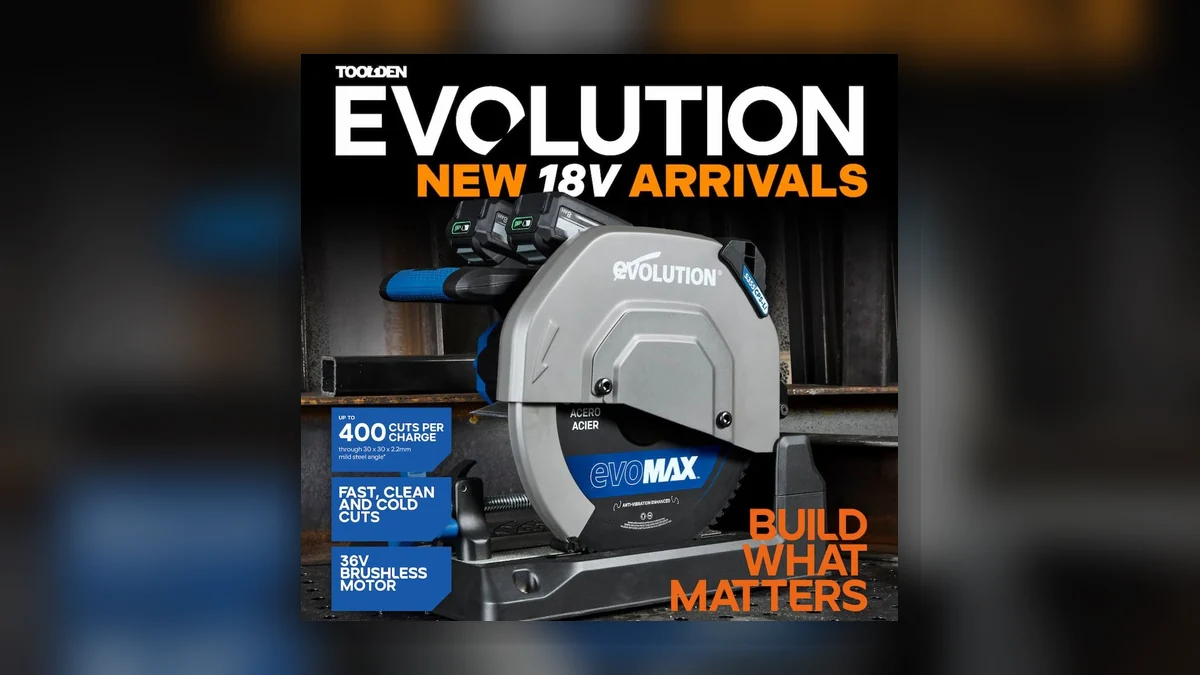
If you have ever dragged a 240V extension lead across a construction site to reach the cold-cut saw, you will understand immediately why Evolution's new S355CPS-Li matters. Evolution has taken the technology that made its corded cold-cut saws a fixture on structural steel jobs and stripped out the cable. The result is a full-size, 355mm metal chop saw running on twin 18V batteries, giving you cordless freedom without dropping down to an underpowered compact.
What is the Evolution S355CPS-Li?
The Evolution S355CPS-Li is a cordless metal chop saw. The model number breaks down like this: S355 tells you the blade diameter (355mm), CPS refers to Evolution's cold-cut and precision saw platform, and Li is the lithium battery designation.
Two 18V batteries run in series, giving the saw an effective 36V operating voltage. This is an important distinction. A single 18V battery driving a large-diameter blade through structural steel section would struggle for both torque and run time. Running two packs in series doubles the voltage while keeping the current demand on each pack manageable, which is how cordless platforms achieve useful power at this scale.
What does "cold cut" actually mean?
Standard abrasive chop saws (also called cut-off saws or angle grinders used with a cutting disc) work by grinding through metal. The friction generates enough heat to melt and remove material. This is why you get orange sparks, a burnt smell, and heat at the cut edge that can leave the metal discoloured and surface-hardened.
A cold-cut saw works differently. Evolution uses a Tungsten Carbide Tipped (TCT) blade, the same type of technology used in quality circular saw blades for timber. Instead of grinding through the metal, the TCT teeth shear through it at high speed. The material is removed cleanly, at or near room temperature.
The practical benefits:
- No sparks. You can use the saw close to timber, insulation, or other combustibles that an abrasive saw would ignite. No spark screen or fire watch required for every cut.
- No work-hardening of the cut edge. Standard abrasive cutting heats the cut face enough to partially harden it. If you then need to drill through that face or tap a thread, the hardened edge makes the job significantly harder. A cold-cut edge does not have this problem.
- Burr-free finish. The TCT cut leaves a clean, square edge that requires minimal deburring. On abrasive saws, the cut end typically needs a grinder pass before it is ready to use or weld.
- Lower noise and vibration than abrasive cutting. TCT cutting through metal is quieter than the grinding action of an abrasive disc.
What can it cut?
The 355mm blade handles the full range of structural metal section that most building and construction trades encounter:
- Steel box section (SHS and RHS) up to the saw's capacity
- Steel angle iron
- Steel flat bar
- Structural pipe and tube
- Steel studwork and track (metal stud partitioning)
- Aluminium section and profile
- Copper pipe (useful for M&E trades working without a pipe cutter in awkward locations)
Think of it this way: a 355mm cold-cut saw covers the same structural range as a corded version, which means if you are currently renting or borrowing a corded machine for steel cutting on site, this is the direct cordless replacement.
How many cuts does it actually get?
Evolution claims up to 400 cuts per charge on mild steel. To put that in context: 400 cuts at a job length of, say, 100mm per piece of box section represents 40 linear metres of mild steel from a single pair of battery charges. For most site-cutting tasks, that is a full working day or more without touching the charger.
The headline number is based on a standardised test material, so real-world cut count will vary with material thickness, alloy, and section profile. Thicker and harder materials will reduce the count. However, the direction of the figure is useful: 400 cuts is not a marginal number designed to make the spec sheet look good. It is a working-day figure.
Who is this for?
Steel fixers and structural steelworkers. Anyone currently dragging a lead to a corded cold-cut saw on a frame-up or mezzanine job will see the immediate site benefit.
Roofing contractors. Steel batten clips, lead fixings, and support steelwork all require accurate metal cutting. A cordless saw that can be positioned anywhere on a roof without cable management is a meaningful time-saver.
Groundworkers and general builders. Cutting steel reinforcement bar, flat bar, and angle iron is a daily task on most construction sites. Cold-cut quality means the cut ends are ready to use immediately.
M&E contractors. Metal conduit, cable tray, and containment cutting in plant rooms and service voids is one of the harder places to get 240V power to quickly. A cordless cold-cut saw fits where extension leads do not reach.
Shopfitters and interior contractors. Metal stud partitioning, aluminium angle, and steel frame cutting on fit-out projects often happens in finished or part-finished buildings where sparks are not acceptable. Cold cut is the answer; cordless cold cut removes the cable problem entirely.
What about the batteries?
The S355CPS-Li uses Evolution's own 18V battery platform. You will need two batteries to run the saw, and Evolution recommends using matched capacity packs (two 5Ah or two 4Ah packs rather than mismatched sizes) for consistent performance. If you are already on the Evolution 18V platform with other tools, your existing packs are compatible.
If you are considering the saw as a standalone purchase, budget for two battery packs and a charger as part of the initial outlay. Buying a kit that includes batteries is typically better value than buying bare tool plus batteries separately.
How does it compare to a corded Evolution cold-cut saw?
The corded Evolution cold-cut saws (the EVOSAW380 and similar) run directly from mains 240V. The advantages of the corded versions are unlimited run time and consistent power delivery regardless of battery state. The disadvantage is the cable.
For a fixed workshop bench or a site with reliable mains access, the corded saw remains a sensible choice. For any application where you are moving around a site, working at height, or cutting in locations without immediate mains access, the S355CPS-Li's cordless format removes the main practical obstacle.
What does twin 18V mean on the Evolution S355CPS-Li?
Two 18V battery packs run in series, giving the saw an effective operating voltage of 36V. This provides the power needed to drive a 355mm TCT blade through structural steel. You need two batteries to use the saw.
Can the Evolution S355CPS-Li cut stainless steel?
The standard TCT blade that ships with the saw is optimised for mild steel and aluminium. Stainless steel requires a specialist grade TCT blade. Evolution offers stainless-compatible blades separately. Check Evolution's blade specification before cutting stainless.
What does burr-free mean in practice?
It means the cut end of the metal does not have a sharp raised lip or rough oxide layer that needs grinding back. TCT cold-cut saws shear material cleanly, leaving a cut face that can typically go straight to fabrication, welding, or finishing without a separate deburring step.
Can I use my existing Evolution 18V batteries with the S355CPS-Li?
Yes, provided you have two packs of the same capacity. The S355CPS-Li uses Evolution's standard 18V battery format. Mismatched capacity packs (e.g. one 2Ah and one 5Ah) will run but may limit performance and affect battery longevity.
How does the S355CPS-Li differ from an angle grinder with a cutting disc?
An angle grinder with an abrasive cutting disc generates sparks, work-hardens the cut edge, and produces a rough cut face that typically needs grinding smooth. The Evolution TCT cold-cut process produces no sparks, leaves the cut edge in its original hardness state, and delivers a cleaner finish that is ready to use with minimal preparation.
Is 400 cuts per charge enough for a full day's work?
For most site-cutting applications, yes. 400 cuts based on a standard test section is a benchmark figure; actual count varies with material thickness and alloy. As a reference point, a busy structural steel day might involve 80 to 120 cuts. 400 cuts is a comfortable multi-day figure for moderate workloads.
What is the blade diameter and what does that determine?
355mm is the blade diameter. This determines the maximum depth of cut and the range of section sizes the saw can handle. 355mm is the industry-standard "full size" for metal chop saws, equivalent to a 14-inch saw in imperial measure. It handles the full range of structural steel sections used in construction, including box section, angle iron, and structural pipe. ---