
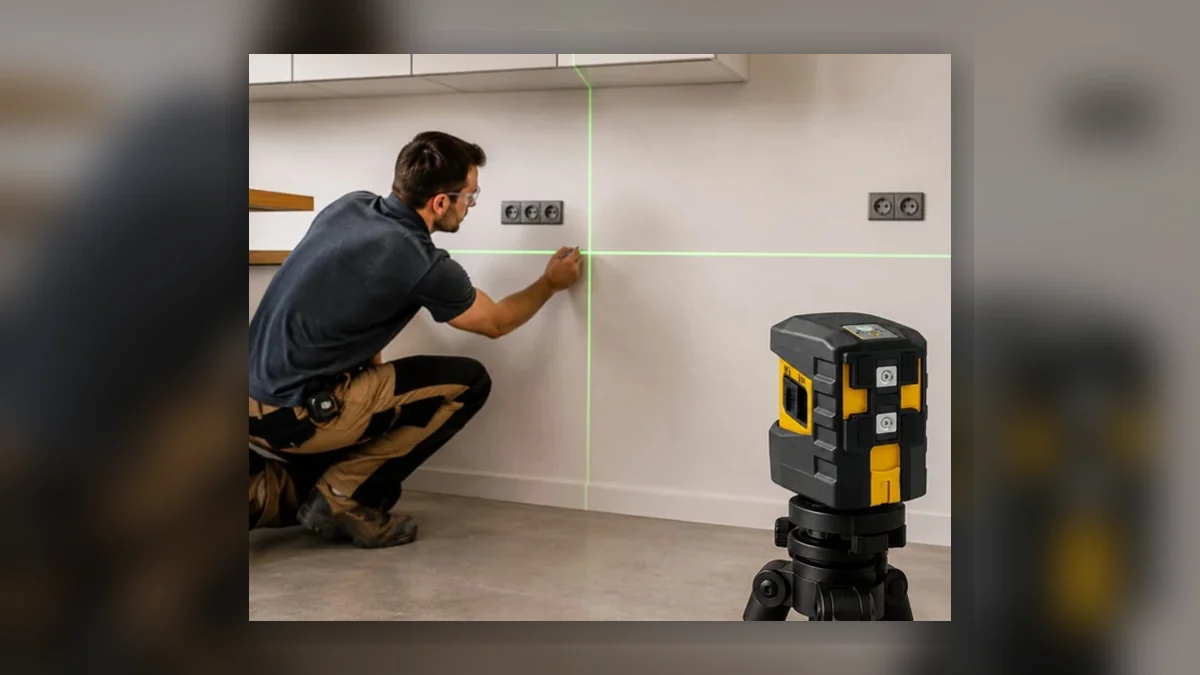
Image credit: Stabila / ITS Hub (reference only)
---
Meta
---
Stabila has a long-standing reputation in the UK trade market for making levels that are accurate and that stay accurate under the conditions a building site actually creates. Drops, knocks, temperature changes, and dust are the normal environment for a site-level tool, and Stabila builds its products to that standard rather than the clean-room conditions that some manufacturers seem to test against.
The LAX 60 G is the green-beam version of Stabila's compact cross-line laser, and it sits at the entry point to Stabila's self-levelling laser range. This review covers what it does, what the green beam actually adds in real working conditions, where it earns its keep, and where you might want to step up to something more powerful.
---
What the Stabila LAX 60 G does
The LAX 60 G projects two laser lines: one horizontal and one vertical. They intersect at 90 degrees, creating a cross-hair reference that you can use to establish level lines across a room, align tiles or boards to a consistent horizontal, set electrical box heights across multiple walls, set out door or window frame positions, and check partition alignment before fixing.
The tool self-levels automatically using a pendulum mechanism. If you set it on an uneven surface or a tripod that is slightly off plumb, the laser adjusts itself to true horizontal and vertical as long as the tilt is within approximately 4 degrees of level. This matters in practice because it removes the need to fiddle with the tool to get a clean reference line. Set it on a tripod or a level platform, switch it on, and the lines are true.
When the tool is tilted beyond its self-levelling range, an alarm beeps and the beam flashes to indicate the reading is not reliable. This is an important safety feature for accurate work: it is better to know immediately that your reference is wrong than to find out at the end of a tiling run that your lines were off by 8mm across a 3-metre wall.
---
Why green instead of red?
This is the question that comes up most consistently about laser levels, and the answer is grounded in how the human eye works rather than in marketing.
The human eye is most sensitive to light in the green part of the visible spectrum, around 550 nanometres. Red lasers typically emit at around 630 to 680 nanometres, which is towards the edge of the range where the eye's sensitivity drops significantly.
In practical terms, this means a green laser beam appears roughly four times brighter to the human eye than a red beam of the same optical power. On a site in direct sunlight or under bright artificial lighting, a red laser can become very difficult to see at distances beyond 2 to 3 metres. The same beam intensity in green remains visible at significantly greater distances under the same conditions.
For interior work where the distances are modest and the light levels are controlled, a red laser is often adequate. For larger rooms, outdoor use in low-light conditions, or situations where you need to read the laser quickly without hunting for the line, green provides a genuine working advantage.
---
Who the LAX 60 G is aimed at
The LAX 60 G is positioned at tradespeople who need accurate horizontal and vertical references quickly and who are working in spaces where the self-levelling range of 4 degrees is adequate.
It is well suited to:
Electricians setting conduit runs, socket heights, and consumer unit positions across multiple walls. Being able to establish a consistent height reference line across a room in under a minute, rather than marking with a tape and string line, saves meaningful time when you are working through a house of outlets.
Tilers working on bathroom and kitchen walls, where a true horizontal at the starting course can be the difference between a job that looks right at the end and one where the grout lines gradually drift out of level.
Joiners and carpenters fitting skirting and architrave, setting out stud walls to a chalk line, or aligning kitchen units across a run where the floor is not perfectly level.
Decorators and drylining contractors establishing partition top and bottom tracks, particularly where the room height varies enough that a string line requires constant rechecking.
General builders doing internal refurbishment work where a cross-line reference speeds up tasks that would otherwise require a second pair of hands to hold a long level while the other person marks.
---
Where the LAX 60 G has limits
The LAX 60 G is a compact, general-purpose laser and it is honest about that. There are situations where it is the right choice and situations where a different tool makes more sense.
The self-levelling range of approximately 4 degrees means it is designed for interior use on surfaces that are close to level. If you are working on a floor that is significantly out, or setting a reference line across a very uneven older structure, you may trigger the alarm regularly and need a tool with a wider self-levelling tolerance or a manually adjustable head.
The beam projects at a single horizontal line and a single vertical line. For trades who need 360-degree line projection (so the reference line continues around all four walls of a room without repositioning the laser) a rotary laser or a 360-degree cross-line laser is the right category.
The working range is adequate for most interior rooms but limited on large open-plan sites. Stabila's own specification for the LAX 60 G indicates a working range suitable for typical room sizes in residential and light commercial settings. For warehouse-scale spaces or anything requiring references across distances above 15 to 20 metres, a more powerful instrument is appropriate.
---
Build quality and the Stabila factor
One thing that Stabila consistently delivers is accuracy that is independently verifiable. The brand tests its tools against a stated accuracy figure and builds to that standard. The LAX 60 G is rated to plus or minus 0.5 millimetres per metre. That means a horizontal line projected across a 5-metre wall should be accurate to within 2.5 millimetres end to end.
In practical terms: if you are setting electrical socket heights to be consistent across a room, or aligning the bottom course of a tile layout, that accuracy is more than sufficient. The tool will not be the source of your layout errors.
The pendulum self-levelling mechanism is protected against knocks during transport by a locking function. When the tool is switched off or the lock is engaged, the pendulum is held firmly in place so it cannot swing and damage the mechanism during movement between locations. This is a basic quality detail that matters on a working site and is not universal at this price point in the laser level market.
---
Does the Stabila LAX 60 G work outdoors?
What tripod fitting does the LAX 60 G use?
How long does the battery last?
Is green beam more expensive than red in Stabila's range?
What is the difference between the Stabila LAX 60 G and the LAX 300?
Can I use the Stabila LAX 60 G for outdoor concrete formwork?
Summary
The Stabila LAX 60 G is a well-built, accurate compact green cross-line laser that earns its place in the kit of any trade doing regular interior setting-out work. The green beam provides a real visibility advantage over red in mixed-light conditions, the self-levelling mechanism is quick and reliable, and the accuracy specification is what you would expect from a Stabila product. It is not a full-room rotary laser and it is not designed for large external sites, but for the work it is designed for, it performs consistently and is built to last on a working site rather than in a toolbox that never gets opened.
---