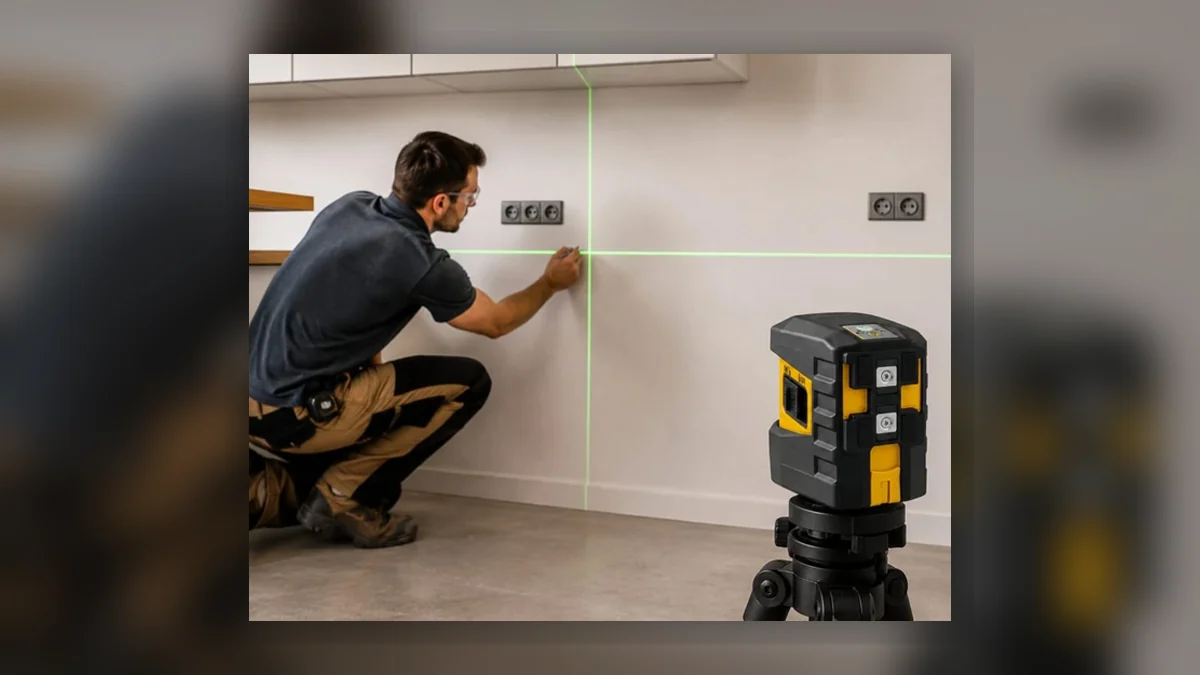
Stabila's LAX 60 G is a self-levelling cross-line laser that uses green diodes. That last detail, the green laser, is the practical difference from the cheaper end of the laser level market, and it matters more than most tool reviews acknowledge. This piece covers what the LAX 60 G does, why green laser matters in a working site environment, and which trades will find it genuinely useful.
Why green laser outperforms red in site conditions
The human eye is most sensitive to green light in the middle of the visible spectrum. Red lasers sit at the longer wavelength end, where visual sensitivity is lower. The result is that a green laser line appears roughly five times brighter than a red laser of the same power output, in the same lighting conditions.
In practice, on a well-lit site, a red laser line can be difficult to see at distances beyond two or three metres. A green laser at the same distance in similar conditions remains clearly visible. The implication is direct: working range without a detector. On an indoor room-sized space, a green laser is usable with the naked eye in daylight. A red laser in similar conditions may require dimming the room or waiting until lower-light conditions to work effectively.
The LAX 60 G puts the visual range of a detector-equipped red laser into a naked-eye tool for indoor work. For the kind of layout tasks UK tradespeople carry out most often, that is a meaningful upgrade.
What the Stabila LAX 60 G produces
The LAX 60 G generates two laser lines: one horizontal and one vertical. These are produced simultaneously or can be selected independently. The horizontal line runs continuously around the room (a plane, not just a single beam); the vertical line similarly projects a full plane.
The practical result: a horizontal line lets you mark a level datum around all four walls of a room in one placement. Set the laser at the height you want (a metre above finished floor level, for example) and you have a reference mark for tiling, setting out kitchen units, hanging picture rails, or positioning radiators that is consistently level to within 0.5mm per metre, which is the tool's stated accuracy.
The vertical line is equally useful: it projects a plumb plane for aligning door frames, setting out bathroom tile lines, or checking the vertical alignment of stud partitions.
The two lines intersect at right angles on the tool, which gives you a reference grid: horizontal and vertical simultaneously from a single placement.
Self-levelling range and lock mode
The LAX 60 G self-levels within a 4-degree working range. The pendulum mechanism inside the tool compensates for minor deviations from level when the tripod or surface it is placed on is not perfectly flat. Within 4 degrees of level, the laser lines are accurate and the tool is silent.
Outside the 4-degree range, the tool detects that it cannot self-level and enters a lock mode. In lock mode, the lines continue to project but the accuracy warning (an audible beep on some models) tells you the tool is not self-levelled. This is the correct behaviour: it prevents you working to lines that appear level but are not.
The lock mode also allows deliberate use of the tool off-plumb for layout tasks where the line needs to be at a specific angle. Switch to lock mode intentionally and you can project a line at any angle you choose, useful for setting out rake cuts on a stair stringer or marking a drainage fall.
IP54 rating: what it means on a building site
IP54 is the ingress protection rating for the LAX 60 G. The first digit (5) indicates dust protection to the level of limited dust ingress; no harmful deposit. The second digit (4) indicates splash protection: water splashing from any direction will not harm the tool.
This does not make it a tool to use in rain or submerge in a bucket. It does mean that site dust, plaster spray, and incidental splashes from wet materials will not damage the unit in normal working conditions. For a laser level that lives on site rather than in a cupboard at home, IP54 is the baseline specification you want.
Accessories and setup
The LAX 60 G has a standard 1/4" tripod thread on the base, compatible with most camera tripods and dedicated laser level tripods. Stabila produces a range of tripods and poles for the tool including micro-adjust fine-level poles that let you set height precisely without moving the tripod.
The micro-tilt base included with the LAX 60 G allows minor pitch adjustment independently of the tripod, which is useful when the floor surface is uneven and you want to check the self-levelling range before committing to a position.
A magnetic adapter fits the LAX 60 G to metal surfaces, which allows hands-free mounting on steel lintel uprights, cupboard door tracks, or metal stud partitioning.
Trade applications where this laser earns its place
Tiling: setting a level horizontal reference line at the start of each tiling session eliminates the need for constant manual level checking. On a floor-to-ceiling tile layout, the LAX 60 G sets out the grid in seconds.
Electricians: marking switch heights, socket positions, and consumer unit centres across an entire floor consistently. One laser placement, marks on all the walls.
Joiners: aligning door frames, setting kitchen unit heights, positioning architrave lines, checking if a wall is plumb before fitting cladding.
Plumbers: radiator centres, setting the height of surface-mounted pipework runs, confirming falls on horizontal pipework chases.
Plasterers and drylining: checking stud straightness before boarding, setting the depth of beads, confirming reveal widths across multiple openings.
What is the working range of the Stabila LAX 60 G?
With the naked eye in typical indoor conditions, the green laser is clearly visible at up to 20 to 25 metres. With a Stabila laser receiver/detector, working range extends to around 40 metres, allowing use in larger spaces or outdoors in daylight.
Why is a green laser level better than a red laser level?
The human eye is more sensitive to green wavelengths than red. A green laser appears approximately five times brighter than a red laser of equivalent power in the same lighting conditions, making it more visible at greater distances without a detector.
What does self-levelling mean on a laser level?
A self-levelling laser contains a pendulum mechanism that compensates for minor deviations from level automatically. Within the self-levelling range (4 degrees on the LAX 60 G), you place the tool approximately level and it adjusts itself to a precise horizontal or vertical. Outside that range, it locks and warns you.
Is the Stabila LAX 60 G suitable for outdoor use?
The IP54 rating protects against dust and splash, but outdoor use in bright sunlight significantly reduces visible range without a detector. With a green laser receiver, outdoor use is practical; naked-eye outdoor use is limited in bright conditions.
What accuracy does the Stabila LAX 60 G achieve?
Stabila states +/- 0.5mm per metre accuracy in self-levelling mode. Over a 5-metre room that is +/- 2.5mm of variance from one wall to the opposite, which is well within the tolerance required for most building trades.
Can the Stabila LAX 60 G be used with a tripod?
Yes. The base has a standard 1/4" thread that accepts most camera tripods and all dedicated laser level tripods.
What is the difference between the Stabila LAX 60 and LAX 60 G?
The LAX 60 uses a red laser; the LAX 60 G uses a green laser. The G model costs more but offers significantly better visibility in normal working lighting conditions.