
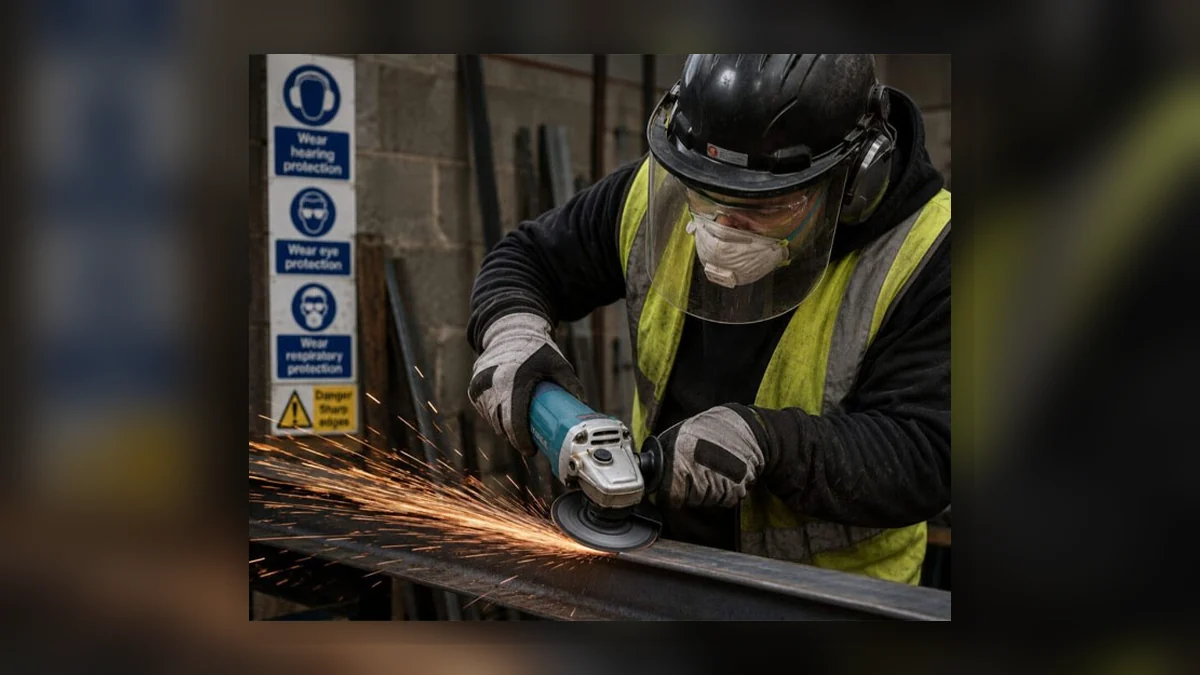
The angle grinder is the most useful and the most dangerous tool most trades own. It will cut rebar, chase a wall, grind a weld, cut a paving slab and remove a rusted bolt, and it will do serious damage to you in a fraction of a second if the disc snags. Choosing one is mostly about matching disc size to the work you actually do, and then not skimping on the safety features that stop a bad moment becoming a hospital visit.
---
Disc size: the decision that determines everything else
Angle grinders are sold by their maximum disc diameter, and that single number sets cutting depth, weight, power and how the tool handles.
115mm (4½")
The most common size in UK trades, and the right default for most people.
- Cutting depth: roughly 28-30mm with a new disc, less as it wears down.
- Weight: typically 1.8-2.5kg corded.
- Best for: electricians chasing, plumbers cutting pipe and threaded bar, general metal cutting, tile cutting, cleaning up welds, cutting off bolts.
- Handling: one-handed use is possible, which is convenient and also the main reason people get hurt. It should still be run two-handed with the side handle fitted.
125mm (5")
The other mainstream size, and increasingly the standard on cordless platforms.
- Cutting depth: roughly 33-36mm.
- Weight: marginally heavier than 115mm, with usually a bit more motor.
- Best for: the same jobs as 115mm, with useful extra depth for cutting 100mm block or thicker section steel. Where the two sizes overlap, disc availability is the tiebreaker — 115mm discs are more widely stocked in UK merchants, 125mm is more common across Europe.
150mm (6") and 180mm (7")
Less common in the UK, sitting awkwardly between the small and large sizes. Reasonable for heavier fabrication work.
230mm (9")
A different class of tool entirely, not just a bigger version.
- Cutting depth: roughly 65-70mm — enough for a paving slab, a kerbstone or a 100mm block in a single pass.
- Weight: typically 5-6kg, always two-handed.
- Best for: groundworks, demolition, cutting slabs and kerbs, heavy structural steel.
- Caution: the stored rotational energy at this size is very large. A 230mm grinder that kicks back is extremely hard to control, and this is the size that causes the worst injuries in the trade. Many contractors have moved 230mm cutting work to a cut-off saw or a dedicated wall chaser precisely for this reason.
Practical answer for most trades: one 115mm or 125mm grinder for everyday work, and hire a 230mm or a petrol/battery cut-off saw for the occasional slab-cutting day.
---
Corded or cordless?
Cordless angle grinders have moved from marginal to genuinely good over the past few years, driven by brushless motors and higher-capacity 18V batteries. The trade-off has shifted but not disappeared.
Cordless makes sense when: you are doing intermittent cutting — a handful of cuts on a first fix, cutting off bolts, chasing short runs — and the convenience of no lead on a scaffold or in a loft outweighs run time. Modern 18V brushless grinders will do meaningful work on a 5.0Ah pack, and features like electronic brakes are more common on cordless than corded.
Corded still wins when: you are grinding continuously — dressing welds for an hour, cutting a long run of steel, prepping a floor. Sustained heavy grinding is exactly the duty cycle that empties batteries fastest, and a 1000-1500W corded grinder will hold power indefinitely.
Motor power (corded): 700-900W is adequate for a 115mm grinder used intermittently. 1000W+ is worth having if you grind regularly. For 230mm, expect 2000W+.
---
Discs: getting this wrong is how people get hurt
The disc does the work, and disc selection is not interchangeable. Every disc carries a maximum RPM rating that must be equal to or higher than the grinder's no-load speed — a common failure is fitting a disc rated for a slower, larger grinder onto a fast 115mm tool.
Cutting discs (thin, typically 1-3mm)
For cutting only — never grind on the face of a cutting disc. They are designed to take load on the edge, and side loading is what causes them to shatter.
- Metal cutting discs: aluminium oxide abrasive, for steel and non-ferrous metals. Check for a "for steel" or "inox/stainless" designation — stainless discs are iron-free to avoid contaminating the stainless surface, which matters for food-grade and architectural work.
- Masonry/stone cutting discs: silicon carbide abrasive, for brick, block and concrete. Wear rapidly compared with diamond.
Diamond blades
A steel disc with diamond grit bonded to the rim. Much longer-lasting than abrasive masonry discs and the sensible choice if you cut masonry regularly.
- Segmented rim: fast, aggressive cutting in concrete, brick and block. Rougher finish.
- Continuous rim: slower, much cleaner cut, for tile, porcelain and stone where chipping matters. Often used wet.
- Turbo rim: a compromise — faster than continuous, cleaner than segmented.
Diamond blades are graded by the material they are bonded for. A general-purpose blade will cut most things adequately; a blade bonded for hard materials will not last in soft, abrasive ones (and vice versa), because the bond needs to erode at the right rate to keep exposing fresh diamond.
Grinding discs (thick, typically 6mm)
For material removal — dressing welds, chamfering edges, cleaning up cut steel. Used at an angle to the work, typically 15-30°.
Flap discs
Overlapping abrasive flaps, effectively a grinding and finishing disc in one. Cooler-running and leaving a better finish than a rigid grinding disc, and increasingly the default for weld dressing. Available in grits from around 40 to 120.
Wire brushes and cups
For rust removal and paint stripping. The hazard here is ejected wire bristles — full face protection is not optional, and a bristle embedded in skin is a genuine and well-documented injury route.
---
Safety features worth paying for
This is where the price difference between a budget grinder and a professional one earns itself back.
Electronic brake. Stops the disc in around two seconds rather than the twenty-plus seconds a free-spinning disc takes to coast down. Most angle grinder injuries happen after the trigger is released, when the tool is put down with the disc still turning. If you buy one feature on this list, buy this.
Kickback / anti-kickback control. Detects the rapid rotational change that signals a pinched or snagged disc and cuts power. On a 230mm grinder this is close to essential.
Restart protection (no-volt release). Prevents the tool restarting on its own if power is interrupted while the switch is locked on. A grinder that leaps into life on a bench when the extension lead is plugged back in is exactly the scenario this prevents.
Soft start. Ramps the motor up rather than snapping to full speed, which reduces the startup torque trying to twist the tool out of your hands and is easier on the disc.
Guard adjustment without tools. A guard that takes a spanner to move is a guard people leave in the wrong position, or remove. Tool-free guard adjustment is a safety feature disguised as a convenience feature.
Vibration-damped side handle. Angle grinding is a high-vibration activity, and under the Control of Vibration at Work Regulations 2005 daily exposure has to be assessed and controlled. Anti-vibration handles and lower-vibration tools extend how long you can legitimately work before hitting exposure limits.
---
The safety rules that actually matter
Never remove the guard. It is there to direct fragments away from you if the disc breaks. Every experienced tradesperson has seen someone take a guard off to reach into a tight spot. It is the single most common serious-injury factor with this tool.
Full face shield, not just glasses. Safety glasses stop dust; they do not stop a fragment of a shattered cutting disc travelling at the speed a 11,000rpm grinder throws it. Wear a face shield over the glasses.
Dust control on masonry. Cutting or chasing brick, block, concrete or stone dry produces respirable crystalline silica, which causes silicosis and lung cancer. HSE requires exposure to be controlled — on-tool extraction with an M-class vacuum, or water suppression, plus appropriate RPE. This is not a paperwork requirement; it is the main long-term health hazard of the tool.
Let the disc reach full speed before it touches the work, and let it stop before setting the tool down.
Check the disc before fitting it. Cracks, chips and a disc that has been dropped are grounds for binning it. Check the expiry date on abrasive discs — resin-bonded discs degrade and typically carry a three-year life from manufacture.
Cut in the correct direction. With the guard between you and the disc, and with the sparks and debris directed away from your body, other people and anything flammable.
Never lock the trigger on for handheld work unless the tool's design and the task specifically call for it.
---
Quick reference: matching disc to job
| Job | Disc | Notes | |---|---|---| | Cutting steel, rebar, threaded bar | Thin metal cutting disc | 1mm for thin section, 2.5-3mm for heavier | | Cutting stainless | Inox cutting disc | Iron-free bond to avoid contamination | | Cutting brick, block, concrete | Segmented diamond blade | Dust control mandatory | | Cutting tile and porcelain | Continuous rim diamond | Slower, cleaner, often wet | | Dressing welds | Flap disc, 60-80 grit | Cooler and cleaner than a rigid grinding disc | | Heavy material removal | Grinding disc, 6mm | Held at 15-30° to the work | | Rust and paint removal | Wire cup brush | Face shield essential — ejected bristles | | Chasing walls for cables | Diamond blade + on-tool extraction | Consider a dedicated wall chaser for volume work |
---