British Gypsum has published a new best practice guide covering fire-rated junctions in GypWall partition systems. It addresses a gap in UK construction fire safety that has been quietly visible for years: individual building elements such as partitions and fire doors must pass rigorous fire tests, but there has never been a legal requirement or industry standard for testing how those elements perform at the points where they connect.
The junctions are where real-world performance and tested performance can diverge. A partition wall certified to 60 minutes of fire resistance provides that protection across its face. At the corner where it meets another partition, at the head detail where it hits the concrete soffit, at the column wrap where steel meets plasterboard: those are the points where site conditions force adaptations, where the tested assembly ends and the trade's judgement begins. British Gypsum has now published tested solutions for exactly those locations.
What the guidance covers
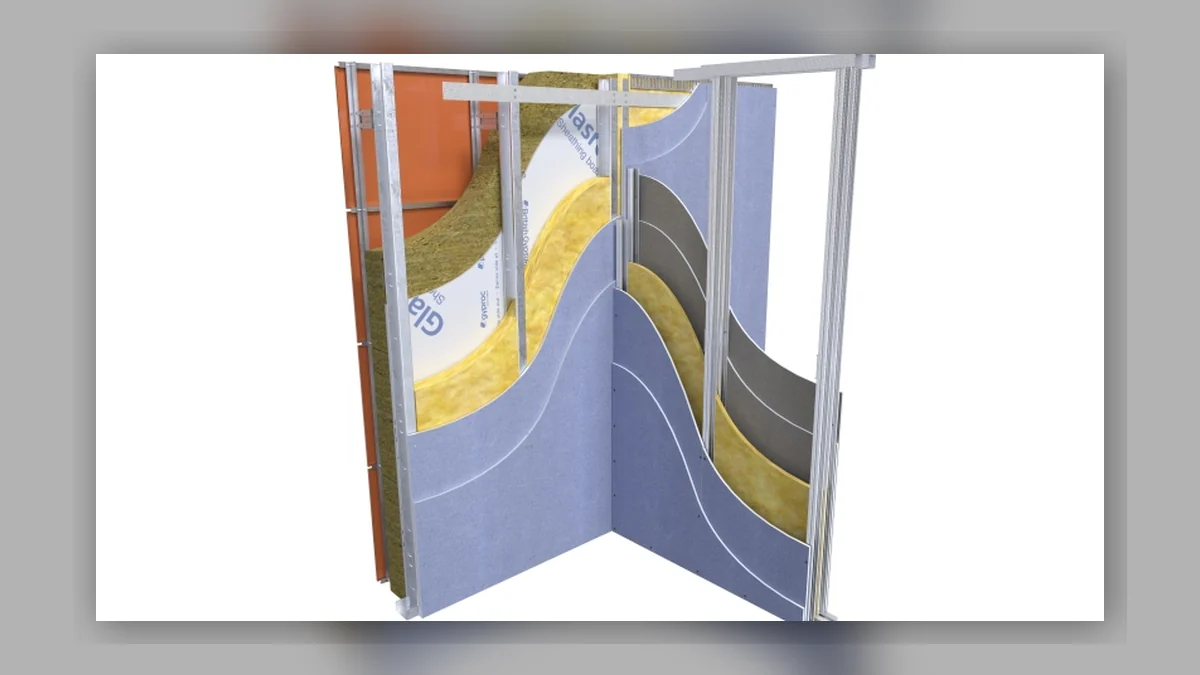
The guide is the product of a year-long R&D programme that included full-scale fire testing of GypWall systems at the junction types most commonly encountered on site. The test locations covered were:
- Internal corners, where two partition walls meet
- T-junctions, where a partition intersects another at 90 degrees mid-run
- Partition-to-structural-column interfaces, where the GypWall system meets a steel or concrete column
- Offset beam situations, where the wall must negotiate a horizontal structural element
- Ceiling junctions, where the partition meets the ceiling soffit
These are the details that appear most often in design drawings, and the ones where installers and specifiers have historically had to extrapolate from tested partition and ceiling system data rather than tested junction data.
Why this matters for dry lining contractors and specifiers
For dry lining contractors, the practical value is a tested reference for junction details that previously required either manufacturer consultation, a conservative interpretation of the partition system test data, or professional engineering judgement. Installers working on projects with prescriptive fire protection requirements, including post-Grenfell building regulations under the Building Safety Act 2022, have more pressure than ever to demonstrate that their details are evidence-based.
For specifiers and fire engineers, the guide provides tested junction solutions within the GypWall range that can be specified directly, reducing reliance on generic details or ad hoc manufacturer coordination.
The guide is available as a free download from British Gypsum. It is described as a "best practice" document rather than a code or standard, but given the absence of a formal junction testing standard in the UK, tested manufacturer guidance of this kind carries practical authority.
The broader fire safety context
The construction industry has operated under heightened fire safety scrutiny since the Grenfell Tower fire in 2017. The Building Safety Act 2022 and the updated building regulations that have followed have increased compliance obligations for higher-risk buildings, but they have also shifted expectations across the wider sector. Specifiers and contractors on all types of projects are now expected to document and evidence their fire protection decisions more robustly than before.
One consequence is that general guidance, "use a standard junction detail," is increasingly inadequate when a project requires documented evidence that each detail will perform as intended under fire conditions. British Gypsum's new guide is a direct response to that expectation: tested details, documented methodology, and free access for the industry to build into specification practice.
---