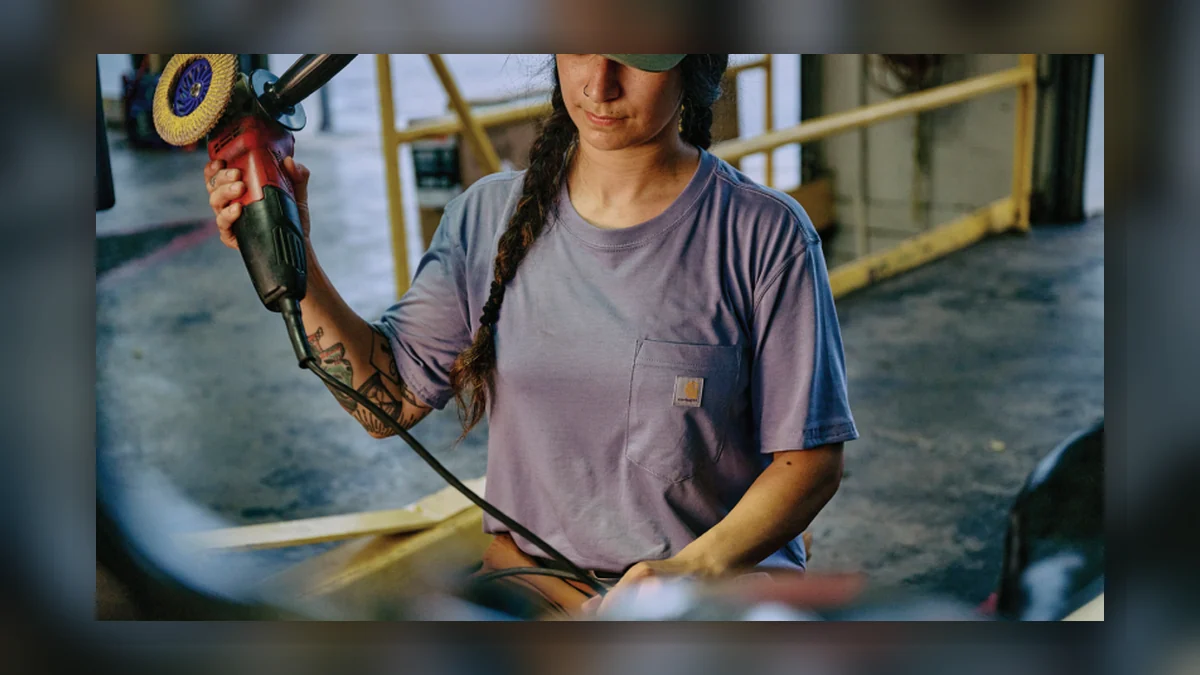
Image credit: Carhartt (reference only)
---
Meta
---
There is a point in a UK summer, usually somewhere around the end of June, when working outside in standard dark work trousers and a heavy fleece becomes actively dangerous rather than just uncomfortable. The body's core temperature starts to climb, concentration drifts, and errors that would not happen on a cold January morning start to happen. On a construction site, that is a real risk.
Carhartt's Nick Poulson has been talking publicly this week about how to pick breathable, UPF-rated workwear that handles heat without leaving trades exposed to UV damage. The guidance is practical and the points are worth unpacking, because there is a lot of confusion in the trade sector about what "breathable" and "UPF-rated" actually mean when you are on your knees laying block in direct sun for eight hours.
---
What UPF actually means on a hot site
UPF stands for Ultraviolet Protection Factor. It is the clothing equivalent of SPF sunscreen, but it describes how much UV radiation a fabric blocks rather than how much it absorbs on skin.
A UPF 50 garment blocks 98% of UV radiation. That means that if 1,000 units of UV hit the outside of the fabric, only 20 units reach your skin. By comparison, a standard white cotton T-shirt typically has a UPF rating of around 5 to 7, meaning it blocks somewhere between 80% and 85% of UV. If you have ever turned pink through a white shirt after a day on a hot roof, that is why.
For trades working exposed sites through June, July, and August, a UPF 50 fabric is not a premium nicety. It is genuinely doing the job that a shirt and sunscreen would otherwise need to cover.
---
Breathable fabrics: what the difference actually feels like
The problem with a lot of workwear is that it was designed for durability and warmth. A 340-gram cotton duck canvas is excellent at withstanding abrasion and it will last several years on a hard site, but wearing it in 26 degrees with no shade is genuinely unpleasant and creates sweat accumulation that makes heat exhaustion more likely, not less.
Breathable fabrics do two things. First, they allow sweat vapour to pass through the fabric rather than trapping it against the skin. Second, lighter weave structures allow some air movement, which helps with evaporative cooling.
Carhartt's summer range uses lighter-weight woven fabrics, typically in the 190 to 240 gram per square metre range, that manage sweat more effectively than heavier cotton. The trade-off is that they are less resistant to snags and heavy abrasion than a canvas alternative, which is why the seasonal choice matters. For groundwork trades or anyone who regularly kneels on concrete, a reinforced lightweight trouser still makes more sense than a standard lightweight pant, even in summer.
---
Heat exhaustion: what it looks like and why trades miss it
Heat exhaustion develops when the body loses more fluid through sweating than it is replacing. The early symptoms are tiredness, dizziness, and mild headache, which are easy to attribute to a long week or a short night's sleep. By the time nausea or muscle cramps develop, the situation is getting serious.
The Health and Safety Executive (HSE) guidance on thermal comfort notes that employers have a duty to assess heat risk in warm environments, but the practical enforcement burden still falls on trades themselves to manage their own hydration and to not work through heat symptoms they recognise.
The simple rules are the same as they have always been: drink water before you feel thirsty, take shade breaks during peak sun hours (roughly 11am to 3pm in a UK summer), and wear clothing that reduces rather than accelerates heat accumulation.
---
Carhartt's summer workwear range: the practical context
Carhartt has been selling to the UK trade market for long enough to understand what the working conditions actually look like. The summer range focuses on a few core principles: lightweight durable construction, moisture management, and UV protection.
The brand is not trying to produce technical athletic wear. What Carhartt does is take workwear construction principles (reinforced knees, tool pocket placement, belt loop strength) and apply them to lighter-weight, more breathable fabrics. The result is workwear that still functions as workwear under hard use but does not turn a warm day into a health risk.
For trades who spend most of their year in Carhartt's heavier winter lines, the summer range is worth knowing about because the fit and ergonomics are broadly consistent with what they are already used to. Switching to a lighter summer alternative does not mean relearning where the pockets are.
---
Is UPF workwear better than putting sunscreen on under a standard shirt?
Does lightweight workwear actually last on a UK site?
What is the risk of skin cancer for UK outdoor workers?
What temperature should I switch from standard to summer workwear?
Does Carhartt workwear comply with UK hi-vis requirements?
Summary
The choice of workwear in summer is a practical decision with real health implications. UPF-rated, breathable fabrics reduce UV exposure without requiring trades to stop and reapply sunscreen, and they manage heat accumulation during physical work better than heavier standard fabrics. Carhartt's summer range applies the brand's workwear construction standards to lighter materials, making it a sensible choice for UK trades who need clothing that actually works through a warm British summer rather than just looking the part.
---