
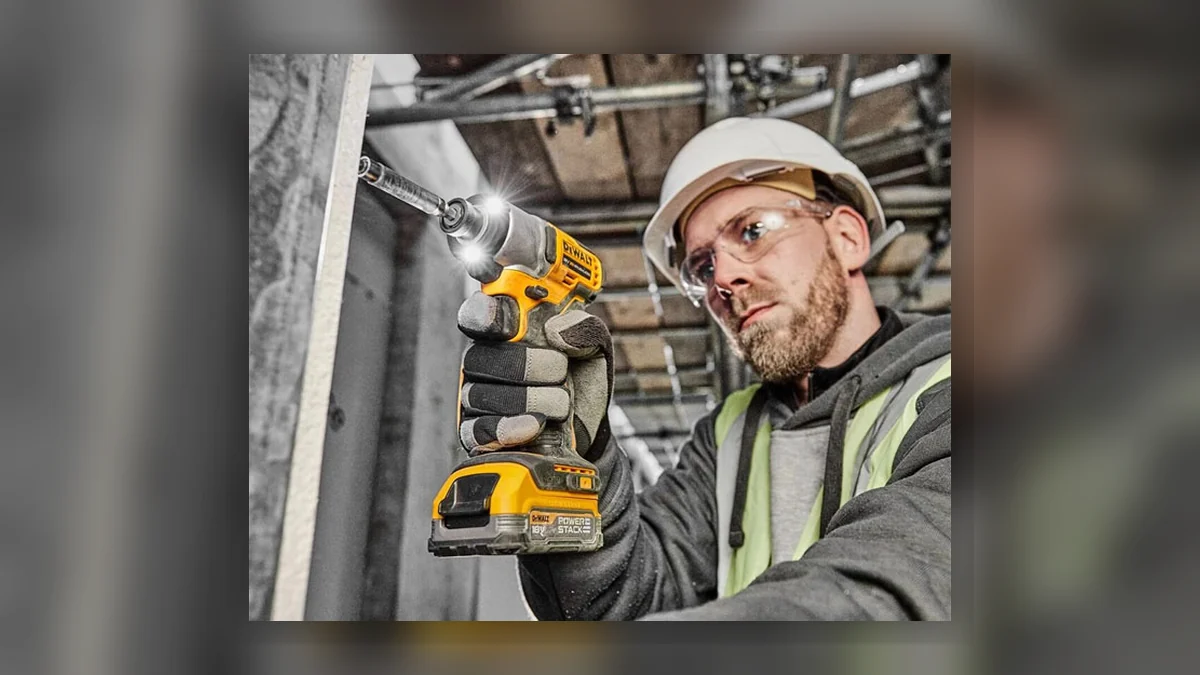
"Which drill should I buy?" usually turns out to be the wrong question, because combi drills, impact drivers and SDS drills solve different problems and none of them is a straight upgrade on the others. Before comparing specific models — torque figures, battery platforms, chuck sizes — it's worth working out which of the three categories actually fits the work, because buying the wrong category means owning a tool that's either overkill or underpowered for the jobs you do most.
Combi drill: the general-purpose default
A combi drill combines a rotary drill/driver with a hammer action for masonry, controlled through a keyed clutch that limits torque so you don't strip screw heads or overdrive fixings. It's the right starting tool for most UK trade and DIY work: drilling pilot holes in timber, driving screws with clutch control, and putting fixings into brick or block with the hammer function switched on. If you can only own one drill, a combi is almost always the right choice, because it covers timber, metal and light-to-medium masonry in a single tool.
Where a combi runs out of road is repetitive screwdriving — decking, fencing, plasterboard first-fix — and heavy or sustained masonry drilling, where its hammer action is noticeably slower and harder on the wrist than a purpose-built tool.
Impact driver: fast, high-volume screwdriving
An impact driver delivers rotational force in rapid, high-torque pulses rather than continuous rotation, which is what lets it drive long screws and lag bolts far faster than a drill and with much less kickback transmitted to the wrist. It has no clutch in the way a combi drill does, so it isn't built for delicate, torque-sensitive work like fitting hinges or driving into thin material where overdriving would split or strip it. Its natural home is high-volume fastening: decking boards, stud and joist work, fixing plasterboard, and any job where you're driving dozens or hundreds of screws in a session. Most UK trade users end up owning a combi drill and an impact driver as a pair — the drill for holes and delicate driving, the impact driver for volume fastening — rather than treating either as a replacement for the other.
SDS drill: dedicated masonry and concrete
An SDS (or SDS+/SDS-max for larger work) drill uses a different chuck and hammer mechanism to a combi drill's hammer action, delivering far more consistent impact energy into masonry and concrete without the bit binding or the motor labouring. This is the tool for structural masonry work — reinforced concrete, lintels, dense aggregate block, chasing out for cables or pipework — where a combi drill's hammer function will struggle or overheat under sustained use. If your work is mostly first-fix electrical or plumbing chasing, structural alterations, or any job cutting into solid concrete, an SDS drill earns its place in the kit even though it can't drive screws or drill fine timber the way a combi or impact driver can.
Choosing by job type
| If most of your work is… | Reach for a… | |---|---| | General DIY, flat-pack, shelves, occasional masonry | Combi drill | | Decking, fencing, stud work, plasterboard fixing in volume | Impact driver | | Structural masonry, concrete, chasing for cables or pipework | SDS drill | | Daily professional trade use across mixed materials | Combi drill + impact driver as a pair, with an SDS drill added if the work includes structural masonry |