
The drill itself gets most of the attention, but the bit does the actual cutting, and the wrong bit in the right drill still gives a poor result: a burnt-out hole in wood, a cracked tile, a masonry bit that won't touch reinforced concrete. This guide breaks down the main bit families by material so you can match bit to substrate rather than reaching for whatever's loose in the bag.
---
HSS (high-speed steel) twist bits — general metal and light-duty use
HSS bits are the standard twist-shaped bit most people picture when they think "drill bit." They're designed primarily for metal, and cobalt-alloyed HSS (often labelled HSS-Co or "M35/M42") holds an edge significantly longer in stainless steel and hardened metals than plain HSS. Black oxide or titanium-coated HSS bits add a wear-resistant surface layer, useful for extending life in mixed-material work, but the coating wears off with resharpening, so it's a bonus rather than the main spec to buy on.
HSS bits will also cut softwood and plastics reasonably well at low pressure, but they're not optimised for either. Run them too fast in wood and the point burns and glazes rather than cutting cleanly.
What to check: cobalt content for stainless and hardened steel; point angle (118° for general use, 135° split-point for self-centring on hard or curved surfaces without a pilot mark).
---
Masonry bits (carbide-tipped) — brick, block and light concrete
Masonry bits have a tungsten carbide tip brazed onto a steel shaft, shaped to fracture and grind masonry rather than cut it like a metal bit does. They're designed to be used with a drill's hammer action (or SDS hammer mechanism), which drives the carbide tip into the material in rapid pulses while it rotates. Used in rotation-only mode on dense masonry, a carbide bit will still make a hole, but far more slowly and with more heat build-up than in hammer mode.
Standard masonry bits (round shank, for combi drills) are suited to brick, blockwork and light-duty fixing holes, generally up to around 10-12mm diameter and moderate depths. Beyond that, or into harder engineering brick and concrete, SDS bits (see below) are the better tool.
What to check: carbide tip quality (four-cutter tips clear masonry dust more efficiently than two-cutter on larger diameters); shank type must match the chuck (round shank for keyless chucks, SDS Plus/Max for SDS drills — they are not interchangeable).
---
SDS bits — concrete, engineering brick and heavy masonry
SDS bits use a grooved shank that locks into an SDS chuck without tightening, and are built to transmit the hammer drill's striking energy far more efficiently than a round-shank masonry bit clamped in a standard chuck. SDS Plus bits (5-30mm) cover the great majority of on-site fixing and anchor work in concrete and block; SDS Max is for larger-diameter core drilling and heavy demolition work, and takes a different, larger shank format entirely.
SDS bits are not interchangeable with standard masonry bits, and a standard chuck can't grip an SDS shank at all.
What to check: flute design (fewer, deeper flutes clear dust faster in deep holes); tip style — a 4-cutter carbide tip drills straighter and lasts longer in reinforcing steel contact than a basic 2-cutter tip.
---
Wood bits: twist, spade, auger and Forstner
Wood drilling covers a wider range of bit shapes than any other material, because the jobs vary so much:
- Standard twist bits (often brad-point, with a centre spike for accurate starts) suit general-purpose holes up to around 10mm.
- Spade (flat) bits are fast, cheap, and good for rough holes up to 38mm or so, commonly used for running cables and pipes through joists. They tend to leave a rougher exit hole and can split timber near edges.
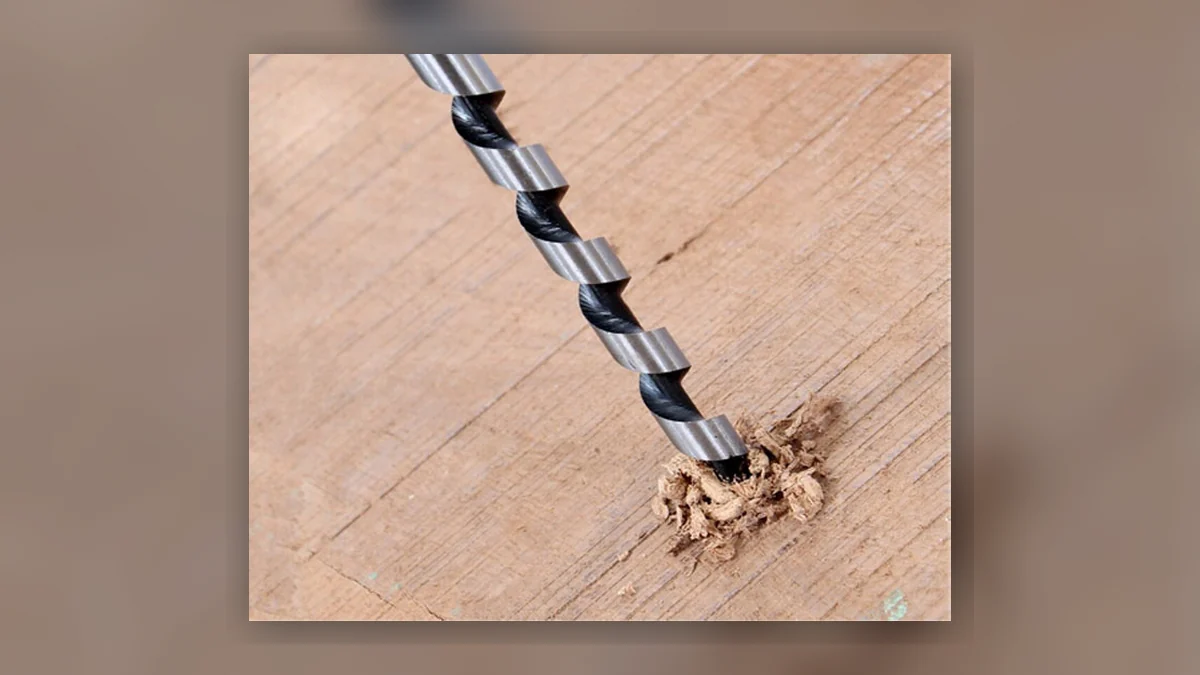
- Auger bits (single or double-flute, with a screw point that self-feeds) are the standard for deep, clean holes through joists and studwork, particularly with an SDS or right-angle drill for services work. The screw tip pulls the bit through the timber, reducing the physical effort compared with a spade bit.
- Forstner bits cut very clean, flat-bottomed holes, useful for hinge recesses and cabinetry work, but are slower and need steadier control than the other types.
What to check: for services work (cable and pipe runs through joists), a long-series auger bit in a right-angle or SDS drill will out-perform a spade bit on speed and hole quality; for visible joinery work, Forstner bits give the cleanest finish.
---
Tile and glass bits — diamond and tungsten-tipped
Tile, porcelain and glass need a bit designed to grind rather than cut, since the material is too hard and brittle for a standard cutting edge. Tungsten carbide-tipped spear-point bits handle standard ceramic tile at moderate cost; diamond-coated core bits (hollow, ring-shaped cutting edge) are the better choice for porcelain, which is significantly harder than standard ceramic tile and will blunt a basic tungsten tip quickly.
The critical technique point, more than the bit spec, is starting the hole: begin at a low speed with no hammer action, ideally with masking tape over the start point to stop the bit skating on the glazed surface, and keep the tip cool (some trades use a small amount of water) to stop it overheating and cracking the tile.
What to check: diamond-coated bits for porcelain and natural stone; tungsten spear-point is adequate for standard glazed ceramic tile; never use hammer action on tile or glass.
---
Quick reference
| Material | Bit type | Drill mode | |---|---|---| | Softwood, general holes | Twist or brad-point | Rotation only | | Structural timber, deep/service holes | Auger bit | Rotation only | | Cabinetry, hinge recesses | Forstner bit | Rotation only, low speed | | Mild steel, stainless | HSS or HSS-Cobalt twist | Rotation only | | Brick, block (light duty) | Carbide masonry bit | Hammer mode | | Concrete, engineering brick | SDS Plus/Max bit | SDS hammer | | Ceramic tile | Tungsten spear-point | Rotation only, no hammer | | Porcelain, natural stone | Diamond-coated core bit | Rotation only, no hammer, keep cool |
---