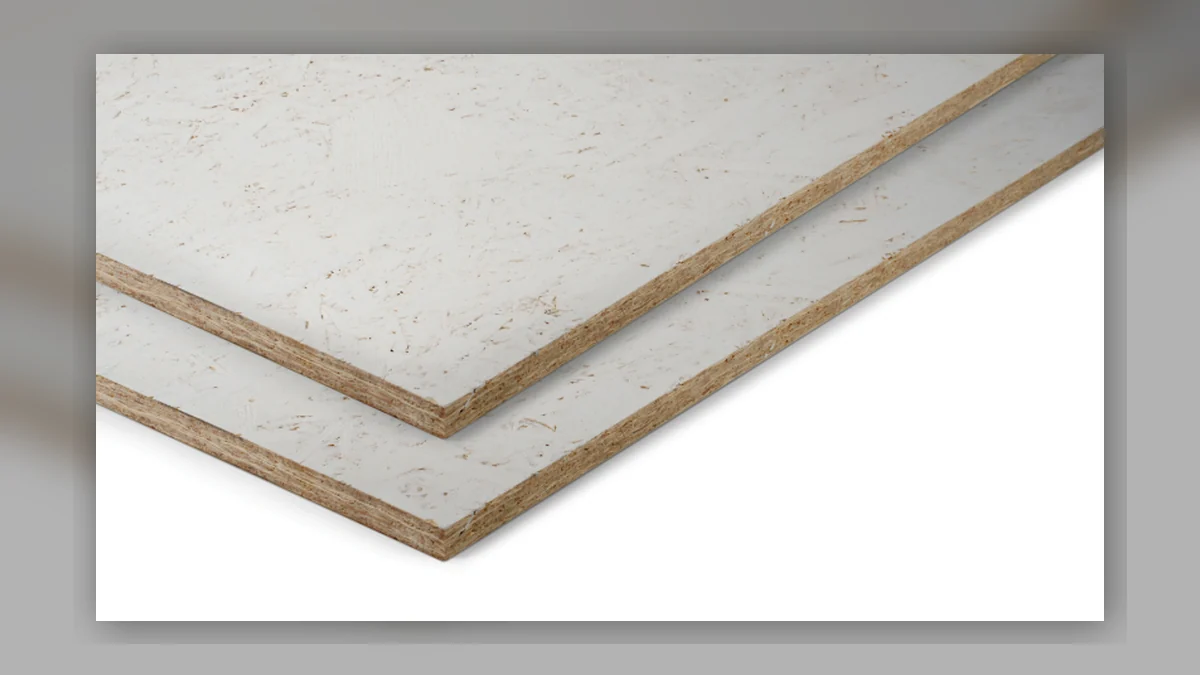
Jonathan Lynch, UK Building Products Manager at EGGER UK, has written for Professional Builder on sheathing board selection, making the case that standard OSB — while still the right board for most structural applications on cost, availability and workability — falls short in certain internal wall specifications where fire performance is the governing requirement. EGGER's answer is OSB Flammex, a board that combines structural function with improved reaction-to-fire classification.
Source: Professional Builder
This explainer covers what that actually means, and when it changes what you should be ordering.
---
The problem with standard OSB, stated precisely
OSB/3 is the workhorse board of UK timber frame. It racks well, it takes a nail gun, it is available everywhere, and it is cheap relative to plywood. What it is not is fire resistant.
Untreated OSB typically achieves Euroclass D-s2,d0 under BS EN 13501-1. Breaking that down:
- D — the reaction-to-fire class. Class D means the board makes a significant contribution to fire growth. For reference, the scale runs A1 (non-combustible, e.g. concrete), A2, B, C, D, E, F.
- s2 — smoke production, medium.
- d0 — no flaming droplets or particles.
For most timber frame applications that is acceptable, because the board is covered by plasterboard on the inside face and the wall's fire resistance comes from the lining, not the sheathing. Problems arise where the board is exposed during construction, where the lining is thin or absent, or where a specification calls for the structural layer itself to reach a higher class.
---
What "fire-rated OSB" actually is
Fire-retardant OSB works by introducing chemistry into the board rather than coating it. In manufacture, flame-retardant additives are blended into the strand mix before pressing, so the retardant is distributed through the board thickness rather than sitting on the surface.
That distinction matters on site for one specific reason: you can cut it without destroying the rating. A surface-applied intumescent coating is compromised the moment you rip a sheet or drill it. An integrally treated board keeps its classification on cut edges, which is the only practical option for a sheathing material that gets cut on every single sheet.
Boards of this type typically reach Euroclass B-s1,d0 or B-s2,d0 — two classes up from untreated OSB, with reduced smoke production.
EGGER's positioning for OSB Flammex, per the Professional Builder article, is structural strength plus ease of processing plus enhanced internal fire safety, which is the right three-way trade-off to describe: the point of the product is that it does not force you to give up the structural or workability properties to get the fire performance.
Source: Professional Builder
---
When you actually need it
Most jobs do not. Specifying a fire-retardant board where standard OSB/3 is compliant is wasted money. The situations where it earns its cost:
Internal separating walls where the board is part of the fire strategy. Where the designer has specified the sheathing layer to contribute to reaction-to-fire performance rather than relying on lining alone.
Buildings over 11m, and relevant buildings under the Building Safety Act regime. Combustible material restrictions in external walls of relevant buildings have tightened considerably since 2018, and while the restriction applies to the external wall construction specifically, the specification culture has shifted well beyond the strict legal minimum.
Exposed soffits, plant rooms, riser enclosures and service voids where board is left visible in the finished building.
Extended construction-phase exposure. On a frame that will be weathertight but unlined through a long programme, a lower-combustibility sheathing reduces the construction-phase fire risk that the Joint Code of Practice on fire prevention on construction sites concerns itself with.
Modular and offsite manufacture, where the insurance position on the factory and on stored completed modules increasingly drives the board choice.
---
Working with it on site
Practically, a fire-retardant OSB handles much like OSB/3, with a few differences worth knowing:
- Cutting. Same tooling — a circular saw with a fine-tooth TCT blade, or a track saw for clean sheet breakdown. Dust extraction matters as much as with any wood-based panel; wood dust carries a workplace exposure limit and OSB dust includes resin binder.
- Fixing. Nail and screw fixing as standard OSB. Follow the manufacturer's fixing centres — typically 150mm at panel edges and 300mm intermediate for racking performance, but check the specific board's technical sheet, because racking values are fixing-dependent.
- Moisture. Flame-retardant treatment does not confer moisture resistance. Check whether the board is rated for humid conditions (the OSB/3 equivalent) or dry conditions only, because a fire-rated board in a dry-only grade will fail in a construction-phase soaking.
- Edge sealing. Worth doing on any OSB left exposed to weather during the programme, regardless of fire grade.
- Evidence. If the board is in the specification for its fire classification, keep the delivery documentation and the declaration of performance. Under the Building Safety Act regime, being able to demonstrate what was installed is the point.
---
The honest summary
This is manufacturer-authored trade coverage, so treat the product claims as manufacturer claims. But the underlying point is independent of EGGER: the fire performance of the structural layer is being scrutinised in UK construction in a way it was not ten years ago, and "the plasterboard handles the fire rating" is no longer an answer that holds up in every specification.
If you are a contractor buying boards off a spec, the action is simply to check whether the spec names a Euroclass — and if it does, not to substitute standard OSB/3 for a like-for-like price saving. If you are specifying, the question is whether the sheathing is doing fire work or only structural work.
---