
Brand: Knauf Insulation
---
Knauf Insulation has launched a free online embodied carbon calculator, and it is a useful moment to explain why this matters to UK contractors and what embodied carbon actually means in practice. The term has moved from academic to procurement in the space of a few years, and specifiers who do not understand it are increasingly at a disadvantage when responding to planning authorities and developer requirements.
The difference between embodied carbon and operational carbon
Operational carbon is the carbon produced by using a building: heating it in winter, cooling it in summer, running lights and appliances. Insulation reduces operational carbon by keeping heat in. This is the part of the story that the construction industry has focused on for thirty years and it remains important.
Embodied carbon is the carbon produced in making and transporting the materials used to build something, before anyone moves in. Mining and processing raw materials, running manufacturing plant, transporting products from factory to depot to site, and packaging and disposal all generate greenhouse gas emissions that are counted as embodied carbon.
The two do not always point in the same direction. A material with high embodied carbon can still be the right choice if its operational carbon savings over the life of a building outweigh the manufacturing impact. But a material with low embodied carbon and good thermal performance is, all else being equal, the better choice.
Why embodied carbon is now a specification issue
The UK government's Net Zero commitments, combined with changes to Part L of the Building Regulations and the Future Homes Standard timeline, have created a chain of requirements that now reaches into material selection. Some local planning authorities, particularly in London and the South East, are already requiring embodied carbon assessments as part of planning submissions. This requirement is expected to spread to more authorities as national policy catches up with the leading local plans.
For main contractors, this translates into a responsibility to document material choices with lifecycle data. For subcontractors and installers, it translates into questions from clients and architects about whether the products they are installing can be evidenced against an embodied carbon benchmark.
Manufacturers who can provide calculator tools, Environmental Product Declarations (EPDs), and product-level data are easier to specify under these conditions. Those who cannot are being moved down the shortlist.
What an embodied carbon calculator actually does
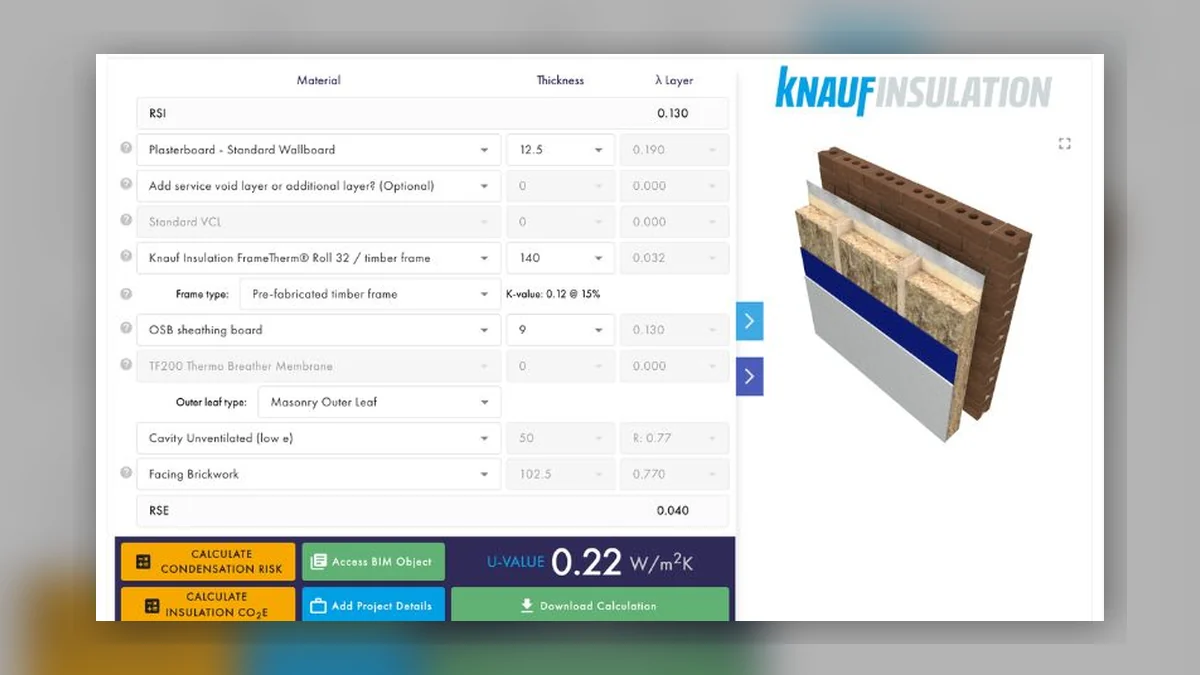
A calculator of this type takes the mass of a product installed, applies the embodied carbon factor for that material (usually measured in kilogrammes of CO2 equivalent per kilogramme of material, or per square metre at a given thickness), and produces a total embodied carbon figure for the installation.
Knauf Insulation's free tool allows specifiers to work through this calculation without needing to own or operate lifecycle assessment software. For a small practice or a contractor team without a dedicated sustainability consultant, that is meaningful.
The output is a number that can be used in planning applications, in client reporting, and in comparison against alternative products. If you are comparing two brands of mineral wool insulation and one can show a lower embodied carbon figure per square metre, that is a legitimate specification argument.
What insulation types look like on embodied carbon
This is a genuinely complex area because there is no single answer, and the comparison depends on factors including product density, manufacturing method, and transport distance. As a general orientation:
Mineral wool and glass wool products (including Knauf's own range) typically have moderate embodied carbon figures. They are manufactured from sand and recycled glass or from rock, which are abundant materials, and they are produced in large volumes in UK-based factories, which reduces transport emissions.
Rigid foam insulation boards (PIR and PUR products) tend to have higher embodied carbon per kilogramme because of the chemical inputs to their manufacture, but they achieve higher thermal performance at thinner thicknesses, which changes the per-unit comparison.
Wood fibre and hemp-based insulation products typically have very low or even negative embodied carbon figures because the raw material absorbed CO2 during its growing phase. However, availability and cost can vary considerably.
The point is not that any single material is always the answer, but that having the embodied carbon figure available allows a specifier to make an informed trade-off rather than relying on incomplete comparisons.
How to access the Knauf calculator
The calculator is free to use and available via Knauf Insulation's UK website: knaufinsulation.co.uk. No registration or software purchase is required.
---
What is embodied carbon in construction?
Why is embodied carbon becoming important in UK planning?
What is an Environmental Product Declaration (EPD)?
Which insulation material has the lowest embodied carbon?
Is the Knauf Insulation embodied carbon calculator free?
Do I need to calculate embodied carbon as a subcontractor?
- Professional Builder
- Knauf Insulation UK: knaufinsulation.co.uk