Walk into any builders' merchant and the drill section is one of the most confusing. Combi drills, hammer drills, impact drivers, SDS Plus drills, SDS Max drills: they all make holes, but they do it in very different ways and suit very different jobs. Buying the wrong one is a waste of money. Buying the right one for your trade can save hours on every job.
This guide cuts through the marketing language and explains what each type of drill actually does, who it suits, and what to look for when you are choosing.
---
The three main types of drill
1. Combi drill (combination hammer drill)
A combi drill is the workhorse of the building site. It does three things: standard rotation drilling (for wood, metal and plastics), hammer drilling (for masonry and brick), and screwdriving with a clutch to stop you stripping heads or snapping fixings. Most combi drills take standard round-shank drill bits up to around 13mm, held in a keyless chuck.
The hammer function on a combi drill works by physically bouncing the chuck forwards and backwards thousands of times a minute while it rotates. Think of it like a tiny pneumatic drill scaled down to handheld size. This percussive action breaks into brick and mortar, which pure rotation alone cannot do efficiently. A combi drill in hammer mode is fine for fixing things into brick and block, drilling through cavity wall ties, or running cables through masonry.
Who it suits: Almost every trade. Electricians, plumbers, carpenters, general builders and multi-traders all reach for a combi drill dozens of times a day. If you buy one drill, this is it.
What to look for:
- Voltage: 18V cordless is the industry standard. It gives enough torque for almost every trade application without the bulk of a larger format.
- Torque rating: measured in Newton metres (Nm). Think of torque like wringing out a wet cloth. A drill with 80Nm of torque can apply more twisting force before the clutch kicks in than one rated at 40Nm. For general use, 60Nm or above is adequate. For heavy joinery or large-diameter screws, look for 80Nm or more.
- Weight: matters for all-day use. Under 1.8kg (without battery) is comfortable for most overhead or repetitive work.
- Battery platform: if you already own tools from Milwaukee, Makita, DeWalt, Bosch or another brand, stay within that platform so batteries are interchangeable.
---
2. Impact driver
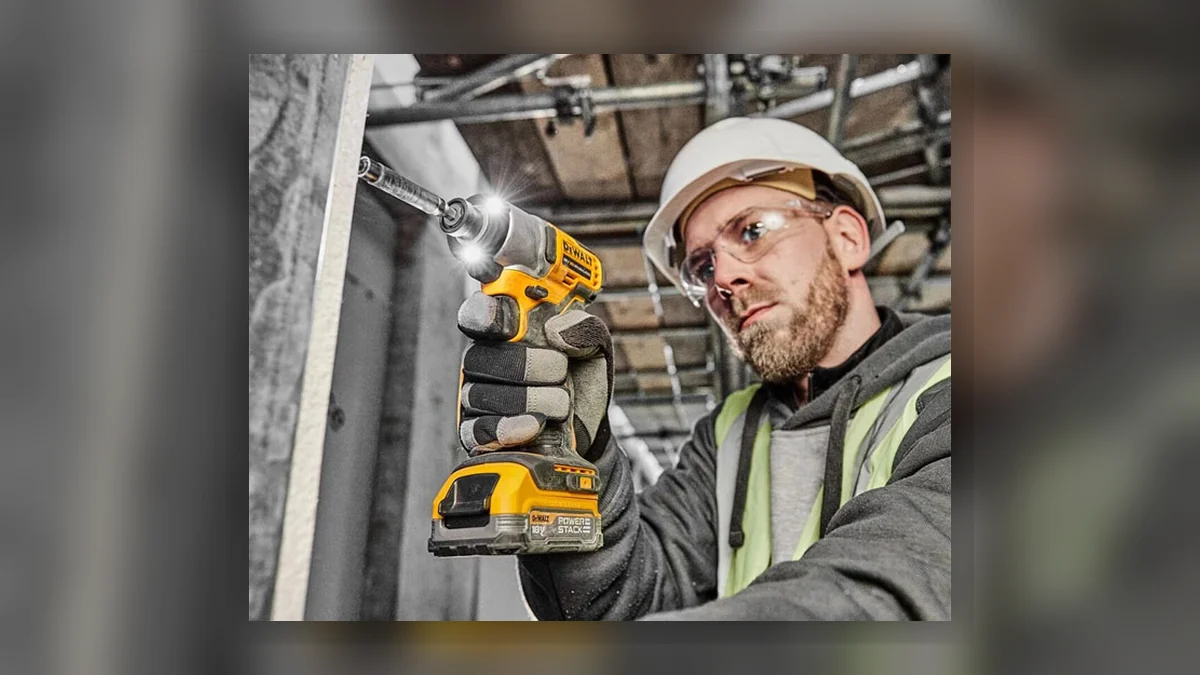
An impact driver looks a bit like a combi drill but works on a completely different principle. Instead of a smooth electric motor turning a chuck, an impact driver uses a hammering mechanism inside the head that delivers rapid, rotational impacts. When the tool senses resistance (like a screw going tight), the hammer strikes the anvil dozens of times per second, driving the fastener without stalling.
The practical effect: an impact driver will drive a 150mm structural screw through hardwood without stripping the head or twisting your wrist. Try that with a standard drill and you will either strip the screw, snap it, or hurt yourself fighting the reaction torque. Impact drivers are also far lighter and more compact than combi drills for the same power output.
Impact drivers use hex-shank bits (1/4-inch hex) rather than a chuck. This means standard drill bits do not fit without an adapter. Impact drivers are not ideal for drilling precise holes or for jobs needing careful torque control.
The rated torque on impact drivers is often given as IPT (Inch Pounds Torque) or Nm and looks eye-watering. A top-end 18V impact driver might claim 340Nm of impact torque. To put that in context: 340Nm is roughly the force you would need if you had a 34cm-long spanner and applied 10kg of force to the end of it. That is more than enough to snap a lower quality bit if you are careless, but in practice the hammering action distributes the force so efficiently that it feels manageable.
Who it suits: Carpenters, decking fitters, structural joiners, steel erectors, roofing contractors and anyone who drives large volumes of screws. Many tradespeople carry both a combi drill and an impact driver on the same battery platform.
What to look for:
- Impact rate (impacts per minute): higher IPM means faster driving. Look for 3,500 IPM or above for heavy structural work.
- Bit grip quality: look at how securely the collet holds bits. Cheap impact drivers lose bits under vibration.
- Size: sub-compact models (shorter, lighter) suit tight spaces like battened ceilings or cabinet carcasses. Full-size models hit harder.
---
3. SDS drill (SDS Plus and SDS Max)
SDS is a bit-retention system developed by Bosch, standing for Steck, Dreh, Sitz (insert, turn, lock) in German. SDS bits do not need to be tightened into a chuck; they click straight in and the bit is free to slide back and forth slightly while the drill hammers. This makes SDS drills dramatically more effective than combi drills for anything more than occasional light masonry work.
SDS Plus is the standard format for most on-site use: drilling fixings into concrete, running cables through block walls, anchor bolt holes, rawl bolt installations. Bits come in sizes from 5mm up to around 30mm. SDS Plus drills can usually also be set to hammer-only mode (no rotation), which is handy for chipping out tiles or breaking small amounts of render.
SDS Max is a larger, heavier format for serious demolition and very large-diameter core drilling. Max bits have a bigger shank that carries more energy per strike. If you are core drilling 100mm+ holes through reinforced concrete, you need SDS Max.
The striking energy of an SDS drill is measured in joules. One joule is roughly the energy of a small apple falling one metre. A combi drill in hammer mode might deliver around 1 to 1.5 joules per strike. An SDS Plus drill delivers 2 to 5 joules per strike. An SDS Max goes from 8 joules upwards. That difference is what makes concrete that would barely mark under a combi drill crumble quickly under a proper SDS.
Who it suits: Any trade drilling into concrete, dense blockwork or stone regularly. Electricians chasing out walls, plumbers core-drilling for pipework, groundworkers fixing anchors, heating engineers going through foundations.
What to look for:
- Impact energy (joules): for general fixing work, 2.5 to 3.5J is the sweet spot. For core drilling large holes, look for 5J or above.
- Vibration rating: SDS drills generate significant vibration. Check the manufacturer's rated vibration figure (m/s2) and cross-reference with HSE hand-arm vibration guidance for daily exposure limits if you use an SDS drill heavily.
- Corded vs cordless: cordless SDS Plus is now mainstream and perfectly capable for most anchor-bolt and fixing work. For all-day core drilling or very large diameter holes, corded models deliver more consistent power output.
---
Quick decision guide
| Job | Best drill type | |---|---| | General screwdriving and drilling in wood, metal | Combi drill | | Driving large volumes of screws | Impact driver | | Fixing into brick and block (occasional) | Combi drill in hammer mode | | Fixing into concrete (regular) | SDS Plus | | Core drilling 50mm+ holes in concrete | SDS Plus or SDS Max | | Heavy chiselling and demolition | SDS Max |
---
Battery platforms: stay consistent
If you are building a toolkit from scratch, choose a brand with a wide product range and commit to its battery platform. The major platforms in the UK trade market are Milwaukee M18, Makita 18V LXT and 40V XGT, DeWalt 18V/54V FlexVolt, Bosch Professional 18V and Ryobi ONE+. All these platforms run their full drill ranges from the same batteries, so one set of batteries serves your combi drill, impact driver, SDS Plus and any other tools in the family.
Mixing platforms means carrying multiple chargers, multiple battery types and multiple sources of confusion. Unless you have a compelling reason to use a different brand for a specific tool, the savings elsewhere in a unified platform are real.
---