
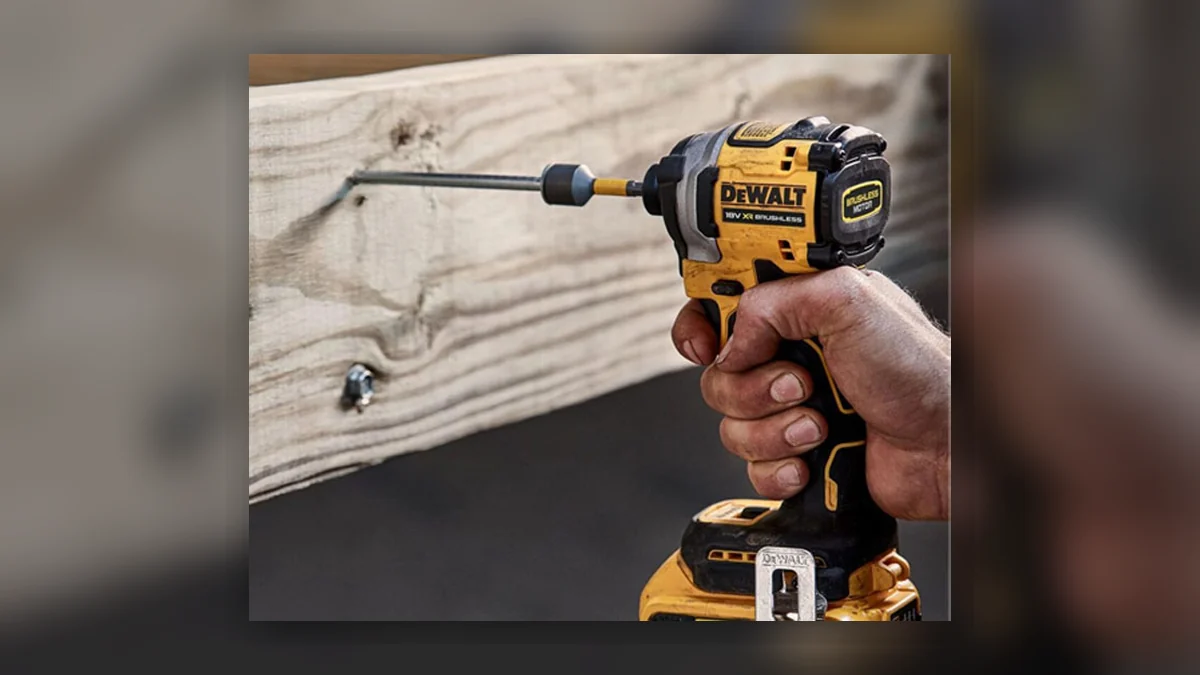
The impact driver is the tool that quietly replaced the drill as the thing most tradespeople actually pick up. If you are driving screws all day — decking, studwork, roofing battens, kitchen carcasses, plasterboard — a combi drill is the wrong tool and an impact driver is the right one. Understanding why comes down to one mechanism.
---
How an impact driver works, and why it matters
A drill/driver applies pure rotational torque through a gearbox. The motor turns, the chuck turns, and everything the tool produces is fed back into your wrist. When the screw gets tight, the tool stops turning and you start turning instead — that sudden wrist-wrenching kick.
An impact driver applies rotation too, but when resistance rises past a threshold, a spring-loaded hammer inside the tool disengages, spins up and strikes an anvil in the rotational direction. It does this hundreds of times per minute, typically 3,000-4,000 impacts per minute (IPM) on a modern 18V tool.
Three consequences follow, and they are the whole reason the tool exists:
Reaction torque disappears. The impact energy is delivered as a series of very short blows, over before your arm can react to them. A tool producing 180Nm of torque through impacts is comfortable one-handed; a drill producing the same torque continuously would break your wrist.
Cam-out drops sharply. Cam-out — the bit riding up out of the screw head and chewing the recess — happens under sustained rotational load. The impact mechanism applies force in pulses, and between pulses the bit reseats. This is why an impact driver drives long screws with less axial pressure than a drill.
Screws go in that a drill would stall on. A 150mm structural screw into dry softwood, or a coach screw into a joist, is a routine job for an impact driver and a genuine struggle for a mid-range combi.
The trade-off is that impacts are noisy, and the pulsing is poor at anything requiring fine control or a genuinely round hole.
---
Impact driver vs combi drill vs impact wrench
| Tool | Chuck | What it's for | What it's bad at | |---|---|---|---| | Combi drill | 13mm keyless | Drilling holes, hole saws, light masonry (hammer mode), controlled screwdriving with a clutch | High-torque screwdriving, sustained fastening | | Impact driver | ¼" hex quick-release | Driving screws and hex-head fasteners at speed and volume | Precise torque control, large drill bits, delicate fixings | | Impact wrench | ½", ⅜" or ⅜" square drive | Nuts, bolts, wheel nuts, scaffold fittings, anchor bolts | Screws — the square drive takes sockets, not bits |
Most trades genuinely need two of these. A combi drill plus an impact driver — which is why the twin kit is the standard entry point on every platform. Adding an impact wrench is a third purchase, worth it if you deal with bolts rather than screws. Our combi drill vs impact driver vs SDS guide covers the wider platform decision, and impact wrench vs impact driver covers the confusion between the two impact tools.
---
The specs that matter (and the ones that don't)
Maximum torque (Nm)
The headline figure, and the most misleading. Manufacturers quote maximum torque under laboratory conditions, and there is no common standard governing how they measure it, so cross-brand comparison is unreliable.
Rough guidance for what you actually need:
- Up to 140Nm: more than adequate for general screwdriving, first and second fix, plasterboard, kitchen fitting. Most sub-compacts sit here.
- 150-200Nm: the mainstream full-size range. Handles decking screws, structural timber screws, coach screws.
- 200Nm+: heavy timber framing, large structural fixings, occasional bolt work. Genuinely useful for carpenters and roofers, overkill for a sparky.
If you are driving 5mm×100mm screws all day, a 180Nm tool and a 250Nm tool feel almost identical. The extra matters at the top of the range only.
Impacts per minute (IPM)
Typically 3,000-4,000. Higher IPM generally means faster driving of long fasteners. It is a secondary consideration to torque and speed control.
No-load speed (RPM)
Usually 0-3,000rpm. What matters more is whether the tool has multiple speed modes — most decent tools offer three or four. Low speed is for starting screws accurately and for small fixings; high speed is for volume driving.
Precision / self-tapping / assist modes
Increasingly common and genuinely useful. These modes drive slowly until the screw bites, then ramp up — which stops self-drilling screws walking across metal, and stops small screws in soft material being driven straight through. Some tools add an auto-stop mode that cuts power the instant impacting begins, for fixings that must not be overdriven.
What doesn't matter much
Battery voltage on its own tells you almost nothing about a tool's capability — an 18V brushless impact driver comfortably out-performs an older 24V brushed one. Chuck "quality" is largely uniform across brands, since almost all use the same ¼" hex quick-release standard.
---
Brushless or brushed?
For an impact driver specifically, brushless is worth paying for. The tool spends its life under high, intermittent load, which is exactly the duty cycle where brushed motors lose efficiency to heat and wear their brushes.
Brushless gives you: roughly 30-50% more work per charge, meaningfully more torque from the same battery, a cooler-running and longer-lived motor, and a shorter tool body because the motor is more compact.
Brushed is defensible if: you use it genuinely occasionally, and the price gap on a specific kit is large. For any daily-use trade tool, it is a false economy.
Nearly every mainstream 18V impact driver sold new in the UK is now brushless. Brushed models persist mostly in entry-level DIY ranges and older platform stock.
---
Size: sub-compact, standard, or high-torque
Sub-compact. Around 100-110mm head length, sub-1kg bare. Typically 130-170Nm. The right choice for electricians, kitchen fitters, plumbers and anyone working in cabinets, consumer units, joist voids and ceiling grids. The length difference sounds trivial and is not — 25mm of head length is the difference between reaching a fixing and not.
Standard. Around 115-125mm. 150-210Nm. The default. If you buy one impact driver and do varied work, buy this.
High-torque / heavy-duty. Longer, heavier, 220Nm+. Carpentry, timber frame, structural fixing, decking at volume. Fatiguing for overhead work.
Right-angle. A specialist body for working between joists and studs where nothing else fits. Lower torque, and a second tool rather than a replacement — see our right-angle impact driver guide.
---
Battery platform: the decision that outlasts the tool
The tool will be superseded in three years. The battery platform you commit to will still be with you in ten. Before comparing individual tools, ask:
- What do you already own? Buying bare tools on an existing platform is a fraction of the kit price.
- How wide is the range? If you expect to add a grinder, a SDS drill, a site light and a vacuum, check they exist on that platform in the UK.
- Are batteries backward-compatible? Most major platforms are, but check when a brand has introduced a new high-output cell format.
- What's local availability like? A platform your nearest merchant stocks is worth real money on a Friday afternoon.
For most UK trades this comes down to Makita LXT/XGT, DeWalt XR/FlexVolt, Milwaukee M12/M18, Bosch Professional 18V, Ryobi ONE+ or Erbauer/Titan on the merchant-brand side.
---
Bits: the part people get wrong
An impact driver will destroy ordinary screwdriver bits, and quickly. Standard S2 steel bits are hardened for torsional strength; the repeated shock loading of an impact mechanism finds the brittleness and snaps them.
Buy impact-rated bits. These use a slightly softer, more ductile steel with a torsion zone — a deliberately narrowed section in the shank that flexes under each impact and absorbs the shock rather than transmitting it to the tip. They last many times longer in an impact driver, and they are marked as impact-rated on the packaging.
Get the size right. The single biggest cause of chewed screw heads is a PZ2 bit in a PZ1 screw, or a Phillips bit in a Pozidriv screw. Pozidriv has four extra small ribs between the main slots; Phillips does not. They are not interchangeable, and using one in the other guarantees cam-out.
Consider bit holders carefully. A magnetic bit holder adds reach and lets you swap bits without touching the chuck, but adds around 60-75mm of length — which defeats the point of buying a sub-compact.
Torsion-zone vs impact-rated is not the same claim. Some "impact" bits are simply softer steel with no torsion zone. The better ones state a torsion zone explicitly.
---
Corded impact drivers
They exist, and almost nobody buys them. The impact driver's core advantage is one-handed, cable-free work at height and in awkward positions, and a lead removes most of that. Unless you have a specific fixed-bench application, buy cordless.
---
What to actually buy
If you're a sparky, plumber or kitchen fitter: a sub-compact brushless 18V impact driver, around 140-170Nm, paired with a compact 2.0Ah battery for weight. Length beats torque for your work.
If you're a general builder or carpenter: a standard brushless 18V, 180-210Nm, with 4.0-5.0Ah batteries. The all-rounder.
If you do decking, timber frame or structural fixing: a high-torque model, 220Nm+, and accept the extra weight.
If you're buying your first cordless kit: a twin pack of combi drill and impact driver on a mainstream platform, with two batteries and a charger. Every brand sells one; it is comfortably the best value entry into a platform.
If it's for occasional DIY: a mid-range brushless 18V single-tool kit is plenty, and a brushed model is defensible if the price gap is significant.
---