
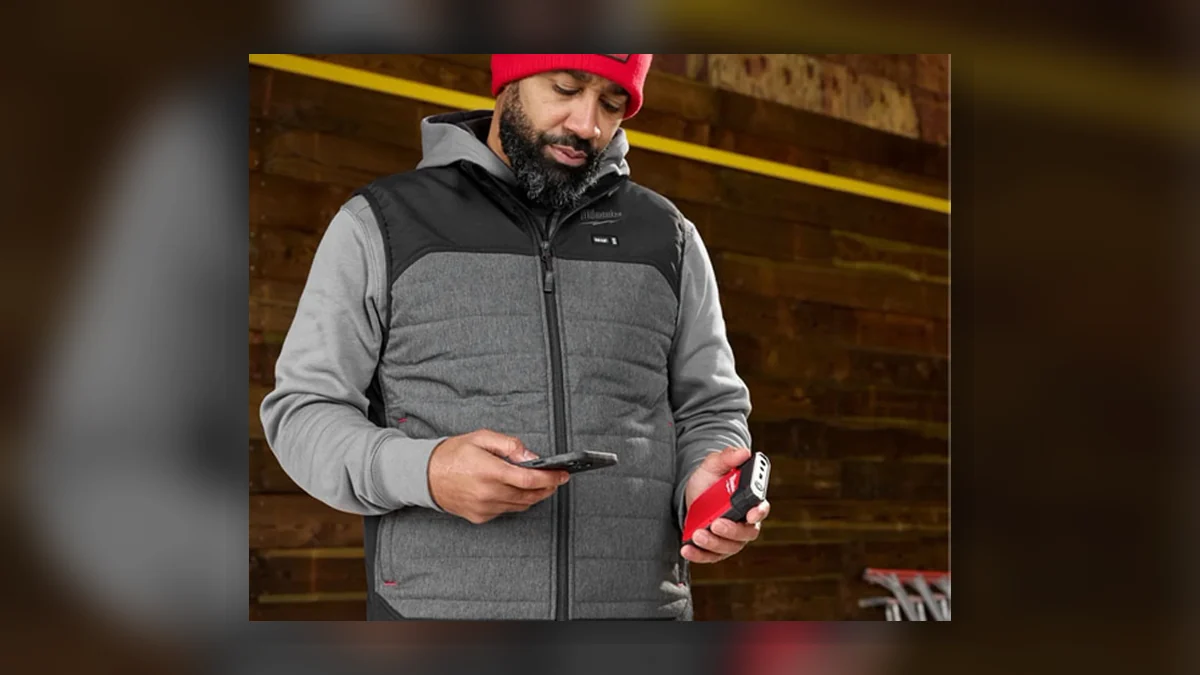
Heated workwear has been on the UK market long enough that most tradespeople have formed an opinion, and that opinion is often "warm in three patches, cold everywhere else." Milwaukee's HEXON Heat Technology is a direct response to that complaint, and understanding what it changes tells you whether the newer generation of heated gear is worth the money or whether your existing jacket is fine.
---
The problem HEXON is designed to solve
Conventional heated garments run a small number of discrete heating pads — typically three, at the chest and mid-back — connected by wiring. Each pad is a fixed panel, and the heat radiates outward from it. That produces exactly the experience people describe: hot spots directly over the pads, and cold gaps between them, particularly across the shoulders and the lower back where you actually get cold on a windy scaffold.
The pads also have a physical consequence. A stiff panel in a jacket lining is something you feel when you reach overhead, and it is the part that fails first when a garment gets folded, stuffed in a bag and sat on for two winters.
What HEXON actually changes
HEXON replaces the discrete-pad layout with a tubular honeycomb pattern of carbon fibre heating elements distributed across the coverage area — chest, back and shoulders — rather than concentrated in a few panels. Milwaukee states this delivers 40 times more coverage within the same garment footprint.
Three practical consequences follow from that design:
- Even heat rather than hot spots. Spreading the element across a honeycomb network means the heated area is continuous rather than patchy. This is the difference most users notice first.
- Faster time to temperature. Milwaukee quotes maximum heat in under two minutes. A distributed element with more surface area in contact with the garment reaches working temperature faster than a small pad heating a large surrounding area by conduction.
- Better heat retention and adaptation. Milwaukee describes the gear as staying warmer for longer and adapting to conditions regardless of environment or battery charge, which in practice means the control electronics modulate rather than simply switching a fixed element on and off.
Carbon fibre as the element material matters too: it is flexible, so it moves with the garment instead of creating a stiff panel, and it is more resistant to the flex-fatigue failure that kills wire-based elements.
The power source and app control
The second half of the story is the Heated Gear Power Source with App Control. Paired with HEXON garments via the Milwaukee Heated Gear app, it gives:
- 10 heat levels, rather than the conventional low/medium/high three-step.
- Independent heat zone activation — chest, back and shoulders can be run separately.
- Run-time personalisation, letting the user trade heat against battery life.
Independent zone control is the feature with real on-site value, and it is not a gimmick. If you are working overhead with your back to the wind, running the back and shoulders only and leaving the chest off does two things: it keeps you warm where you are actually losing heat, and it roughly doubles the useful run time from the same battery.
Does heated gear earn its place on a UK site?
Honest answer: it depends entirely on how you work.
It earns its place if you spend long periods stationary or slow-moving in cold conditions — groundworks in January, scaffolding, roofing, external plant maintenance, anything on a cold site where you are not generating body heat through movement. Heated gear is essentially a way of not having to wear four layers you then can't work in.
It probably does not if you are mostly on the tools indoors, in and out of a warm van, or working hard enough to be sweating in a base layer by ten in the morning. A good windproof softshell and a decent merino base layer will serve you better and cost a fraction as much.
The other consideration is the ecosystem. Heated gear runs on the same M12 batteries as the rest of Milwaukee's sub-compact line, which is a genuine advantage if you are already on M12 and a genuine cost if you are not — a jacket plus a battery and charger is a materially different purchase from a jacket alone. If you already carry M12 for an inspection camera, a right-angle driver or a copper press tool, the marginal cost is just the garment.
A note on layering that people get wrong
Heated gear works by warming the air layer next to you, so it needs an outer layer that holds that air in. Wearing a heated jacket as the outermost layer in wind is close to useless — the heat is stripped away as fast as it is generated. Run the heated garment as a mid-layer under a windproof shell, or buy a heated jacket that is itself windproof, and the run time and effectiveness both improve substantially.
---