
Image credit: West Fraser / Professional Builder (reference only)
---
Plasterboard is the default internal lining for most UK building projects. It goes up fast, takes skim or dry lining direct, and the trade knows it well. But timber panel manufacturer West Fraser has been making the case for oriented strand board (OSB) as a practical and more sustainable alternative in certain applications.
This is not a fringe argument. OSB is already widely specified in structural applications across the UK. The question is whether it makes sense on the wall or ceiling where plasterboard would normally go, and for which projects.
Here is what builders, self-builders, and specifiers need to understand.
---
What is OSB?
Oriented strand board is a wood-based panel made from strands of timber that are compressed and bonded together with resin under heat and pressure. The strands are arranged in layers at right angles to each other, which gives the panel strength in both directions. Think of it as a structural panel, similar in concept to plywood but made from smaller wood pieces that are engineered to create a consistent product.
OSB comes in grades. OSB/3 is the most common grade used in construction in the UK. It is rated for use in humid conditions, which makes it more versatile than basic grade options for building applications.
The sheets are typically 2400mm by 1200mm, the same size as a standard plasterboard sheet, which means they fit the same stud spacings and work with the same handling workflow on site.
---
Why is plasterboard in landfill a problem?
This is the environmental argument at the centre of West Fraser's guidance, and it is a real one.
Plasterboard is made primarily from gypsum, a sulphur-containing mineral. When plasterboard goes to landfill and breaks down in wet anaerobic conditions (which is what happens underground), the gypsum releases hydrogen sulphide gas. Hydrogen sulphide is toxic and has a distinctive rotten egg smell even at very low concentrations. At higher concentrations it is dangerous to people and harmful to the wider environment.
In the UK, regulations around plasterboard disposal in landfill have tightened significantly over the past decade because of this. Plasterboard is technically classified as hazardous waste in landfill, which adds cost and complexity to disposal. On a project generating a lot of offcuts and waste plasterboard, this disposal route is both expensive and environmentally problematic.
OSB, being a timber product, does not carry this issue. Wood waste can go to general waste or biomass recovery. It does not produce toxic gases as it breaks down.
---
Where OSB can replace plasterboard
OSB is not a like-for-like swap in every situation. Understanding where it works and where it does not is what makes the choice useful.
Substrate for tiling OSB is a strong, stable substrate for tiling in dry internal areas. Tiles fixed to OSB with the correct flexible adhesive will perform well. The panel does not have the same risk of paper-face damage from moisture that plasterboard carries.
Structural linings and racking Where a wall needs to provide racking resistance as part of the structure, OSB is the correct answer. Plasterboard alone does not provide structural resistance. In timber frame buildings, OSB sheathing on the structural panels is standard practice for this reason.
Shopfitting, industrial interiors, and utility spaces Garages, workshops, sheds, plant rooms, and similar utility spaces benefit from OSB over plasterboard. OSB is harder and more impact-resistant. You can fix shelving, brackets, and cable runs directly into it without searching for studs. And if you mark it, scratch it, or put a hole in it, it does not collapse the way a dented plasterboard face does.
Self-build and Passivhaus projects In airtight construction such as Passivhaus buildings, OSB is often used as the airtightness membrane as well as the internal lining. Taped OSB joints provide a reliable airtight layer when done properly. Plasterboard requires separate membranes to achieve the same result.
---
Where plasterboard still makes more sense
For standard residential habitable rooms where a smooth decorative finish is the end goal, plasterboard remains the practical choice for most UK builders. It takes skim and paint well. It is lighter to handle than OSB. And the decoration trades are set up to work with it.
Fire performance is also a consideration. Specific fire-rated plasterboard products are tested and certified for applications where a particular fire resistance period is required. OSB does not have the same fire resistance characteristics. In projects where Building Regulations fire performance requirements are critical, the specification needs careful thought and sign-off.
OSB is also rougher to look at when left unfinished in habitable spaces. Builders fitting out a room to a domestic standard will need to paint it, clad it, or find another way to address the surface.
---
The sustainability case in plain terms
The case West Fraser is making is essentially this: if a material ends up in landfill at the end of a building's life, what happens to it there?
Gypsum plasterboard produces toxic gas. OSB, as a timber product, is carbon-storing during its life in the building and far less problematic at end of life. Timber grown and harvested from responsibly managed forests (look for FSC or PEFC certification) also has a much better carbon footprint at the point of production than the gypsum mining and processing required for plasterboard.
For builders working with clients who are asking sustainability questions, particularly on new builds, extensions with eco ambitions, or projects targeting EPC ratings, this is a useful set of facts to have in the bag.
---
What this means on site
The practical changes if you are switching from plasterboard to OSB in an appropriate application are relatively minor.
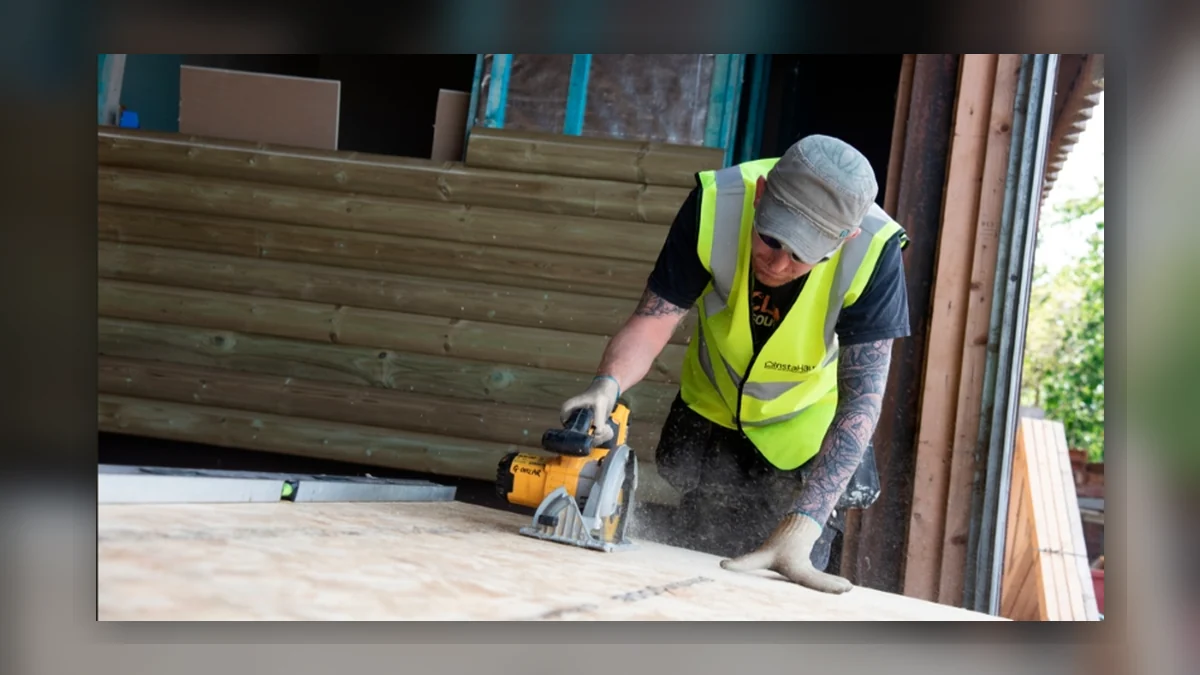
Cutting is the same: circular saw, jigsaw, or track saw. OSB is harder than plasterboard, so blades wear faster, but standard wood-cutting blades handle it fine.
Fixing is the same: screws or nails into studs, the same stud spacing requirements apply. OSB accepts fixings well and holds them reliably.
Finishing is different: OSB will not take skim without a primer coat first, and the surface texture will show through thin finishes. If you want a smooth painted finish, use a good quality primer designed for timber panels and expect to apply two coats of top coat. Or specify a different finish material over the OSB.
Weight is also different: OSB/3 at 18mm is heavier than standard 12.5mm plasterboard. Not dramatically so, but worth accounting for when lifting large sheets overhead on your own.
---