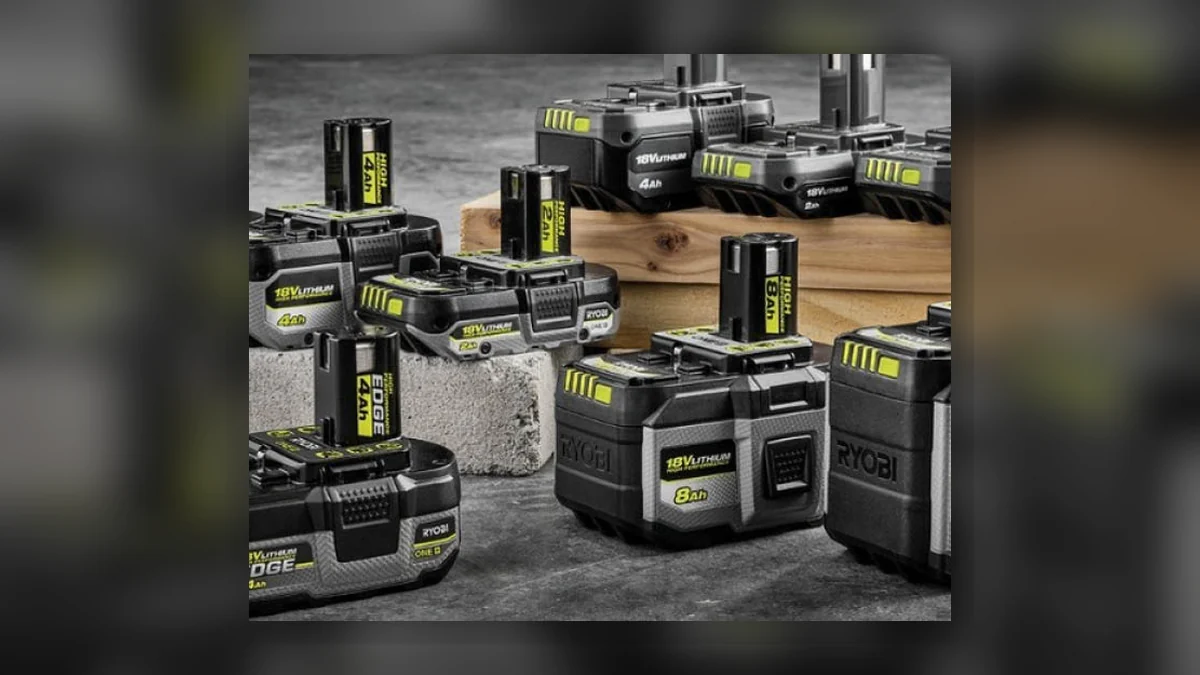
The Ryobi ONE+ system is built around a single battery platform. The principle is simple: one battery, over a hundred tools, no need to buy a separate battery for every new product you add to your kit. In practice, however, compatibility is not always as straightforward as that headline suggests. Different tools make different demands on the battery, and the wrong combination can leave a tool underpowered or reduce the battery's working life.
This guide sets out how Ryobi ONE+ battery interchangeability actually works, which batteries suit which tasks, and what to look for when expanding your Ryobi kit.
How the Ryobi ONE+ System Works
Every Ryobi ONE+ tool runs on an 18V lithium-ion battery. The battery connector is the same across the range, which means any ONE+ battery will physically fit into any ONE+ tool. That is the fundamental promise of the ONE+ platform and Ryobi has maintained that connector consistency since the system launched.
The practical implication is that if you already own a Ryobi ONE+ drill and you buy a Ryobi ONE+ jigsaw, the same battery goes straight into the new tool without any adapter, converter, or additional purchase. You can run a full workshop from a single set of batteries if you choose your tools within the ONE+ family.
Not All ONE+ Batteries Are Equal in Performance
Physical compatibility does not guarantee performance compatibility. A 1.5Ah battery (which holds roughly enough charge to run an average cordless drill for around 20 to 25 minutes of continuous use) will work in a Ryobi ONE+ circular saw, but the saw will run for a much shorter period before needing a recharge. It may also struggle under load if the motor demands more current than the smaller pack is designed to deliver continuously.
To put that in terms a tradesperson can work with:
A 1.5Ah battery is suited to light tasks and occasional use. Think detail sanding, trimming, or using a torch or radio. It is fine for a homeowner doing occasional DIY, but it will frustrate anyone trying to work through a full day's drilling or cutting.
A 2.0Ah or 2.5Ah battery is a reasonable middle ground for moderate-duty work. Drilling fixings, light cutting, or driving screws intermittently across a working day. If you mainly use your Ryobi tools for occasional tasks and keep two or three batteries cycling, this range will serve you well.
A 4.0Ah or 5.0Ah battery is the working tradesperson's choice. More charge means longer run time between swaps, and higher-capacity cells can typically sustain peak current demands from motors under load without dropping voltage as sharply. If you are cutting sheet material, driving long screws into timber, or running a reciprocating saw on a sustained demolition task, a larger battery will outperform a smaller one from the same range.
Backwards Compatibility: Older ONE+ Tools and Newer Batteries
Ryobi has maintained the 18V ONE+ connector across generations of the range, which means newer high-capacity batteries will fit older ONE+ tools. In most cases the tool will work normally. There can be exceptions with very early ONE+ tools from more than a decade ago, where firmware or cell chemistry differences may cause issues, but for tools purchased in the last five to eight years there should be no significant compatibility problem.
The reverse is also relevant: older, smaller batteries will still work in newer ONE+ tools. The tool will function, but run time and sustained power output will be lower than with a matched, current-generation battery.
Batteries to Avoid in Heavy-Duty Tools
Ryobi's ONE+ range includes some demanding tools: angle grinders, circular saws, random orbit sanders, and in some configurations, heat guns. These tools draw significantly more current than something like a drill driver or a detail sander. Pairing them with a 1.5Ah compact battery is likely to result in the battery protection circuit cutting out under load, reduced performance, and faster battery wear.
For anything in the heavier power tool category, a 4.0Ah or 5.0Ah battery is the practical minimum for a working day. If the budget allows, Ryobi's 6.0Ah pack gives the best run time and handles current spikes from demanding tools more comfortably.
Charging and Charger Compatibility
All Ryobi ONE+ batteries use the same charger connector, so a standard ONE+ charger will charge any ONE+ battery regardless of capacity. Charge times obviously vary: a 1.5Ah battery charges faster than a 5.0Ah, and a faster charger (Ryobi makes rapid chargers alongside the standard options) will reduce waiting time between runs.
If you are working on site with limited power access, two batteries and a rapid charger keeps most people productive: one battery in the tool, one charging.
Summary: The Practical Rules for Ryobi ONE+ Compatibility
Match battery capacity to the tool's demand. Any ONE+ battery physically fits any ONE+ tool. Performance depends on choosing the right capacity for the job:
- Light duty (torches, radios, detail sanders): 1.5Ah to 2.0Ah is fine.
- Moderate duty (drills, drivers, jigsaws): 2.5Ah to 4.0Ah keeps you working without constant swaps.
- Heavy duty (circular saws, angle grinders, reciprocating saws): 4.0Ah minimum, 5.0Ah or 6.0Ah preferred for sustained work.
Source: ITS Hub
---