Mixing up screw drives is one of the most common causes of stripped heads and stalled jobs on site, and most of the confusion comes down to two or three tip shapes that look similar at a glance but behave very differently under torque. Knowing which drive you're looking at before you pick up a driver saves rounded-off screw heads, damaged bits and repeat call-outs.
Flathead (slotted)
The oldest drive type, a single straight slot across the screw head. Flathead is still specified for slot-head woodscrews, some electrical terminal screws, and older fixtures and fittings, but it has a real weakness: the driver tip can slip sideways out of the slot under load, an effect known as cam-out. That makes flathead a poor choice for anything driven with a powered driver at speed — hand tightening with a manual screwdriver gives you the control to avoid slipping. Sizes are given in millimetres of blade width and thickness.
Phillips
The cross-shaped drive most people recognise, designed with a slight taper in the arms of the cross so the driver self-centres in the screw head. Phillips is common across general assembly work, from flat-pack furniture to appliance screws, and it was originally designed to cam out deliberately at a set torque to protect against over-tightening on early production lines. On site that same cam-out tendency becomes a nuisance with a powered driver, because it strips the screw head before you reach full torque, particularly in softwood or plasterboard. Sizes run PH0 to PH4, with PH2 covering the vast majority of general fixings.
Pozidriv (Pozi)
Pozidriv looks like Phillips at first glance but has straight-sided arms plus four small secondary tick marks set at 45 degrees between the main cross. That extra contact surface was engineered specifically to reduce cam-out compared with Phillips, giving a more positive drive under power tool torque. Pozidriv is the standard drive for most UK screws sold for construction and joinery — decking screws, chipboard screws, drywall screws are almost always Pozi. Using a Phillips bit in a Pozidriv screw (or the reverse) will seem to work briefly before it chews the head up, because the profiles are close enough to seat partially but not correctly. Check for the tick marks before assuming Phillips.
Torx (star drive)
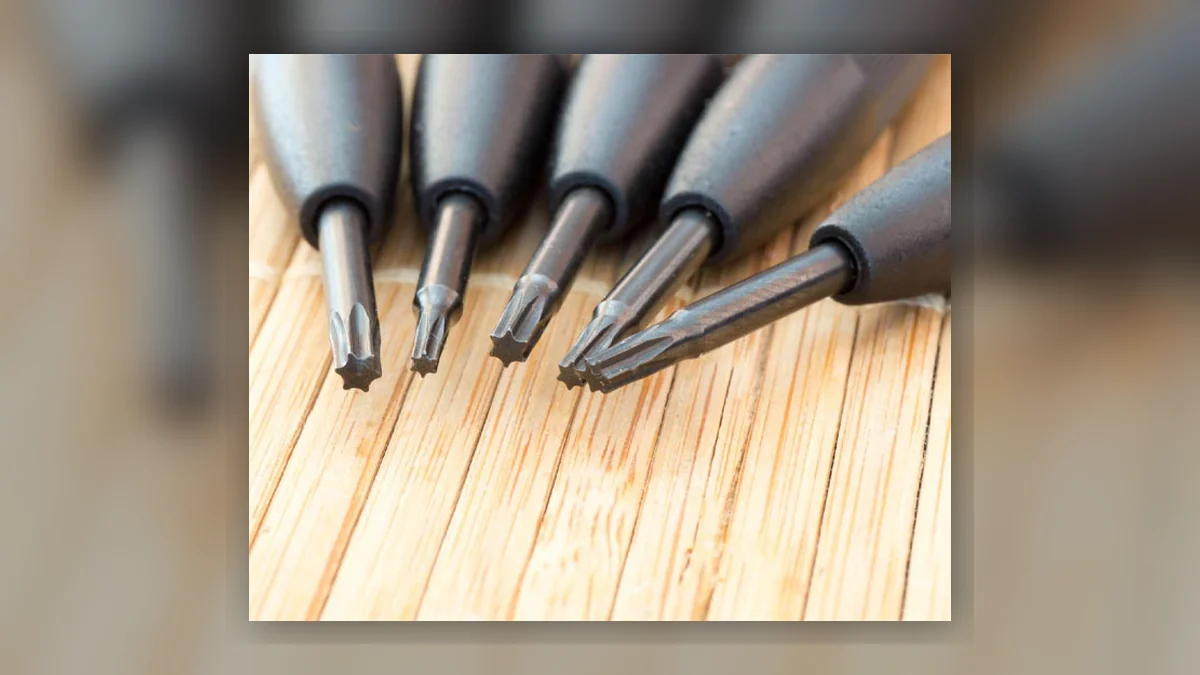
A six-point star-shaped recess that gives far more contact area between bit and screw than either cross-head design, which all but eliminates cam-out and allows much higher torque to be applied without the bit slipping. Torx is specified heavily in automotive work, machinery assembly, and increasingly in decking and construction fixings where high torque and repeated use are involved — it's also the standard tamper-resistant option when a centre security pin is added to the recess (Torx security, sometimes labelled TR or Torx Plus). Sizes are given as T- numbers, from T6 for small electronics up to T50+ for heavy fixings, with T20 and T25 the most common sizes for site work.
Hex (Allen)
A plain hexagonal socket, driven with a hex key or hex-shaped bit, used widely on furniture fittings, machine bolts, and grub screws. Hex gives good torque transfer for its size and is cheap to produce, which is why flat-pack furniture leans on it so heavily, but a worn or slightly undersized key will round the socket out quickly under real force. Sizes are given in millimetres (metric) or fractions of an inch (imperial, common on older or US-sourced fittings) — check which system you're dealing with before assuming a key will fit.
Robertson (square drive)
A square-shaped recess, tapered slightly to help the bit stay seated in the screw without the user holding pressure — genuinely useful for one-handed working at height or in awkward positions. Robertson is the standard drive across Canada and is turning up more often in UK-sourced construction and decking screws because it resists cam-out about as well as Torx while being cheaper to produce. Sizes are colour-coded by the manufacturer (commonly green, red, black and yellow for increasing sizes) rather than numbered in a single universal standard, so colour-matching your bit to the screw head is the quickest way to check.
VDE (insulated) drivers
VDE isn't a tip shape but a safety standard: screwdrivers built and tested to withstand up to 1,000V, with insulated shafts and handles rated for live electrical work. Any electrician working on or near live circuits in the UK should be using VDE-rated screwdrivers as standard, and the tip shape (flathead, Phillips, Pozi or Torx) is specified separately from the VDE rating. Check for the VDE mark and voltage rating stamped on the shaft — a driver without it is not rated for live work regardless of how well insulated the handle looks.
Why the wrong driver strips screws
Every cam-out failure starts the same way: the bit doesn't fully seat in the recess, so torque is transmitted through a smaller contact area than the drive was designed for, and the metal deforms rather than turning the screw. Worn bits make this worse even on the correct drive type, because a rounded or chipped tip no longer fills the recess properly. Keeping a full set of Pozi, Phillips, Torx and hex bits in good condition, replacing them once the tip visibly rounds, and matching the bit size to the screw rather than forcing a close-but-wrong fit will avoid the vast majority of stripped fixings on site.