
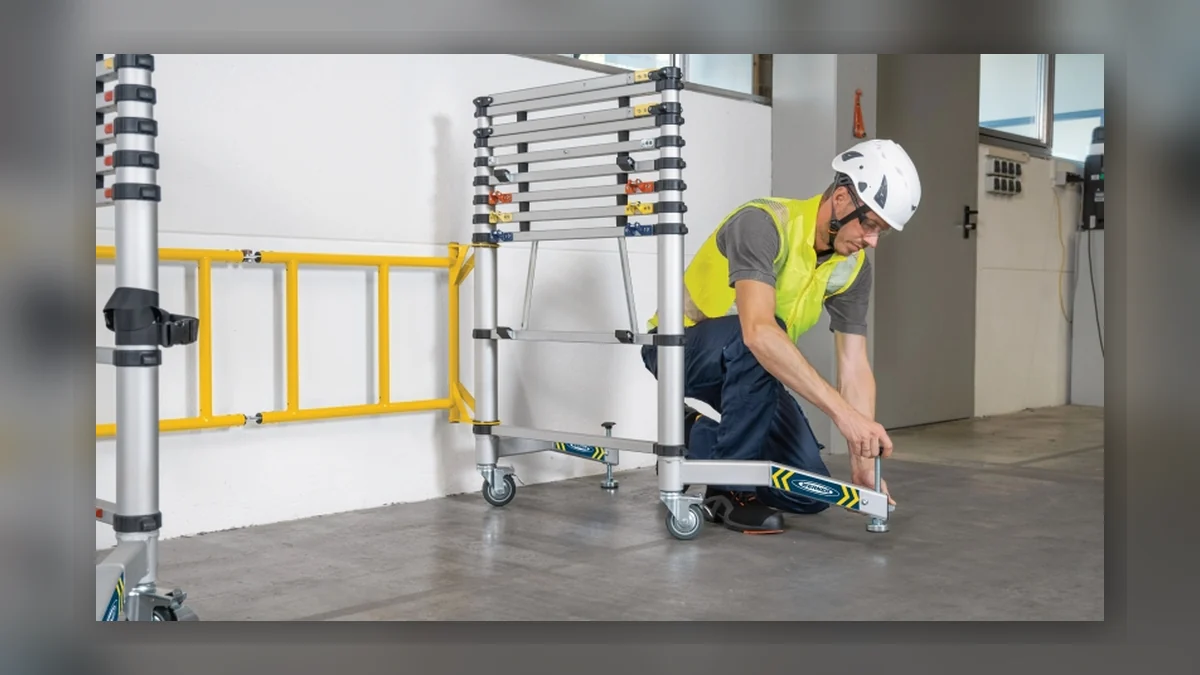
A telescoping access tower is one of those tools that trades use constantly and rarely think much about until something goes wrong. Werner has updated its Telescopic Tower with a focused safety improvement: integrated rung bumpers that address one of the most common minor injury points on this type of equipment, the moment when rungs close back on fingers during assembly or adjustment.
What changed
The updated Telescopic Tower adds rung bumpers built directly into the tower design. When the tower is being extended or collapsed, the bumpers create additional spacing between the rungs, keeping a gap open at the pinch points where fingers are most likely to get caught. This is not a retrofit or accessory; it is a design refinement to new units coming through now.
The change targets the assembly phase. Telescopic towers work by having rungs that slide inside each other as you extend the frame. The gap between rungs narrows to nothing during that movement, and a hand or finger in the wrong place at the wrong moment is the result. Rung bumpers maintain a minimum clearance, giving you time to clear the work area before the section closes.
Dave Elson, Compliance Manager at Werner, described the Telescopic Tower as "a popular choice among trade professionals" and the update as making it "even safer and easier to use."
Specs and configurations
The Telescopic Tower is available across five platform heights: 1.1m, 1.3m, 1.55m, 1.75m and 2.0m. At its maximum platform height of 2.0m, you are working at a total height of around four metres when you factor in arm reach, which covers the vast majority of single-storey interior jobs: ceiling work, high-level fixings, painting, plastering, and light fitting without a separate scaffold contract.
One person can erect the tower in around three minutes. For a sole trader or small crew where setting up and breaking down quickly matters, that erection time is a real operational factor. A full scaffold tower takes considerably longer and needs more storage space in the van.
Who this affects
If you own an earlier model of the Werner Telescopic Tower, the rung bumpers are part of new units rather than a retrofit. That means the update does not apply automatically to your existing tower. If you are buying new, units with the bumpers are coming through now. If you are a fleet buyer or site manager specifying access equipment, worth noting the updated design when renewing stock.
For tradespeople who are working at height regularly under the Work at Height Regulations 2005, the principle of selecting equipment with reduced injury risk at each opportunity is good practice, and an integrated design fix is a more reliable control than a procedure-based one.
How the Telescopic Tower compares to alternatives
The Werner Telescopic Tower sits between a traditional stepladder and a full scaffold tower in terms of what it offers. A podium step or platform ladder gives a working height of roughly 1.5 to 2.5 metres and takes seconds to set up, but offers a smaller working platform and less stability on uneven ground. A full modular scaffold tower reaches higher and is more stable at altitude, but takes time to assemble, needs more components, and is harder to move between rooms. The Telescopic Tower covers the middle ground: a proper platform, up to four metres working height, and fast setup.
Werner is the global market leader in ladders and access equipment, and the UK range covers everything from household stepladders to industrial platform towers and podium steps. The Telescopic Tower is part of the professional range.
---