
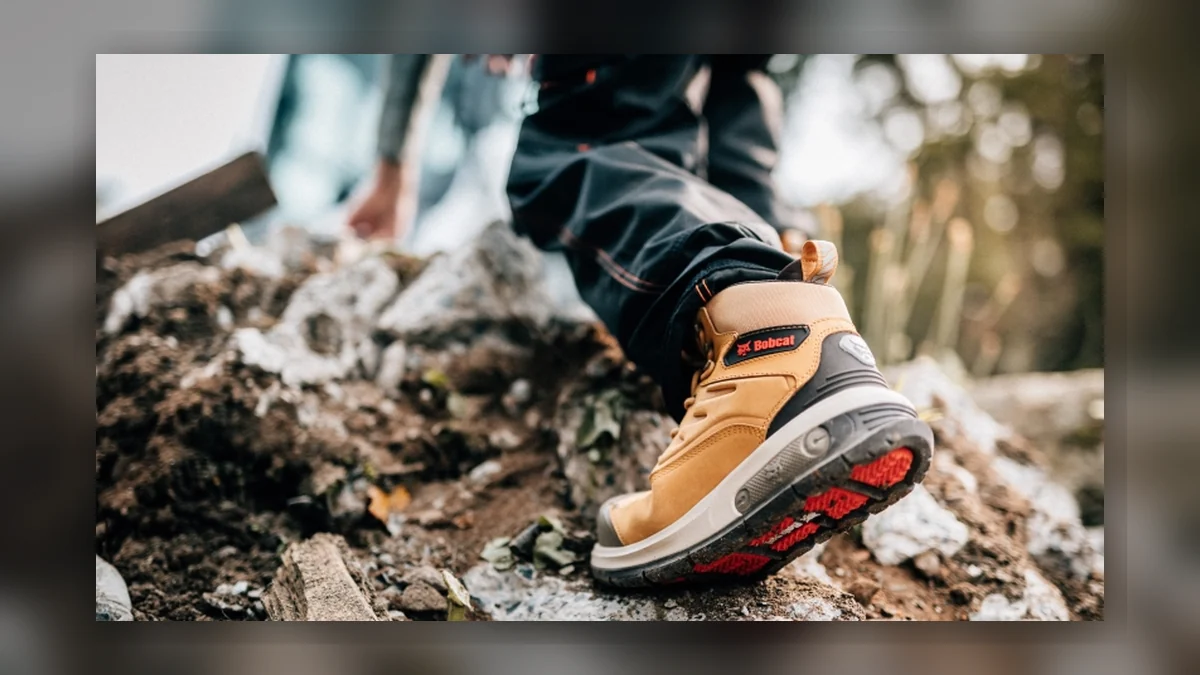
Overland Shoes, the company behind the Bobcat Safety Footwear range, has used the back-to-school moment to make a point that most tradespeople put off until it is already raining: the boots that got you through a dry summer are frequently not the boots you want for a British autumn.
It is a manufacturer making a seasonal case for its own range, so treat the timing accordingly. But the underlying point stands, and it is worth being specific about what actually changes when the weather turns and what you should be checking on your own boots before it does.
---
What actually goes wrong in wet weather
Three failure modes, in rough order of how likely they are to hurt you:
1. Grip on wet, contaminated surfaces. Slips, trips and falls remain one of the largest single causes of workplace injury in UK construction. A worn outsole that is perfectly adequate on dry timber becomes marginal on wet scaffold boards, muddy site tracks, wet steel and site-office lino tracked with rain. Tread depth is the thing to inspect: once the lugs are worn flat across the ball of the foot, the boot is finished for wet-weather work regardless of how sound the upper looks.
2. Water ingress. Wet feet are not merely uncomfortable. Once the sock is soaked, insulation drops toward zero, and a full day in wet boots in single-digit temperatures is a genuine cold injury risk on exposed sites. It is also how you end up with the skin problems that plague the trade over winter.
3. Cold transmission through the sole. Standing on cold concrete or frozen ground for hours draws heat straight out through a thin sole. This is the failure people rarely diagnose correctly — they blame the boot's insulation when the problem is sole construction and standing still.
---
Decoding the safety ratings
The EN ISO 20345 standard was revised in 2022, and the marking system changed with it. If you are buying boots this autumn you will see the newer codes, and they are not intuitive:
| Marking | What it means in practice | |---|---| | SB | Base level: toe cap protection only (200 joules). | | S1 | SB plus closed heel, antistatic, energy-absorbing heel. No water resistance. | | S1P | S1 plus penetration-resistant midsole. | | S3 | S1P plus water-penetration-resistant upper and cleated outsole. The traditional site standard. | | S3S | Newer code: S3-equivalent with the updated penetration resistance and water resistance requirements. | | S7 / S7L | Newer codes for waterproof (not merely water-resistant) footwear; L denotes a ladder-grip outsole feature. | | WR | Whole boot tested waterproof, not just the upper. | | HRO | Outsole resistant to hot contact (300°C for 60 seconds) — relevant for roofing and hot works. | | SRC / SR | Slip resistance markings; the 2022 revision changed how these are expressed, so check the specific test conditions rather than assuming. |
The distinction that costs people money: *water-resistant upper* (the S3 requirement) is not the same as *waterproof boot* (WR / S7). An S3 boot resists water soaking through the leather for a defined test period. It does not guarantee the boot stays dry after eight hours in standing water. If you work in groundworks, drainage or on saturated ground, you want a WR or S7-class boot, not an S3 with a good reputation.
---
What to look for, specifically
Waterproof membrane, or waterproof leather? A membrane (the boot equivalent of a breathable liner) keeps water out while allowing some vapour transmission, so feet sweat less. Premium waterproof leather with sealed seams can perform well but is more dependent on maintenance. Bobcat's autumn and winter models — the Omaha and Fargo boots — are built around heavy-duty waterproof leather with breathable linings; the Summit mid-height boot adds ankle rigidity alongside slip and water resistance.
Ankle height. A mid or high boot is not just about ankle support. On muddy ground, a low-cut safety shoe lets water and grit over the top before the waterproofing has a chance to matter.
Outsole compound and tread pattern. Deep, widely spaced lugs shed mud rather than packing with it. A tread that clogs turns into a smooth sole within twenty metres of a wet site track. Look at lug spacing, not just depth.
Shock absorption and fatigue. Bobcat's range uses Redbacks Leaf Spring Technology, a suspension-style midsole intended to absorb shock and reduce fatigue through the feet, knees and back. Whatever the branding, the principle is worth understanding: standing on hard surfaces all day is a cumulative load, and midsole construction is what determines whether you feel it in your knees by Thursday.
Metal-free construction. Composite toe caps and non-metallic penetration-resistant midsoles are lighter, do not conduct cold, and do not set off site metal detectors. Most of the Bobcat range is metal-free with composite toe caps and puncture-resistant midsoles. The trade-off is that composite caps are bulkier than steel for the same protection rating, so fit matters more.
Fit range. The Bobcat collection runs to 14 styles across men's and women's fits, with ratings from S3S to S7L. Women's-specific lasts rather than downsized men's boots are still not universal in safety footwear, and they make a real difference to whether a boot is wearable for ten hours.
---
Before you buy: check what you already have
Five minutes with your current boots will tell you whether you need new ones:
1. Turn them over. Are the lugs across the ball of the foot worn flat? If yes, replace — this is the wet-weather failure point. 2. Flex the sole. Cracking across the flex point means water gets in regardless of how good the upper is. 3. Check the toe cap area. Delamination between sole and upper at the toe is where site boots usually let go first. 4. Look at the tongue gusset. A bellows tongue that has torn away from the upper makes a "waterproof" boot pointless. 5. Wet test. Stand in a puddle for two minutes. If the sock is damp, the boot is done for winter.
---