
Ali Murtaza, Design Services Technician at ACO House & Garden, has written for Professional Builder on managing rainwater as a climate resilience measure, framing the UK's now-annual pattern of summer heatwaves and regional droughts alongside the intense rainfall events that follow them. The argument is that surface water runoff and water capture are two halves of the same problem, and that both land on the groundworker and the drainage contractor.
Source: Professional Builder
---
The problem, stated plainly
UK rainfall is not necessarily increasing overall so much as arriving differently — longer dry spells punctuated by shorter, heavier downpours. That combination is awkward for drainage because it stresses a system at both ends:
Dry ground sheds water. Baked clay and compacted soil have dramatically reduced infiltration rates. Rain that would soak away in March runs straight off in August, so the peak flow into a drainage system after a dry spell is higher than the same rainfall would produce in wet conditions.
Urban creep has removed the buffer. Front gardens converted to hardstanding, side returns paved, extensions built over what was lawn. Every square metre converted from permeable to impermeable adds to the volume the public sewer has to take.
Combined sewers overflow. Large parts of the UK sewer network still carry foul and surface water in the same pipe. When surface water volume spikes, the result is a combined sewer overflow — which is the mechanism behind a good deal of the sewage discharge coverage of recent years.
---
What this means on the job
For trades, the practical consequences are already appearing in specifications and in what building control will accept.
The drainage hierarchy in Part H. Approved Document H sets an order of preference for surface water disposal: soakaway or other infiltration system first, watercourse second, sewer last. On new build and on extension work, demonstrating you have worked down that hierarchy rather than defaulting to the sewer connection is increasingly expected rather than optional.
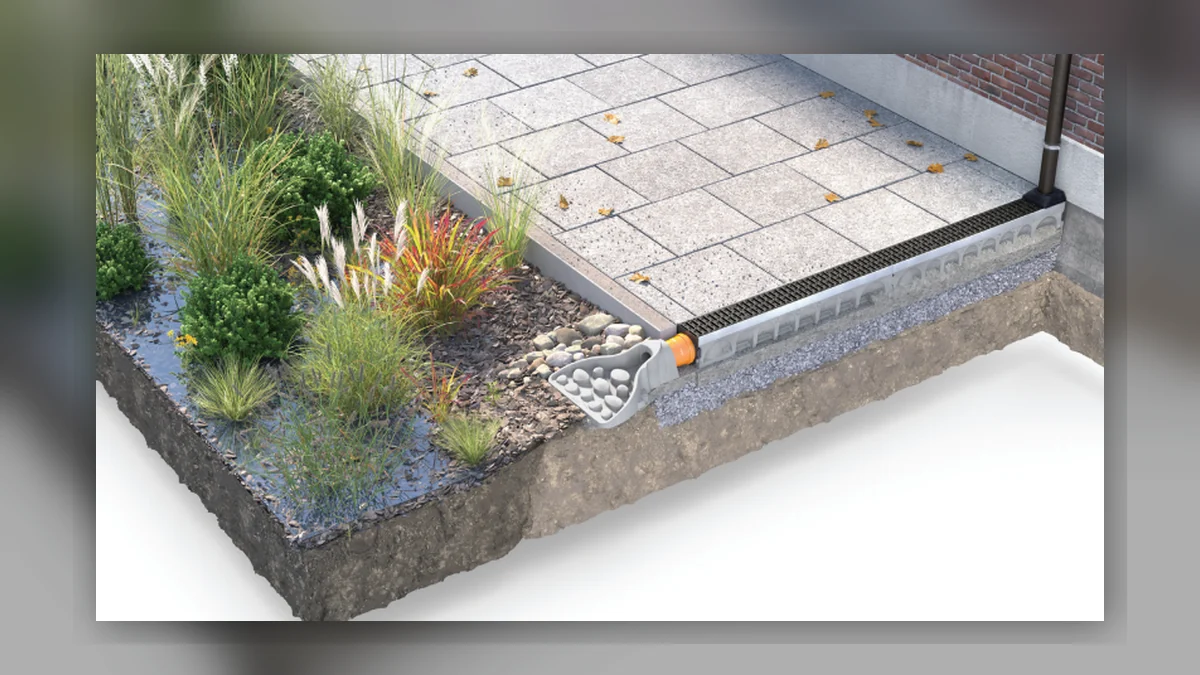
Paving and permeability. Since 2008, laying impermeable hardstanding over more than five square metres in a front garden in England has required planning permission unless the water is directed to a permeable area within the property. That rule is widely ignored and increasingly enforced. Permeable block paving, gravel over a geotextile, or a channel drain discharging to a soakaway all avoid the application.
Attenuation on new build. Sustainable drainage — crates, permeable sub-bases, swales, rain gardens — is routine on new developments now, with statutory SuDS requirements having advanced at different speeds across England, Wales and Scotland. Wales has required SuDS approval on most new developments since 2019; England's position under Schedule 3 of the Flood and Water Management Act has moved more slowly.
Water butts and harvesting. The capture side of Murtaza's argument. A basic 200-litre butt off a downpipe is a homeowner add-on, but the larger below-ground harvesting systems — the category our GRAF rainwater harvesting piece covered in July — sit squarely in groundworks territory and are increasingly specified on self-build.
---
The tooling and plant angle
Drainage work that used to be a trench and a pipe increasingly involves formed products, and that changes what you carry:
- Channel and linear drainage needs accurate falls. A rotary or line laser earns its place on any run over a few metres, and a decent digital level for setting invert levels beats a spirit level and a tape.
- Soakaway crates are quick to install but unforgiving about excavation depth and geotextile wrap. Getting the excavation level right first time is a mini-excavator job, not a shovel job, on anything domestic-sized upwards.
- Cutting polymer concrete and PVC channel is a mitre saw or cut-off saw task with the right blade, and produces dust worth extracting.
---
Why UK trades should care commercially
Retrofit drainage — replacing a failing soakaway, converting an impermeable drive, adding attenuation to an extension — is becoming a recognisable job category rather than remedial work. ACO's positioning here is obviously commercial, as it sells the products in question. But the underlying regulatory direction is real and independent of any one manufacturer: surface water is being pushed out of the sewer and onto the site.
Source: Professional Builder
---