
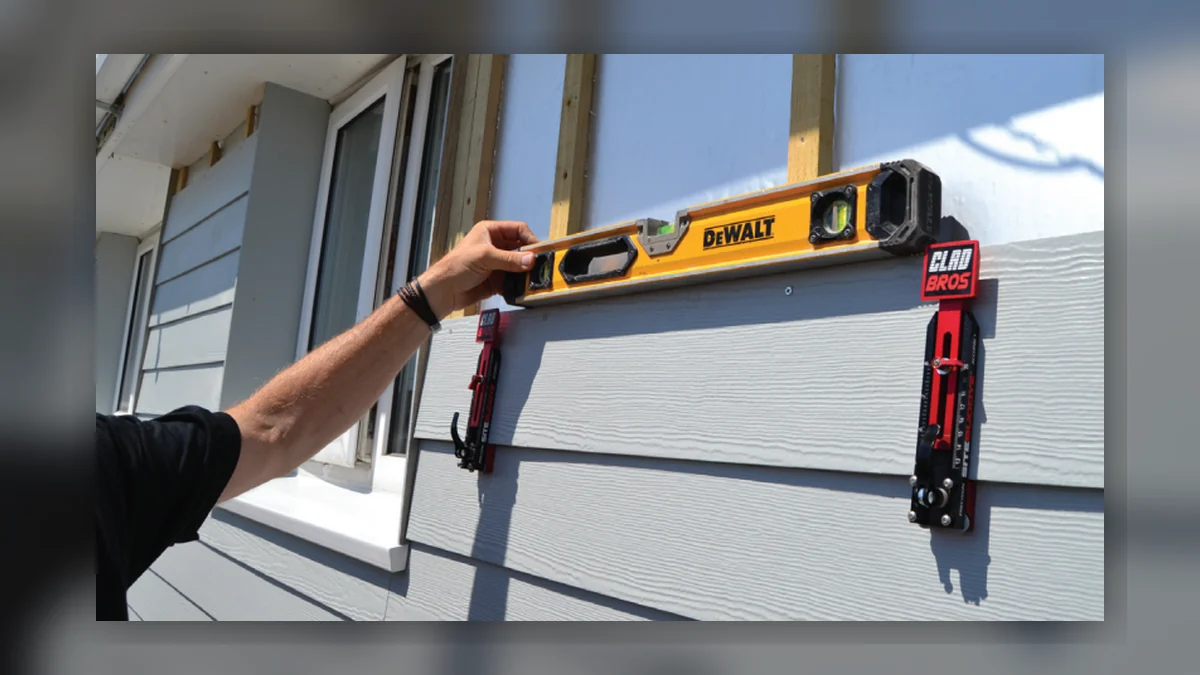
A UK builder-turned-inventor has released a follow-up to an award-winning cladding tool, and this time the target is fibre cement. James Gibbens — whose CLADMAN tool won Professional Builder's Top Product Award for Innovation back in 2015 — has developed CLADBROS, a tool aimed squarely at speeding up installation of fibre cement weatherboards such as James Hardie's HardiePlank and Etex's Cedral range.
Source: Professional Builder
---
Why fibre cement cladding needs its own tool
Anyone who has hung a full elevation of fibre cement weatherboard knows the problem. Unlike timber or PVC, fibre cement planks are heavy, brittle at the edges and completely unforgiving about overlap. Get the gauge wrong on board three and the error compounds all the way up the wall.
The three things that slow a fitter down are consistent:
Holding the board while you fix it. A 3.6m HardiePlank at 8mm thickness is an awkward two-hand load. Fixing it single-handed means either an extra pair of hands on the scaffold or a run of temporary battens screwed to the wall and removed afterwards.
Maintaining consistent overlap. Fibre cement weatherboard is normally specified with a minimum 30mm headlap. Drift by 2-3mm per course and by the twentieth board you are visibly out of level against the window head, with no way to correct it without stripping back.
Setting a level start course. The bottom course dictates everything above it. Most fitters spend disproportionate time on the starter strip and first board for exactly this reason.
Gauge tools and cladding clamps solve one or two of these. Gibbens' pitch, per Professional Builder's coverage, is that CLADBROS was developed from running a cladding firm rather than from a product design brief — the same origin story as CLADMAN.
Source: Professional Builder
---
What UK trades should take from this
Fibre cement cladding has grown steadily on UK sites, helped along by two things: it reads as a low-maintenance alternative to timber on new-build and extension work, and — relevantly, given the post-Grenfell direction of travel — it sits at the non-combustible end of the cladding spectrum. A2-s1,d0 rated boards are increasingly what gets specified on anything over 11m, and that has pulled the material into the mainstream residential market too.
More fibre cement being hung means more demand for tooling built for the material rather than adapted from timber cladding. Whether CLADBROS is the answer is something that will be settled on scaffolds rather than in press releases, but the direction is worth noting: the useful cladding tools of the last decade have mostly come from fitters, not manufacturers.
A practical note on cutting. Whatever holding tool you use, fibre cement demands respirable crystalline silica control. Dry-cutting the material with a standard circular saw produces silica dust well above the workplace exposure limit. Use a fibre cement blade with a low tooth count — typically four to six polycrystalline diamond-tipped teeth — with on-tool extraction, or score-and-snap with a guillotine for straight cuts. This is an HSE enforcement priority, not a nicety.
---
Watch for
- Confirmed UK pricing and stockists for CLADBROS.
- Whether it handles both HardiePlank and Cedral profiles, which differ in thickness and fixing method.
- Independent on-site reviews rather than manufacturer demonstration footage.
---