
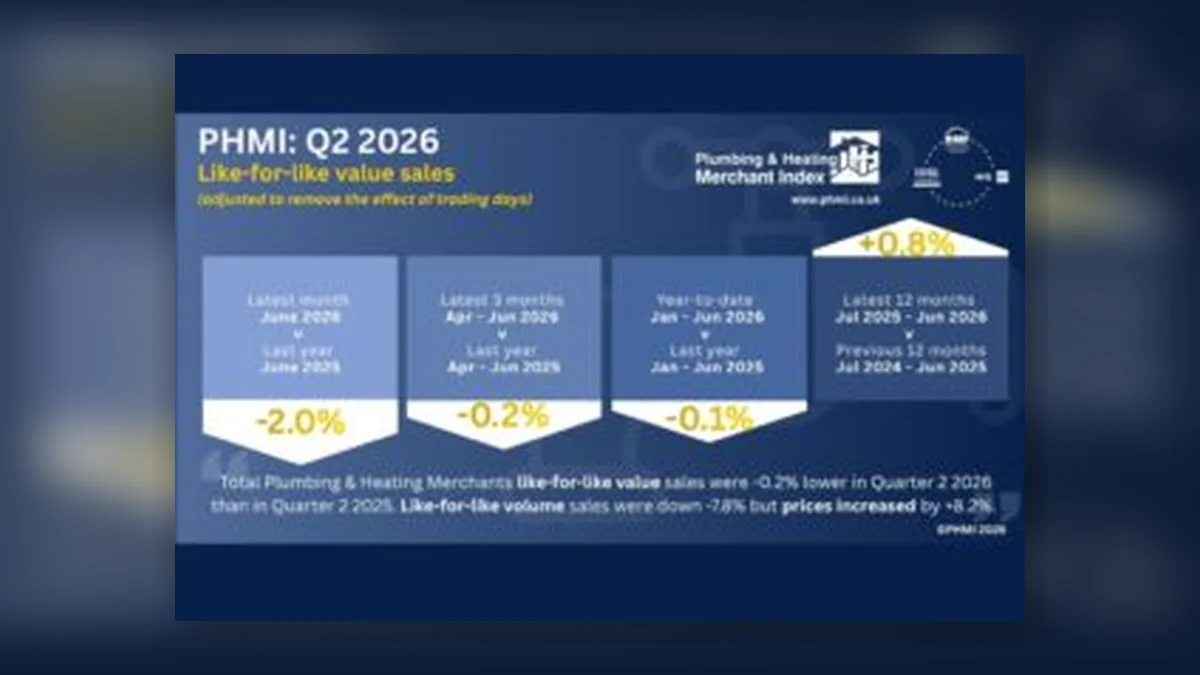
The Builders Merchants Federation has published the latest Plumbing and Heating Merchants Index (PHMI), and the headline number is the one worth reading twice: total value sales in Q2 2026 were only 0.2% below Q2 2025, but that near-flat figure is the product of prices rising 8.2% while the actual volume of material going out of the door fell 7.8%.
In plain terms, merchants took roughly the same money for substantially less product. That is not a stable position for anyone in the chain.
The numbers
- Q2 2026 vs Q2 2025: value sales -0.2%, volume sales -7.8%, prices +8.2%.
- Q2 2026 vs Q1 2026 (like-for-like, adjusted for trading days): value -9.2%, volume -6.7%.
- Q2 2026 vs Q1 2026 (unadjusted, two fewer trading days): value -12.0%, volume -9.6%, prices -2.7%.
- Rolling 12 months to June 2026 vs previous 12 months: value +0.8%, volume -4.4%, prices +5.4%.
The 12-month view is the one to keep. A year of headline growth of under 1% in value, sitting on top of a 4.4% fall in volume, describes a market that is shrinking while inflation papers over it.
Where the data comes from
The PHMI is drawn solely from plumbing and heating specialists — City Plumbing Supplies, James Hargreaves Plumbing Depot, Plumbfix, PTS, Williams & Co and Wolseley — who sit on NIQ GfK's Plumbing & Heating Merchants Panel. It is deliberately separate from the BMF's longer-running Builders Merchants Building Index, which tracks generalist merchants, with no overlap or double counting between the two.
That matters because it means this is a clean read on the plumbing and heating trade specifically, not a general construction number with heating bundled into it.
What it means on the tools
Prices are still climbing while demand is not. An 8.2% year-on-year price rise on plumbing and heating materials is a material figure for anyone quoting fixed-price work more than a few weeks ahead. Quotes with a long lead time need either a validity period on the materials line or a stated allowance for movement — a quote written in April on April's prices is a loss-maker by July.
Volume decline points to deferred work, not disappeared work. Boiler replacements, bathroom refits and heating upgrades are the classic postponable jobs when household budgets are tight. That backlog does not vanish; it queues. The trade risk is a thin autumn followed by a compressed rush when it breaks.
Buy-in patterns are worth revisiting. With volumes down across the specialist merchants, stock depth on less common items is more likely to be trimmed. Ordering ahead on anything non-standard is a sensible habit in a falling-volume market.
The generalist/specialist split is worth watching. If the BMBI generalist numbers hold up better than the PHMI specialist ones over the next quarter, that suggests trade buying is migrating rather than simply contracting — worth knowing before switching where you buy.
Context
This is a continuation, not a turn. The PHMI has been reporting falling volumes through the first half of the year, and Q2's data confirms the trend rather than establishing a new one. The heavier quarter-on-quarter fall (-9.2% like-for-like value against Q1) reflects the usual seasonal shape as much as the underlying trend, but the direction is consistent either way.
Watch for: the Q3 PHMI, and whether the El Niño-driven wetter winter that Arctic Hayes is forecasting demand from actually shows up as an autumn volume recovery in emergency, drainage and heating repair categories.
---